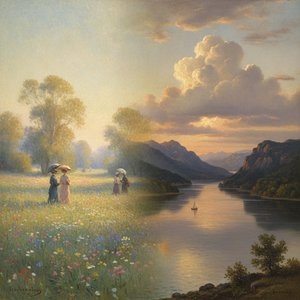
early life and training
charles harold davis, an american landscape painter, was born on january 7, 1856, in amesbury, massachusetts. as a pupil of the boston museum of fine arts, he was sent to paris in 1880 to hone his craft. under the tutelage of jules joseph lefebvre and gustave boulanger at the académie julian, davis developed a deep understanding of the european art scene.artistic style and influences
davis's work is characterized by its serene and idyllic depictions of landscapes, often capturing the beauty of nature with utmost precision. his time in barbizon, where he painted extensively, had a profound influence on his style, which eventually shifted towards impressionism. this transformation is evident in his cloudscapes, for which he became renowned.notable achievements and affiliations
- became a full member of the national academy of design in 1906.
- received a silver medal at the paris exhibition of 1889.
- his works are represented in prominent museums, including the metropolitan museum of art (new york), corcoran gallery of art (washington), and boston museum of fine arts.
legacy
davis's legacy extends beyond his artistic contributions. he played a pivotal role in establishing the mystic art association in 1913, making him a leading figure in the art colony that developed in mystic, connecticut. view charles harold davis's artworks on OriginalUniqueArt: https://OriginalUniqueArt.com/@/charles-harold-davis read more about charles harold davis on wikipedia: https://en.wikipedia.org/wiki/charles_harold_davisQuestions & Answers
Where can I see the color profile of Charles Harold Davis's work?
The Palette Genome of Charles Harold Davis is a page that presents the color profile of the artist's body of work.
Where can I find statistics about Charles Harold Davis's works?
The Stats page of Charles Harold Davis presents statistics computed from the artist's artworks listed on this website.
In which historical period did Charles Harold Davis work?
Charles Harold Davis worked in the 19th-Century period. The period situates the artist's activity in history.