Portrait of Bernard Blommers

The 46 Most Famous Bernard Blommers Paintings, Each One of a Kind

Updated November 2026 · ranked by our popularity score (searches, visits and orders for each work) · 48 works by Bernard Blommers in our catalogue

In short

Fishwives by the Sea (1888) is the Bernard Blommers painting that draws the most eyes. After it, the eye goes to Little Girl's Head (1868) and The Romance Novel (1860). Among the 48 works of Bernard Blommers in our catalog, these 46 are the most famous, each a unique original presented with its year, its museum and the reason it endures.

1845 – 1914, The Hague Hague school Most works: The Mesdag Collection

Top 10 paintings by Bernard Blommers, through the gallery's eye

1
Fishwives by the Sea (1888) by Bernard Blommers

Fishwives by the Sea

1888 · Oil On Canvas

The North Sea air carries a weight of salt and damp sand. In this 1888 oil on canvas, a group of women gathers at the water's edge, their figures anchored against the shifting tides. They move with the practiced rhythm of those who live by the sea, some tending to baskets, others simply existing within the coastal light. A lone boat rests in the background, a silent witness to the…

2
Little Girl's Head (1868) by Bernard Blommers

Little Girl's Head

1868 · Oil On Canvas · Kunstmuseum Den Haag, The Hague

The oil on canvas portrait presents a close-up bust of a young girl, positioned slightly off-center against a dark, undifferentiated background. The subject looks toward the viewer with a direct, calm gaze. A single light source illuminates one side of her face, casting gentle shadows that define the contours of her features and create a sense of three-dimensionality. The color palette is dominated by warm, earthy tones, specifically deep browns…

3
The Romance Novel (1860) by Bernard Blommers

The Romance Novel

1860 · Oil On Board · Bavarian State Painting Collections, Munich

The Romance Novel is an oil painting by Bernard Blommers, created about 1860. The scene captures a quiet, domestic interior where light enters from a large window on the left. A standing woman, seen in profile, faces away from the viewer toward a second woman who reclines in a bed. The figures exist within a soft, painterly space defined by visible brushstrokes and the textures of fabric and bedding.

4
Interior (1872) by Bernard Blommers

Interior

1872 · Oil On Canvas · Kunstmuseum Den Haag, The Hague

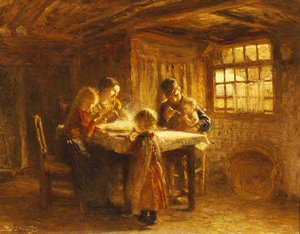
A single window on the right side of the room breathes light into the gloom. This soft glow catches the curve of a wooden table and the heavy folds of fabric worn by the figures gathered there. Three souls occupy this dim space: a woman seated opposite another, and a third figure cradling a child. The air in the room feels thick, weighted by the deep browns and ochre tones…

5
Where are the pigeons? (1875) by Bernard Blommers

Where are the pigeons?

1875 · Oil On Canvas · The Mesdag Collection, The Hague

In this 1875 oil on canvas, we find ourselves drawn into a private, hushed moment of domestic life. The composition is oriented vertically, guiding the eye upward from the heavy, dark tones of the floor toward a tender interaction between a woman and a small child. There is a palpable sense of weight in the room, anchored by the deep browns and ochre of the wooden furniture and the stone…

6
The little rabbit (1873) by Bernard Blommers

The little rabbit

1873 · Oil On Canvas · The Mesdag Collection, The Hague

The little rabbit is a genre painting that captures a tender and intimate domestic moment. The composition centers on two figures positioned before a dark doorway, which serves to create a focal point through the use of light and subject. A woman, dressed in traditional peasant attire, leans toward a small child wearing a white gown. Both figures are looking down at a small rabbit situated on the ground.

7
Fallen (1875) by Bernard Blommers

Fallen

1875 · Oil On Canvas · The Mesdag Collection, The Hague

A small child leans over the edge of a dark, weathered wooden structure, perhaps a toy cart or a high chair, caught in a moment of profound stillness. The scene feels intimate, as if we have stumbled upon a private, domestic secret. A white cap sits atop the child's head, catching a sharp, directional light that spills from the upper left, casting the rest of the room into deep, heavy…

8
Fisherwomen on the Beach (1882) by Bernard Blommers

Fisherwomen on the Beach

1882 · Oil On Canvas

The shoreline is a place of salt and heavy fabric. In this 1882 oil on canvas, the sand holds the damp imprint of labor. A group of women, dressed in long skirts and aprons, gather near the water's edge. They move with a practiced rhythm, their hands busy with baskets and the sorting of fish. To the right, a wooden boat rests in the shallow surf, its tall masts cutting…

9
Little Boat Sailing (1882) by Bernard Blommers

Little Boat Sailing

1882 · Oil · Dordrechts Museum, Dordrecht

Little Boat Sailing, painted by Bernard Blommers in 1882, presents a genre scene of everyday life. The work captures three young children playing in the shallow water along a beach or shoreline. This candid moment of childhood play is rendered with the characteristic focus of Impressionism, prioritizing the immediate sensation of the scene over rigid detail.

10
Playing School (1882) by Bernard Blommers

Playing School

1882 · Oil On Canvas · Dordrechts Museum, Dordrecht

Playing School is an oil painting by Bernard Blommers, executed in 1882. The work captures a group of children engaged in a game of school in an outdoor setting. The composition centers on five children arranged in a semi-circle, creating an intimate, enclosed scene.

Bernard Blommers's famous paintings, numbers 11 to 46

Bernard Blommers's famous paintings, period by period

The subjects that held Bernard Blommers's eye

The four subjects that come back most often in these originals, each with its finest example.

The museums that keep Bernard Blommers's originals

The 8 museums that hold the most of the paintings on this page.

Museum City Works by Bernard Blommers Paintings from this list
The Mesdag Collection, The HagueThe Mesdag Collection The Hague 6 Where are the pigeons?, The little rabbit, Fallen
Rijksmuseum, AmsterdamRijksmuseum Amsterdam 5 Neighborly Gossip, Knitting Girl on a Dune, The Fishermen's Children
Dordrechts Museum, DordrechtDordrechts Museum Dordrecht 4 Little Boat Sailing, Playing School, Little Boat Sailing
Kunstmuseum Den Haag, The HagueKunstmuseum Den Haag The Hague 3 Little Girl's Head, Interior, Jaantje the fish seller
Bavarian State Painting Collections, MunichBavarian State Painting Collections Munich 2 The Romance Novel, Fresh Sea Fish
Museum Boijmans Van Beuningen, RotterdamMuseum Boijmans Van Beuningen Rotterdam 1 painting
Groninger Museum, GroningenGroninger Museum Groningen 1 Feeding
Royal Museum of Fine Arts Antwerp, AntwerpRoyal Museum of Fine Arts Antwerp Antwerp 1 Interior

Bernard Blommers across the decades: one unique original for each

Works per decade

Pick a decade to see the original that defines it.

Bernard Blommers's paintings: questions for the gallery

What is the single most famous work of Bernard Blommers?Reveal the answer

Fishwives by the Sea (1888). Little Girl's Head (1868) and The Romance Novel (1860) come next.

At what age did Bernard Blommers create Fishwives by the Sea?Reveal the answer

43 years old: Fishwives by the Sea dates from 1888, and Bernard Blommers was born in 1845.

Which ten paintings by Bernard Blommers are the most famous?Reveal the answer

Fishwives by the Sea, Little Girl's Head, The Romance Novel, Interior, Where are the pigeons?, The little rabbit, Fallen, Fisherwomen on the Beach, Little Boat Sailing and Playing School. The ranking above gives each one's year and museum.

How many works by Bernard Blommers are known?Reveal the answer

Our catalog holds 48 works by Bernard Blommers, dated from 1860 to 1914.

Where can the most famous Bernard Blommers originals be seen?Reveal the answer

Mostly in The Mesdag Collection (The Hague), Rijksmuseum (Amsterdam) and Dordrechts Museum (Dordrecht). The museum table above lists them all.

During which period did Bernard Blommers create the best-known paintings?Reveal the answer

In 1880s: 12 of the 46 works on this page were made then, Fishwives by the Sea among them.

Which famous Bernard Blommers painting is the earliest, and which the latest?Reveal the answer

On this page, the earliest is The Romance Novel (1860) and the latest The Milkmaid (1914).

What subjects did Bernard Blommers favour?Reveal the answer

Woman (8), Child (7) and Beach (6), across the 46 works on this page.

What materials did Bernard Blommers paint with most?Reveal the answer

Oil On Canvas, for 12 of the 46 works on this page.

Which movement does the work of Bernard Blommers belong to?Reveal the answer

Hague school, judging by the originals on this page.

What Bernard Blommers originals can I see at the The Mesdag Collection?Reveal the answer

Where are the pigeons?, The little rabbit and Fallen: the The Mesdag Collection, The Hague holds 6 of the works on this page.

Bernard Blommers: a portrait of the artist

Bernardus Blommers: A Dutch Master of Light and Life

Bernardus Johannes, or Bernard as he’s more commonly known, was a pivotal figure in the late 19th and early 20th-century Dutch art scene. Born in The Hague in 1845, his life and work are inextricably linked to the burgeoning Hague School, a movement that sought to capture the essence of everyday Dutch life with remarkable realism and sensitivity. More than just an artist, Blommers was a keen observer of humanity, meticulously portraying the lives of fishermen, farmers, and their families against the dramatic backdrop of the North Sea coastline and its expansive dunes.

Blommers’ artistic journey began not in a formal studio, but within his father's printing shop. This early exposure to visual reproduction instilled a deep appreciation for detail and craftsmanship – qualities that would later inform his meticulous brushwork. He initially pursued lithography as a trade, yet it was through evening classes at the Hague Academy of Arts that he discovered his true passion: painting. Influenced profoundly by Josef Israëls, particularly his depictions of working-class life, Blommers quickly established himself as a master of capturing intimate scenes and conveying a sense of quiet dignity.

His early works are characterized by a strong emphasis on genre paintings – scenes of fishermen mending nets, women tending to their homes, and children playing along the shore. These subjects weren’t merely decorative; they were imbued with a profound respect for the lives of ordinary people. The influence of Israëls is evident in Blommers' use of light and shadow, his careful attention to costume and setting, and his ability to evoke a sense of atmosphere. However, Blommers soon developed his own distinct style, moving beyond mere imitation to create works that possessed a unique emotional resonance.

The Evolution of a Landscape Painter

As the 1880s progressed, Blommers’ focus shifted towards landscape painting, particularly scenes of the North Sea coastline. He spent considerable time in Scheveningen and later Katwijk, meticulously documenting the ever-changing light and weather conditions that shaped these dramatic environments. These weren't simply picturesque views; they were imbued with a sense of melancholy and solitude, reflecting the lives of those who depended on the sea for their livelihood.

A key turning point in Blommers’ artistic development was his marriage to Anna van der Toorn, a fish-seller from Scheveningen. Anna became not only his beloved wife but also a frequent model and muse, appearing prominently in many of his paintings. This intimate connection with the subject matter – particularly the lives of women and children – deepened his understanding of human emotion and informed his artistic vision. His later works, often depicting mothers and children playing on the beach, are filled with warmth, tenderness, and a quiet sense of contentment.

Blommers’ technique evolved over time, moving from a more polished, academic style to one characterized by looser brushwork and a greater emphasis on capturing fleeting moments. He embraced *impasto*, applying thick layers of paint to create texture and depth, particularly in his depictions of the dunes and the turbulent sea. This tactile quality adds another layer of sensory experience to his paintings, inviting the viewer to feel the wind, smell the salt air, and sense the drama of the natural world.

Recognition and Legacy

Bernardus Blommers enjoyed considerable success during his lifetime, exhibiting his work both in the Netherlands and abroad. His paintings were highly sought after by collectors in England, Scotland, America, and Canada, reflecting a growing appreciation for Dutch art outside of Europe. He was awarded medals at numerous prestigious exhibitions, solidifying his reputation as one of the leading artists of the Hague School.

Beyond his artistic achievements, Blommers also played a significant role as an educator, mentoring young artists and sharing his knowledge and experience. His influence extended beyond his immediate circle, shaping the course of Dutch art for decades to come. His legacy is not simply one of technical skill or aesthetic beauty; it’s a testament to his ability to capture the essence of human life with honesty, empathy, and profound artistic vision.

Key Works and Recurring Themes

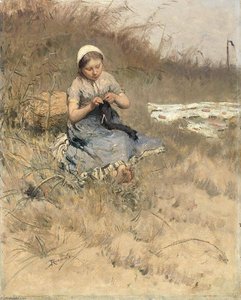
Several paintings stand out as particularly representative of Blommers' style and thematic concerns. “Girl with Cherries” (1876) exemplifies his early genre work, capturing a moment of quiet domesticity. "Knitting Girl on a Dune" (1882) showcases his ability to convey the beauty of the natural world while simultaneously exploring themes of rural life and human connection. His later works, such as “The Fishermen’s Children” (circa 1900), are characterized by their emotional depth and evocative use of light and color.

Recurring themes in Blommers' work include the sea, family life, poverty, and the dignity of labor. He consistently depicted ordinary people – fishermen, farmers, and their families – with respect and compassion, offering a poignant commentary on the challenges and rewards of rural existence. His paintings are not simply representations of reality; they are imbued with a profound sense of humanity.

A Lasting Impression

Bernardus Blommers died in The Hague in 1914, leaving behind a rich and enduring artistic legacy. His paintings continue to resonate with viewers today, offering a glimpse into the lives of ordinary people and reminding us of the beauty and dignity that can be found in the simplest of moments. He remains a vital figure in Dutch art history, a master of light, color, and human emotion – a true testament to the power of observation and artistic expression.