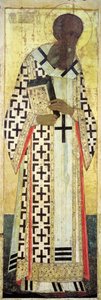
Portrait of Andrei Rublev

The 34 Most Famous Andrei Rublev Paintings, a Gallery Selection

Updated October 2026 · ranked by our popularity score (searches, visits and orders for each work) · 35 works by Andrei Rublev in our catalogue

In short

Of all the originals Andrei Rublev left, the most famous is Holy Trinity (1411), in the collection of the Tretyakov Gallery, Moscow. Close behind it come Deesis Range: The Archangel Michael (1410) and Deesis Range: The Saviour (1410). Our catalog holds 35 works by Andrei Rublev; the gallery has kept the 34 the world admires most, each shown with its date, its museum and its story.

1360 – 1430, Grand Principality of Moscow Byzantine Most works: Assumption Cathedral

Andrei Rublev's top 10 paintings: the gallery's choice

1
Holy Trinity (1411) by Andrei Rublev

Holy Trinity

1411 · Oil On Panel · Tretyakov Gallery, Moscow

Andrei Rublev’s “Holy Trinity,” painted circa 1411, stands as an unparalleled testament to the spiritual heart of medieval Russia and a cornerstone of its artistic heritage. This iconic icon, meticulously crafted in the early 15th century, transcends mere representation; it is a profound meditation on divine unity, peace, and humility – values deeply ingrained within the Russian Orthodox tradition. Commissioned for the Trinity Lavra of St. Sergius, the monastery’s spiritual…

2
Deesis Range: The Archangel Michael (1410) by Andrei Rublev

Deesis Range: The Archangel Michael

1410 · Oil On Canvas · Tretyakov Gallery, Moscow

To stand before a work echoing the spirit of Andrei Rublev is not merely to observe paint on wood; it is to step across the threshold into a realm of profound spiritual contemplation. This piece, evocative of his masterful period around 1410, captures a moment of sublime divine communion. The central figure, the Virgin Mary, radiates an ethereal stillness, her hands clasped in an attitude of perfect prayer. Draped in…

3
Deesis Range: The Saviour (1410) by Andrei Rublev

Deesis Range: The Saviour

1410 · Oil On Canvas · Tretyakov Gallery, Moscow

To stand before an image evocative of Andrei Rublev’s profound spiritual vision is to step across the threshold of time itself. This depiction, echoing the solemnity of a Deesis grouping, centers on a figure whose gaze seems to penetrate the veil between worlds. The subject, bearing the unmistakable gravitas associated with Christ or a deeply contemplative saint, commands attention through sheer emotional resonance. It is not merely a portrait; it…

4
Deesis Range: The Apostle Paul (1410) by Andrei Rublev

Deesis Range: The Apostle Paul

1410 · Tempera On Panel · Tretyakov Gallery, Moscow

In the quiet, hallowed halls of art history, few figures command as much spiritual reverence as Andrei Rublev, the master whose brush breathed life into the very soul of Russian iconography. His work, Deesis Range: The Apostle Paul, stands as a profound testament to this era of mystical devotion. This painting is not merely a depiction of a saint; it is an invitation into a celestial dialogue. The figure of…

6
The Last Judgement: Jesus Christ (1408) by Andrei Rublev

The Last Judgement: Jesus Christ

1408 · Fresco · Assumption Cathedral, Vladimir

In the Assumption Cathedral in Vladimir, Russia, a fresco remains fixed upon the stone. It is a window into 1408, a moment where the air feels heavy with the weight of eternity. At the center, Jesus Christ emerges from an oval mandorla, a shape that contains the heavens. He does not look down in anger. His expression is serene, a quiet stillness that settles the soul. One hand is raised…

7
The Virgin of Vladimir (1400) by Andrei Rublev

The Virgin of Vladimir

1400 · Tempera On Panel · Vladimir-Suzdal Museum Reserve, Vladimir

In The Virgin of Vladimir, Andrei Rublev presents a profound study of intimacy through the Eleusa style. The composition centers on the tender connection between the Mother of God and the Christ Child. Their faces are pressed together in a quiet embrace, a detail that emphasizes their shared humanity. The Child’s arm is wrapped around her neck, pulling her closer, while he appears to be nursing from his mother. This…

8
Himmelfahrt christi by Andrei Rublev

Himmelfahrt christi

Tempera On Panel

The religious painting and icon titled Himmelfahrt christi was executed by the artist Andrei Rublev. This work belongs to a specific series of paintings created for the Assumption Cathedral in Vladimir. The piece is rendered as a religious icon, a form of art central to the spiritual traditions of the region.

10
The Last Judgement (1408) by Andrei Rublev

The Last Judgement

1408 · Fresco · Assumption Cathedral, Vladimir

The Last Judgement is a religious fresco painted by Andrei Rublev. This work was created in 1408. It belongs to the Byzantine and Moscow School of icon painting movements. The composition depicts the final judgement day as described in Christian theology. The imagery includes a central Christ figure and an assembly of holy figures, such as angels and saints, who bear books.

The Andrei Rublev selection continues, 11 to 34

The subjects that held Andrei Rublev's eye

The four subjects that come back most often in these originals, each with its finest example.

The museums that keep Andrei Rublev's originals

The 5 museums that hold the most of the paintings on this page.

Museum City Works by Andrei Rublev Paintings from this list
Assumption Cathedral, VladimirAssumption Cathedral Vladimir 16 The Last Judgement: Procession of the righteous to heaven, The Last Judgement: Jesus Christ, The Last Judgement
Tretyakov Gallery, MoscowTretyakov Gallery Moscow 4 Holy Trinity, Deesis Range: The Archangel Michael, Deesis Range: The Saviour
The Cathedral of the Dormition in Gorodok, ZvenigorodThe Cathedral of the Dormition in Gorodok Zvenigorod 2 St. Laurus, Venerable Barlaam and his disciple prince Josaphat
Vladimir-Suzdal Museum Reserve, VladimirVladimir-Suzdal Museum Reserve Vladimir 1 The Virgin of Vladimir
Cathedral of the Annunciation, MoscowCathedral of the Annunciation Moscow 1 Annunciation

Andrei Rublev decade by decade: the original that defines each

Works per decade

Pick a decade to see the original that defines it.

Collectors' questions about Andrei Rublev's paintings

Which work is Andrei Rublev most famous for?Reveal the answer

Holy Trinity (1411), Tretyakov Gallery, Moscow. Deesis Range: The Archangel Michael (1410) and Deesis Range: The Saviour (1410) come next.

What age was Andrei Rublev when Holy Trinity was made?Reveal the answer

51 years old: Holy Trinity dates from 1411, and Andrei Rublev was born in 1360.

What are the ten most famous Andrei Rublev paintings?Reveal the answer

Holy Trinity, Deesis Range: The Archangel Michael, Deesis Range: The Saviour, Deesis Range: The Apostle Paul, The Last Judgement: Procession of the righteous to heaven, The Last Judgement: Jesus Christ, The Virgin of Vladimir, Himmelfahrt christi, St. Laurus and The Last Judgement. The ranking above gives each one's year and museum.

How many paintings did Andrei Rublev leave?Reveal the answer

Our catalog holds 35 works by Andrei Rublev, dated from 1400 to 1427.

In which museums do Andrei Rublev's masterpieces hang?Reveal the answer

Mostly in Assumption Cathedral (Vladimir), Tretyakov Gallery (Moscow) and The Cathedral of the Dormition in Gorodok (Zvenigorod). The museum table above lists them all.

In which years did Andrei Rublev paint the most famous works?Reveal the answer

In 1400s: 24 of the 34 works on this page were made then, The Last Judgement: Procession of the righteous to heaven among them.

What are the first and the last famous originals of Andrei Rublev?Reveal the answer

On this page, the earliest is The Virgin of Vladimir (1400) and the latest St. Demetrius of Thessalonica (1427).

Which subjects did Andrei Rublev choose most often?Reveal the answer

Medieval art (7), Religious iconography (7) and Angels (5), across the 34 works on this page.

Which technique did Andrei Rublev use most?Reveal the answer

Tempera On Panel, for 7 of the 34 works on this page.

To which art movement does Andrei Rublev belong?Reveal the answer

Byzantine, judging by the originals on this page.

Which Andrei Rublev works hang at the Assumption Cathedral?Reveal the answer

The Last Judgement: Procession of the righteous to heaven, The Last Judgement: Jesus Christ and The Last Judgement: the Assumption Cathedral, Vladimir holds 16 of the works on this page.

Andrei Rublev: life and work

Andrei Rublev: The Soul of Russian Iconography

Andrei Rublev (c. 1360 – c. 1430) remains one of the most enigmatic and profoundly influential figures in the history of Russian art. More than simply a painter, he embodies a confluence of spiritual devotion, artistic mastery, and the very essence of medieval Russia—a nation grappling with its identity amidst Byzantine influence and nascent national consciousness. While details of his life remain shrouded in mystery, his legacy as the foremost iconographer of his era is undeniable, shaping not only the visual language of Russian Orthodox art but also profoundly impacting subsequent generations of artists.

Little concrete information survives regarding Rublev’s early years. He is believed to have been born in Moscow, though some accounts suggest a possible origin in the Trinity-St. Sergius Lavra Monastery near the city – a location that would deeply inform his artistic development. His apprenticeship under Theophanes the Greek, a renowned Byzantine icon painter who had migrated to Russia, provided him with an invaluable foundation in the techniques and stylistic conventions of the era. However, Rublev quickly transcended mere imitation, imbuing these established forms with a uniquely Russian sensibility – a palpable sense of humility, spiritual depth, and emotional resonance that distinguished his work from its Byzantine predecessors.

  • Early Career at the Kremlin: Rublev’s early career is inextricably linked to the Moscow Kremlin. In 1405, he joined forces with Theophanes and Prokhor of Gorodets to decorate the Annunciation Cathedral, a pivotal moment in Russian icon painting. This collaboration exposed Rublev to the highest echelons of power and provided him with invaluable experience working on a grand scale.
  • The Trinity Icon: Arguably Rublev’s most celebrated work, the “Trinity” icon (c. 1420-1428), is a testament to his artistic genius. This masterpiece, now housed in the Tretyakov Gallery in Moscow, departs subtly from traditional Byzantine iconography. The figures of Abraham and Sarah are absent, replaced by a more intimate depiction of the Trinity – God the Father, God the Son, and the Holy Spirit—a shift that has been interpreted as reflecting Rublev’s own spiritual understanding of divine unity.
  • Andronikov Monastery: Following his work at the Kremlin, Rublev spent the latter part of his career at the Andronikov Monastery near Moscow. Here, he continued to paint icons and frescoes, including a series of stunning murals in the Savior Cathedral, showcasing his evolving style and deepening spiritual exploration.

The Fusion of Byzantine and Russian Traditions

Rublev’s artistic vision was not born in isolation; it was deeply rooted in both Byzantine traditions and emerging Russian sensibilities. Theophanes' influence is undeniable – the meticulous detail, the rich colors, and the formal structure of his compositions are all hallmarks of Byzantine icon painting. However, Rublev skillfully integrated these elements with a distinctly Russian aesthetic—a profound sense of humility, an emphasis on emotional expression, and a connection to the spiritual life of the monastic community.

  • Byzantine Influence: The influence of Byzantine iconography is readily apparent in Rublev’s use of hierarchical composition, his careful rendering of drapery, and his adherence to established iconographic conventions. His work demonstrates a deep understanding of Byzantine artistic principles, reflecting the cultural and religious exchange between Russia and Byzantium.
  • Russian Spirituality: Simultaneously, Rublev infused his art with a uniquely Russian spiritual perspective. His figures are not idealized or heroic; they possess a quiet dignity and an aura of profound humility. This emphasis on inner spirituality resonated deeply with the monastic ethos of his time – a period marked by intense religious fervor and a yearning for divine union.
  • Novgorodian Iconography: Rublev’s style also shows traces of Novgorodian icon painting, which was known for its expressive faces and emotional intensity. This influence contributed to the psychological depth and emotional resonance that characterize his work.

Symbolism and Spiritual Depth

Rublev's icons are not merely beautiful images; they are imbued with layers of symbolic meaning, reflecting a profound understanding of Christian theology and spiritual practice. His compositions often feature subtle gestures, facial expressions, and spatial arrangements that convey complex theological ideas.

  • The Trinity Icon: The “Trinity” icon is particularly rich in symbolism. The three angels represent the Father, Son, and Holy Spirit, while the central figure—a humble peasant—symbolizes humanity’s need for divine grace. The absence of Abraham and Sarah from the composition suggests a shift away from traditional narratives towards a more intimate and personal understanding of God’s relationship with humankind.
  • Other Iconographic Elements: Rublev frequently employed symbolic gestures, such as hands clasped in prayer or eyes turned heavenward, to convey spiritual longing and devotion. His use of color—particularly the rich blues and golds—also carries symbolic weight, evoking notions of divinity and transcendence.

Legacy and Historical Significance

Despite his relatively short life, Andrei Rublev left an indelible mark on Russian art and culture. His work profoundly influenced subsequent generations of icon painters, shaping the development of Russian iconography for centuries to come. The Stoglavi Sobor in 1551 officially proclaimed Rublev’s style as a model for church painting, cementing his status as a national artistic hero.

  • Tarkovsky's Film: Andrei Tarkovsky’s 1966 film *Andrei Rublev* played a crucial role in reviving interest in the artist’s life and work. The film, though loosely based on historical events, captured the spiritual depth and artistic genius of Rublev, introducing him to a wider audience.
  • Saintly Recognition: In 1988, the Russian Orthodox Church canonized Rublev as a saint, recognizing his profound contribution to Russian spirituality and art. His feast day is celebrated on January 29th, commemorating both his death and his enduring legacy.
  • Enduring Influence: Today, Andrei Rublev remains one of Russia’s most beloved artists—a symbol of spiritual devotion, artistic mastery, and the enduring power of faith. His icons continue to inspire awe and reverence, offering a glimpse into the soul of medieval Russia and the timeless beauty of Christian iconography.