A Life Rooted in Norway
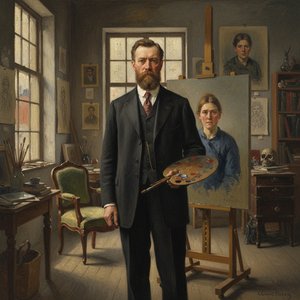
Andreas Bloch entered the world on 29 July 1860, born into the quiet surroundings of the Hellerud farm in Skedsmo, within Akershus county, Norway. He was the son of Jens Peter Blankenborg Bloch and Anne Julie Margrethe Schroeter. His early years were shaped by this Norwegian landscape, a setting that would later find its way into his sketches and historical interests. In 1878, he began formal training at the art school of Knud Bergslien, spending a year refining his initial skills before seeking broader horizons.
His pursuit of knowledge led him away from home to the Art Academy of Düsseldorf, where he studied under Johann Peter Theodor Janssen between 1880 and 1881. This period of academic rigor was supplemented by travels through Belgium, Paris, and Leipzig, allowing him to absorb the varied artistic currents of Europe. In 1890, he married Ingeborg Elise Tellefsen, and he remained in Kristiania until his death on 11 May 1917.
The Art of Illustration and Design
While he worked as a painter, Bloch is most frequently remembered for the precision of his drawings. He possessed a particular talent for capturing narrative through line, making him a sought-after illustrator for several satirical magazines, including Vikingen, Krydseren, and Korsaren. His hand was also found in the pages of many books, bringing stories to life for readers across Norway.
His versatility extended far beyond the printed page. He moved between different creative disciplines with ease:
- He designed theatrical costumes for both the Christiania Theater and Nationaltheatret.
- He created posters and portraits that captured the likenesses of his contemporaries.
- He contributed to civic identity by designing the Coat of arms of Lillehammer.
- He even designed the Holmenkollen Medal, an award for skiing established in 1895.
Historical Narratives and Legacy
Bloch had a deep interest in history, which manifested in both his paintings and his book illustrations. He illustrated works by authors such as Margrethe Aabel Munthe, Nordahl Rolfsen, Henrik August Angell, and Jacob Breda Bull. His drawings for Fridtjof Nansen’s expedition books, Paa ski over Grønland and Fram over Polhavet, provided a visual record of significant Norwegian explorations.
His paintings often focused on weighty historical moments. One notable work from 1906 depicts the coronation of King Haakon VII and Queen Maud in Nidaros Cathedral. Through these works, he documented the changing face of his nation. Today, his contributions to Norwegian visual culture are preserved in the collections of the National Gallery and the Oslo City Museum.
Questions & Answers
How can I see every artwork made by Andreas Bloch?
Every work by Andreas Bloch on this website can be browsed from the artist's All Artworks page.
How is Andreas Bloch's career divided into periods?
Andreas Bloch's career unfolds period by period on the artist's Chronicle page: a horizontal timeline of the artworks, grouped into career-period chapters.
Can I explore Andreas Bloch's works by subject?
The Subject Atlas of Andreas Bloch is a page that maps the artist's artworks by their subjects.
Can I study Andreas Bloch's use of color across all works?
The color profile of Andreas Bloch's work is shown on the artist's Palette Genome page.