

1


Updated November 2026 · ranked by our popularity score (searches, visits and orders for each work) · 52 works by Allan D'Arcangelo in our catalogue
In short
Of all the originals Allan D'Arcangelo left, the most famous is Full moon (1969). Close behind it come Untitled ( Road to Williamsville) and American madonna no. - (1). Our catalog holds 52 works by Allan D'Arcangelo; the gallery has kept the 51 the world admires most, each shown with its date, its museum and its story.

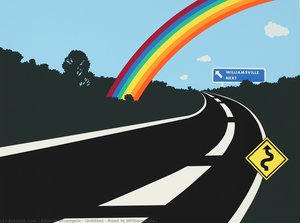
The scene unfolds in Untitled ( Road to Williamsville), a work that captures a specific moment of transit. This piece is by the artist Allan D'Arcangelo, who brings a focused gaze to the American landscape. His vision is rooted in the experiences of a traveler, looking out through a windshield at the world passing by. The work carries the weight of a life spent observing the movement of people and…


 Untitled (698)
12
 Untitled - bridge
13
 Refraction SIGNED
14
 Morning star
15
 Landscape II
16
 Landscape III
17
 Untitled - roadway yield
18
 Yield
19
 Proposition
20
 Smoking blonde
21
 US Highway -1
22
 Tall
23
 Untitled
24
 Constellation i
25
 Caves
26
 Madonna and Child
27
 Mr. and Mrs. Moby Dick
28
 Left turn (2)
29
 Reflection
30
 Can our national bird survive
31
 The holy family
32
 Smoke dreams
33
 Yield from Homage to Picasso
34
 Marilyn
35
 April
36
 The trip
37
 Sky bars
38
 Web
39
 Squared star
40
 Smoke dream 2 (1963)
41
 Mr. and Mrs. Moby Dick (2)
42
 Constellation III
43
 Landscape
44
 The bride
45
 TG DARCANGELO Curve - (1000px)
46
 Landscape i
47
 Ian tyson incision
48
 Mid century mordern
49
 Constellation IV
50
 Aspen, Colo (A 14)
51
 Untitled1968
The four subjects that come back most often in these originals, each with its finest example.
Barely a decade, 1962 to 1970, gave the world every dated Allan D'Arcangelo original in this selection: here it is, year by year.
Pick a year to see its originals.
More from 1965

The Untitled painting by Allan D'Arcangelo, created in 1968, is a captivating piece that showcases the artist's unique style and technique. This screenprint, measuring 114 x 75 cm, is currently housed at the Smithsonian American Art Museum in Washington, DC. As a professional expert in Art and salesman for AllPaintingsStore.com, I am excited to delve into the world of this intriguing artwork. The Artist's Vision Allan D'Arcangelo was an American…
Full moon (1969). Untitled ( Road to Williamsville) and American madonna no. - (1) come next.
39 years old: Full moon dates from 1969, and Allan D'Arcangelo was born in 1930.
Full moon, Untitled ( Road to Williamsville), American madonna no. - (1), Icarus, Landscape II, from the portfolio 11 Pop Artists, Volume II, Landscape III, from the portfolio 11 Pop Artists, Volume III, US Highway 1, June Moon 1963, from the portfolio 7 Serigraphien, Untitled, from the portfolio Peace Portfolio I and Untitled - under overpass. The ranking above gives each one's year and museum.
Our catalog holds 52 works by Allan D'Arcangelo, dated from 1962 to 1970.
In 1965: 2 of the 51 works on this page were made then, Landscape II, from the portfolio 11 Pop Artists, Volume II among them.
On this page, the earliest is US Highway 1 (1962) and the latest Untitled, from the portfolio Peace Portfolio I (1970).
Landscape (5), American iconography (4) and Geometric design (3), across the 51 works on this page.
Pop art, judging by the originals on this page.
Allan D’Arcangelo (1930-1998) remains a quietly compelling figure in 20th-century American art, an artist who eschewed the limelight yet produced work of remarkable depth and resonance. Often categorized as a Pop artist, his oeuvre transcends simple labels, drawing instead from Minimalism, Precisionism, Surrealism, and a distinctly American sensibility—a cautious gaze upon the nation’s evolving landscape and its complex relationship with modernity. Born in Buffalo, New York, to Italian immigrant parents, D’Arcangelo's early life instilled within him a deep appreciation for both his heritage and the vastness of the American experience, themes that would become central to his artistic explorations.
D’Arcangelo’s formal education began at the University at Buffalo in 1948, where he earned a bachelor's degree in history. This academic grounding—a study of time and narrative—proved surprisingly influential in shaping his visual language. Following college, he moved to New York City, immersing himself in the vibrant art scene of the late 1950s and early 60s, encountering Abstract Expressionism, a movement that initially captivated him but ultimately proved too emotionally driven for his artistic temperament. Seeking a more disciplined approach, D’Arcangelo spent several years in Mexico City, honing his skills and developing a distinctive style characterized by clean lines, geometric forms, and a deliberate restraint.
D’Arcangelo's breakthrough came in 1962 with his contribution to *The International Anthology of Contemporary Engraving: America Discovered*, an etching that signaled the beginning of his recognition within the art world. His first solo exhibition followed in 1964 at the Thibaud Gallery, establishing a reputation for meticulously rendered images of American highways and road signs. These weren’t idyllic depictions of open roads; rather, they were stark, almost clinical representations of infrastructure—a visual meditation on distance, movement, and the increasingly mediated experience of travel. The repetitive patterns of signage, the endless stretches of asphalt, and the subtle shifts in perspective created a sense of both familiarity and alienation, reflecting a growing unease about America’s trajectory.
His work during this period—including pieces like “Place of Assassination” (1965), depicting the site of John F. Kennedy's assassination—demonstrates a willingness to engage with contemporary events, but always through a detached, almost objective lens. He wasn’t interested in overt political commentary; instead, he sought to capture the emotional atmosphere surrounding these moments, using geometric forms and muted colors to convey a sense of melancholy and uncertainty. Influences from de Chirico's surreal landscapes and Dali's dreamlike imagery are subtly present, adding layers of psychological depth to his seemingly straightforward compositions.
While often associated with Pop Art due to the subject matter of his paintings—including images of Superman, Marilyn Monroe, and Jacqueline Kennedy—D’Arcangelo resisted easy categorization. He shared certain techniques with Pop artists, such as the use of screenprinting and assemblage, but his primary concern was not consumerism or celebrity culture. Instead, he used these familiar motifs to explore broader themes of American identity, the impact of technology on human experience, and the anxieties of a rapidly changing world. His work can be seen as a subtle critique of the commodification of images and the erosion of authentic experience in a mass-mediated society.
In the 1970s, D’Arcangelo shifted his focus to expansive landscapes—particularly the Grand Coulee Dam in Washington state—commissioned by the Department of the Interior. These monumental paintings, characterized by their cool color palettes and precise geometric forms, further solidified his reputation as a master of Minimalism. However, despite achieving significant recognition within the art world, D’Arcangelo remained politically active, quietly engaging with issues such as environmentalism and anti-Vietnam War protests through his work.
Allan D'Arcangelo died in New York City in 1998, leaving behind a body of work that continues to resonate today. His paintings are characterized by their quiet intensity, their meticulous attention to detail, and their subtle yet profound exploration of the American experience. While he avoided the spotlight, his art speaks volumes about the complexities of modern life—a silent road leading through the landscape of the 20th century.


