Portrait of Albrecht Adam

The 37 Most Famous Albrecht Adam Paintings, a Gallery Selection

Updated November 2026 · ranked by our popularity score (searches, visits and orders for each work) · 38 works by Albrecht Adam in our catalogue

In short

Of all the originals Albrecht Adam left, the most famous is Eugène de Beauharnais and Napoleon in Russia (1835). Close behind it come General wounded (1802) and Mountain Landscape with Plowing Farmer (1825). Our catalog holds 38 works by Albrecht Adam; the gallery has kept the 37 the world admires most, each shown with its date, its museum and its story.

1786 – 1862, Nördlingen Most works: Bavarian State Painting Collections

Albrecht Adam's top 10 paintings: the gallery's choice

1
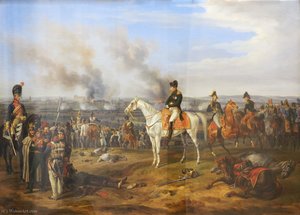
Eugène de Beauharnais and Napoleon in Russia (1835) by Albrecht Adam

Eugène de Beauharnais and Napoleon in Russia

1835 · Oil

The canvas captures a heavy, decisive moment amidst the 1812 Russian campaign. Two figures on horseback dominate the composition, framed by the atmospheric tension of a landscape shaped by conflict. One man, mounted upon a white horse, carries a sword, marking him as a figure of military authority. Beside him, a companion on a brown horse engages in a quiet, intense dialogue. Their proximity and posture suggest a private exchange…

2
General wounded (1802) by Albrecht Adam

General wounded

1802 · Oil · National Museum of Fine Arts, Buenos Aires

Albrecht Adam’s General wounded, created about 1802, captures a somber scene of military casualty set within a quiet landscape. The work focuses on the immediate aftermath of combat, centering on a wounded officer reclining against the base of a large, dark tree trunk. A second soldier, dressed in a dark uniform with red trousers, leans over the officer to tend to his wounds or check his condition. This interaction provides…

4
Hugo Philipp Graf Waldbott von Bassenheim on Horseback (1843) by Albrecht Adam

Hugo Philipp Graf Waldbott von Bassenheim on Horseback

In this 1843 oil painting, we find Hugo Philipp Graf Waldbott von Bassenheim presented with a quiet, commanding presence. He sits atop his horse, positioned centrally within a landscape that suggests the rolling hills of a private estate. The composition is vertical, drawing the eye upward from the immediate details of the foreground to the noble silhouette of the rider against a vast, cloudy sky. There is a certain stillness…

5
Caroline Gräfin Waldbott von Bassenheim on Horseback (1844) by Albrecht Adam

Caroline Gräfin Waldbott von Bassenheim on Horseback

1844 · Oil On Canvas · Bavarian State Painting Collections, Munich

The scene unfolds through the portrait titled Caroline Gräfin Waldbott von Bassenheim on Horseback, a work that captures a moment of quiet dignity. The subject of this composition is Caroline Gräfin Waldbott von Bassenheim, presented with a poise that suggests a life of high standing. She moves through the landscape atop her horse, her presence commanding the space around her. This depiction of the noblewoman offers a glimpse into the…

7
Soldiers and Horses at the Campfire (1847) by Albrecht Adam

Soldiers and Horses at the Campfire

1847 · Gouache

In Soldiers and Horses at the Campfire, Albrecht Adam presents a quiet moment of respite for soldiers. The scene is set during the transitional light of dusk or dawn, a time when the world seems to hold its breath. A group of soldiers and horses are gathered around a small campfire, their forms anchored in the foreground and middle ground. This central gathering provides a sense of camaraderie amidst the…

8
The Battle of Szeged (1853) by Albrecht Adam

The Battle of Szeged

1853 · Oil

Albrecht Adam captures a moment of heavy, historical friction in The Battle of Szeged. Painted about 1853, this large-scale work depicts a military conflict, likely the Battle of Szeged. The canvas holds the weight of organized troop movements set against the grim reality of casualties on the ground. It is a scene of structured violence and the sudden stillness of the fallen.

9
Field Marshal Radetzky and his staff at the Battle of Novara on March 23, 1849 (1855) by Albrecht Adam

Field Marshal Radetzky and his staff at the Battle of Novara on March 23, 1849

1855 · Oil On Canvas

Field Marshal Radetzky and his staff at the Battle of Novara on March 23, 1849 by Albrecht Adam captures a decisive moment in the First Italian War of Independence. The work, created about 1855, focuses on Field Marshal Joseph Radetzky as he oversees the military operations. He is positioned on a white horse, accompanied by his general staff, in the period leading up to the fall of Milan.

10
King Vittorio Emanuele Ii Meeting Joseph Radetsky Von Radetz At Vignale (1766) by Albrecht Adam

King Vittorio Emanuele Ii Meeting Joseph Radetsky Von Radetz At Vignale

1766 · Oil

In this work, titled King Vittorio Emanuele Ii Meeting Joseph Radetsky Von Radetz At Vignale, Albrecht Adam captures a specific moment of historical encounter. The painting depicts a meeting between King Vittorio Emanuele Ii and Joseph Radetsky Von Radetz at Vignale. It is a scene that places these figures within a precise setting, recorded by the hand of Albrecht Adam. The artist's signature is visible in the lower right corner,…

The Albrecht Adam selection continues, 11 to 37

The subjects that held Albrecht Adam's eye

The four subjects that come back most often in these originals, each with its finest example.

The museums that keep Albrecht Adam's originals

The 6 museums that hold the most of the paintings on this page.

Museum City Works by Albrecht Adam Paintings from this list
Bavarian State Painting Collections, MunichBavarian State Painting Collections Munich 5 Hugo Philipp Graf Waldbott von Bassenheim on Horseback, Caroline Gräfin Waldbott von Bassenheim on Horseback, Field Marshal Joseph Wenzel Graf Radetzky on Horseback
National Museum of Fine Arts, Buenos AiresNational Museum of Fine Arts Buenos Aires 1 General wounded
Lenbachhaus, MunichLenbachhaus Munich 1 Mountain Landscape with Plowing Farmer
Alte Nationalgalerie, BerlinAlte Nationalgalerie Berlin 1 The Battle of Abensberg on 20 April 1809
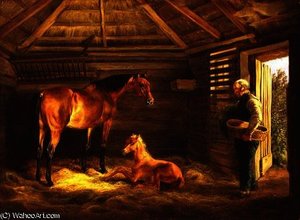
Royal Collection, LondonRoyal Collection London 1 Interior of a Stable
Hermitage Museum, Saint PetersburgHermitage Museum Saint Petersburg 1 Horses at the Porch

Albrecht Adam decade by decade: the original that defines each

Works per decade

Pick a decade to see the original that defines it.

Collectors' questions about Albrecht Adam's paintings

Which work is Albrecht Adam most famous for?Reveal the answer

Eugène de Beauharnais and Napoleon in Russia (1835). General wounded (1802) and Mountain Landscape with Plowing Farmer (1825) come next.

What age was Albrecht Adam when Eugène de Beauharnais and Napoleon in Russia was made?Reveal the answer

49 years old: Eugène de Beauharnais and Napoleon in Russia dates from 1835, and Albrecht Adam was born in 1786.

What are the ten most famous Albrecht Adam paintings?Reveal the answer

Eugène de Beauharnais and Napoleon in Russia, General wounded, Mountain Landscape with Plowing Farmer, Hugo Philipp Graf Waldbott von Bassenheim on Horseback, Caroline Gräfin Waldbott von Bassenheim on Horseback, Field Marshal Joseph Wenzel Graf Radetzky on Horseback, Soldiers and Horses at the Campfire, The Battle of Szeged, Field Marshal Radetzky and his staff at the Battle of Novara on March 23, 1849 and King Vittorio Emanuele Ii Meeting Joseph Radetsky Von Radetz At Vignale. The ranking above gives each one's year and museum.

How many paintings did Albrecht Adam leave?Reveal the answer

Our catalog holds 38 works by Albrecht Adam, dated from 1802 to 1855.

In which museums do Albrecht Adam's masterpieces hang?Reveal the answer

Mostly in Bavarian State Painting Collections (Munich), National Museum of Fine Arts (Buenos Aires) and Lenbachhaus (Munich). The museum table above lists them all.

In which years did Albrecht Adam paint the most famous works?Reveal the answer

In 1840s: 8 of the 37 works on this page were made then, Hugo Philipp Graf Waldbott von Bassenheim on Horseback among them.

What are the first and the last famous originals of Albrecht Adam?Reveal the answer

On this page, the earliest is General wounded (1802) and the latest Field Marshal Radetzky and his staff at the Battle of Novara on March 23, 1849 (1855).

Which subjects did Albrecht Adam choose most often?Reveal the answer

Horse (7), Sky (7) and Royalty (5), across the 37 works on this page.

Which technique did Albrecht Adam use most?Reveal the answer

Oil, for 6 of the 37 works on this page.

Which Albrecht Adam works hang at the Bavarian State Painting Collections?Reveal the answer

Hugo Philipp Graf Waldbott von Bassenheim on Horseback, Caroline Gräfin Waldbott von Bassenheim on Horseback and Field Marshal Joseph Wenzel Graf Radetzky on Horseback: the Bavarian State Painting Collections, Munich holds 5 of the works on this page.

Albrecht Adam: life and work

The Chronicler of Conquest and Cavalry

Albrecht Adam stands as a profound witness to one of history's most turbulent eras, capturing the raw, visceral energy of the Napoleonic Wars through his brush. Born in Nördlingen, Germany, his early life took an unexpected turn from a confectioner's apprenticeship toward the prestigious Academy of Fine Arts in Nuremberg. This transition from the sweetness of sugar to the grit of the battlefield defined his artistic soul. As an official artist attached to the Bavarian contingent of the Grande Armée, Adam did not merely observe history from a distance; he lived within its chaos. His presence during the 1812 Russian campaign allowed him to document the harrowing march to Moscow and the devastating carnage of battles such as Borodino with an intimacy that few of his contemporaries could claim.

A Legacy of Motion and Majesty

The essence of Adam's work lies in his dual mastery of the battlefield scene and the equine form. His canvases and engravings serve as a vital historical record, blending the terrifying reality of war with a deep, anatomical reverence for the horses that powered the era's cavalry. In works such as Ownerless Horse at Moshaisk, one can feel the haunting stillness following the storm of combat, while his depictions of French cuirassiers charging into the Great Redoubt pulse with the frantic movement of steel and muscle. This fascination with the horse was not merely incidental but became a cornerstone of his identity, establishing him as a renowned equine artist whose influence would even extend to his grandson, Emil Adam.

Artistic Evolution and Historical Impact

Throughout his career, Adam’s technique evolved from capturing the marching troops of southern Germany to portraying the grand, sweeping tragedies of European conflict. His journey took him through the artistic circles of Munich and Vienna, where he refined his ability to translate the smoke and thunder of war into evocative compositions. Beyond the mere depiction of events, his memoirs and sketches provide a psychological layer to his art, offering a glimpse into the human and animal cost of Napoleon's ambitions. By weaving together the precision of military detail with the emotional weight of loss, Adam ensured that the fleeting moments of the Napoleonic period were etched permanently into the annals of art history.