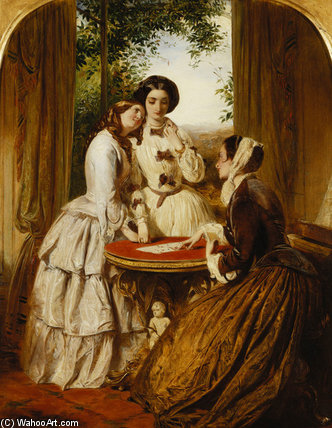
Portrait of Abraham Solomon

The 43 Most Famous Abraham Solomon Paintings, Each One of a Kind

Updated November 2026 · ranked by our popularity score (searches, visits and orders for each work) · 44 works by Abraham Solomon in our catalogue

In short

Waiting for the Verdict (1859) is the Abraham Solomon painting that draws the most eyes; the original belongs to the J. Paul Getty Museum, Los Angeles. After it, the eye goes to Conversation Piece (1847) and First Class: The Meeting…and at First Meeting Loved (1854). Among the 44 works of Abraham Solomon in our catalog, these 43 are the most famous, each a unique original presented with its year, its museum and the reason it endures.

1823 – 1862, London Most works: J. Paul Getty Museum

Top 10 paintings by Abraham Solomon, through the gallery's eye

1
Waiting for the Verdict (1859) by Abraham Solomon

Waiting for the Verdict

1859 · Oil On Canvas · J. Paul Getty Museum, Los Angeles

Waiting for the Verdict is an oil on canvas by the British painter Abraham Solomon. Created in 1859, the work belongs to the tradition of Victorian contemporary-life genre painting. Solomon, born in London, established himself as a significant figure in the nineteenth-century British artistic landscape through his technical proficiency and ability to render complex narrative scenes.

2
Conversation Piece (1847) by Abraham Solomon

Conversation Piece

1847 · Oil · Birmingham Museum and Art Gallery, Birmingham

In "Conversation Piece" by Abraham Solomon, we find ourselves observing an intimate moment of social etiquette. The work, dating from about 1847, centers on a cluster of five figures caught in the midst of a greeting or a quiet social interaction. These individuals are dressed in 18th-century style attire, their clothing suggesting a specific level of decorum and status. The arrangement of the group is tight, creating a sense of…

3
First Class: The Meeting…and at First Meeting Loved (1854) by Abraham Solomon

First Class: The Meeting…and at First Meeting Loved

1854 · Oil On Panel

The scene unfolds within the intimate, enclosed confines of a first class railway carriage, a setting that captures a fleeting moment of human connection. This work, titled First Class: The Meeting…and at First Meeting Loved, presents a quiet drama occurring amidst the travel of passengers. The narrative focuses on the subtle interactions between those sharing this private space, as the rhythmic motion of the train seems to pause for a…

4
Waiting for the Verdict (1857) by Abraham Solomon

Waiting for the Verdict

1857 · Oil On Canvas

is an oil on canvas by the British painter Abraham Solomon. Executed in 1859, the work belongs to the tradition of Victorian contemporary-life genre painting. It focuses on the human cost of legal or social judgment, capturing a moment of profound tension.

Abraham Solomon's famous paintings, numbers 11 to 43

The subjects that held Abraham Solomon's eye

The four subjects that come back most often in these originals, each with its finest example.

The museums that keep Abraham Solomon's originals

The 4 museums that hold the most of the paintings on this page.

Museum City Works by Abraham Solomon Paintings from this list
J. Paul Getty Museum, Los AngelesJ. Paul Getty Museum Los Angeles 2 Waiting for the Verdict, The Acquittal
Birmingham Museum and Art Gallery, BirminghamBirmingham Museum and Art Gallery Birmingham 1 Conversation Piece
Yale Center for British Art, New HavenYale Center for British Art New Haven 1 First Class -
National Gallery of Australia, CanberraNational Gallery of Australia Canberra 1 Second Class - the parting:

Abraham Solomon across the years: the unique originals of each

13 years separate Abraham Solomon's first and last dated originals shown here, 1847 and 1859: each year has its place below.

Works per year

Pick a year to see its originals.

Abraham Solomon's paintings: questions for the gallery

What is the single most famous work of Abraham Solomon?Reveal the answer

Waiting for the Verdict (1859), J. Paul Getty Museum, Los Angeles. Conversation Piece (1847) and First Class: The Meeting…and at First Meeting Loved (1854) come next.
At what age did Abraham Solomon create Waiting for the Verdict?Reveal the answer

36 years old: Waiting for the Verdict dates from 1859, and Abraham Solomon was born in 1823.

Which ten paintings by Abraham Solomon are the most famous?Reveal the answer

Waiting for the Verdict, Conversation Piece, First Class: The Meeting…and at First Meeting Loved, Waiting for the Verdict, Academy for instruction in the discipline of the fan, Second class, The Departure Of A Diligence From Biarritz, The Fair Amateur, Doubtful Fortune - and Le Malade Imaginaire. The ranking above gives each one's year and museum.

How many works by Abraham Solomon are known?Reveal the answer

Our catalog holds 44 works by Abraham Solomon, dated from 1847 to 1859.

Where can the most famous Abraham Solomon originals be seen?Reveal the answer

Mostly in J. Paul Getty Museum (Los Angeles), Birmingham Museum and Art Gallery (Birmingham) and Yale Center for British Art (New Haven). The museum table above lists them all.

During which period did Abraham Solomon create the best-known paintings?Reveal the answer

In 1854: 2 of the 43 works on this page were made then, First Class: The Meeting…and at First Meeting Loved among them.

Which famous Abraham Solomon painting is the earliest, and which the latest?Reveal the answer

On this page, the earliest is Conversation Piece (1847) and the latest Waiting for the Verdict (1859).

What subjects did Abraham Solomon favour?Reveal the answer

Victorian era (8), Man (3) and Woman (3), across the 43 works on this page.

What materials did Abraham Solomon paint with most?Reveal the answer

Oil On Canvas, for 2 of the 43 works on this page.

What Abraham Solomon originals can I see at the J. Paul Getty Museum?Reveal the answer

Waiting for the Verdict and The Acquittal: the J. Paul Getty Museum, Los Angeles holds 2 of the works on this page.

Abraham Solomon: a portrait of the artist

Abraham Solomon: A Victorian Vision of Jewish Life

Born in the heart of London’s East End in 1823, Abraham Solomon emerged as a significant figure within the vibrant artistic landscape of 19th-century Britain. The second son of Meyer Solomon, a Leghorn hat manufacturer and a man who broke barriers by becoming one of the first Jews admitted to the freedom of the city, Solomon’s upbringing instilled in him both an appreciation for craftsmanship and a unique perspective on his heritage. His family's history of artistic endeavor—his sister Rebecca and brother Simeon both achieving acclaim—created a fertile environment for his own creative development, shaping not only his technical skills but also his thematic interests.

Solomon’s early training began at Sass’s School of Art in Bloomsbury, a prestigious institution that nurtured the talents of many future artists. At just thirteen years old, he demonstrated exceptional promise, earning an Isis silver medal for his drawing from a statue – a remarkable achievement for such a young student. This initial success paved the way for his admission to the Royal Academy in 1839, where he quickly established himself as a skilled draughtsman, receiving two silver medals within just one year: one for drawing from the antique and another for drawing from life. These early accolades reflected not only his technical proficiency but also an innate ability to capture the essence of both classical subjects and contemporary figures.

A Painter of Domestic Scenes and Literary Subjects

Solomon’s artistic output spanned a remarkable range of styles and subject matter, yet he is most remembered for his evocative depictions of domestic scenes, particularly those centered around Jewish life. His early works, such as “Rabbi expounding the Scriptures” (1840) and “My Grandmother and a scene from Sir Walter Scott’s *Fair Maid of Perth*” (1841), showcased his ability to render intricate details with remarkable precision and sensitivity. These paintings established him as a skilled portraitist and storyteller, capturing not just physical appearances but also the emotional nuances of his subjects.

Solomon's artistic trajectory shifted towards literary themes throughout the 1840s and 1850s. He produced meticulously researched and beautifully executed scenes from works by Shakespeare, Walter Scott, and Molière, including “A Scene from the Vicar of Wakefield” (1842), “Crabbe’s Parish Register” (1843), and “Peveril of the Peak” (1845). These paintings were distinguished by their attention to historical detail, costume, and setting, reflecting Solomon's commitment to accuracy and his deep understanding of the source material. Notably, works like "The Breakfast Table" (1846) and a subsequent scene from *The Vicar of Wakefield* (1847) garnered considerable attention for their vibrant colors and skillful composition.

Pre-Raphaelite Influences and Artistic Style

While not formally associated with the Pre-Raphaelite Brotherhood, Solomon’s work shares many characteristics with this influential artistic movement. His paintings are characterized by a rich color palette, meticulous detail, and an interest in depicting scenes from literature and history. The influence of the Pre-Raphaelites is particularly evident in his later works, such as “Ballroom in the Year 1760” (1848) and “The Academy for Instruction in the Discipline of the Fan, 1711” (1849), which are notable for their dazzling displays of color and elaborate costumes. These paintings demonstrate Solomon’s mastery of technique and his ability to create visually stunning works that evoke a sense of historical grandeur.

Solomon's style evolved over time, moving from the more rigid conventions of academic painting towards a looser, more expressive approach. His later works, such as “Too Truthful” (1850) and "An Awkward Position" (1851), are characterized by a greater sense of spontaneity and emotional depth. The inclusion of scenes like “The Grisette” (1854) and “Consolation” (1861) reveals his growing interest in social commentary, reflecting the concerns of Victorian society.

Legacy and Historical Significance

Abraham Solomon’s career was tragically cut short at the age of 39 when he died in Biarritz, France, on December 19, 1862, from heart disease. Despite his untimely death, Solomon left behind a significant body of work that continues to be admired for its technical skill, artistic sensitivity, and unique perspective on Jewish life in Victorian England. His paintings offer valuable insights into the social, cultural, and religious experiences of the time, and his legacy as one of Britain’s most accomplished artists endures.

Solomon's work is now housed in prominent collections around the world, including the National Gallery of Canada, the National Gallery of Australia, and the Royal Holloway College. His paintings are a testament to his talent, dedication, and enduring contribution to the history of British art.