The Eye of Discovery: Masterpieces Capturing the Spirit of Scientific Observation
Explore the profound intersection of art and science. Discover how master illustrators captured the essence of discovery through botanical realism, from Enlightenment precision to Victorian naturalism. A deep dive into the masterpieces that defined scientific observation.
The Evolution of Observation: From Ancient Herbals to Scientific Realism The Art of Precision: A Definitive Guide to Scientific Illustration and Botanical Mastery The Roots of Observation: From Ancient Herbals to Scientific Realism The Flourishing Ca...
To wander through the annals of art history is to witness a profound, ancient dialogue between humanity and the verdant world. Long before the advent of sophisticated scientific tools or the clarity of the camera lens, our understanding of the plant kingdom was inextricably linked to the skill and patience of the artist. The earliest glimpses into this relationship are not found in modern textbooks but are etched into the walls of ancient tombs and temples, where stylized depictions of flora served as symbolic elements within a broader cosmological framework. As centuries progressed, this impulse evolved from pure symbolism toward a burgeoning need for utility and survival.
During the medieval period, monasteries became vital centers for preserving botanical knowledge. Within these cloistered gardens, monks cultivated plants not merely for sustenance but for their medicinal properties. Their herbals—illustrated compendiums detailing plant uses—became essential resources for healing. While early works often relied on artistic conventions that prioritized symbolic meaning over strict realism, they laid the groundwork for a more disciplined approach to observation. This era marked the transition from art as myth to art as a tool for human advancement, setting the stage for a revolution in naturalism where the artist's eye became a primary instrument of scientific discovery.
Masters of the Macro: The Artistry of Botanical Illustration
A Study in Botanical Elegance: Robert Havell Jr.’s *Lilium candidum* This exquisite botanical illustration, *Lilium candidum*, by Robert Havell Jr., offers a captivating glimpse into the meticulous world of 19th-century scientific artistry. More than...
As the thirst for knowledge expanded, the discipline of botanical illustration emerged as a realm where scientific rigor meets visual impact. This is not merely about documenting a specimen; it is about capturing the very blueprint of existence with such clarity that the viewer feels the pulse of the subject. In this high-impact world, every vein in a leaf and every delicate filament of a stamen must be rendered with an uncompromising eye for detail. The beauty of this genre lies in its ability to translate microscopic complexities into a macroscopic visual triumph.
Consider the exquisite work of Robert Havell Jr., whose Lilium candidum offers a captivating glimpse into the meticulous world of 19th-century scientific artistry. His technique employs fine, precise lines to define the delicate forms of lily petals, creating an illusion of three-dimensionality on a flat surface. Through expert use of hatching and cross-hatching, he suggests subtle shading and texture, contrasting smooth petals with the veining of leaves. Similarly, the 1932 watercolor study of the 'Trumpet Creeper' by Maud H. Purdy showcases how scientific precision can coexist with natural beauty. For those who find themselves drawn to this level of detail, our museum-quality oil reproductions offer a tactile experience far beyond a mere print; our artists use visible brushstrokes and deep tonal ranges to bring these historical studies to life on 100% cotton canvas.
The Enlightenment Canvas: Where Empirical Evidence Meets Aesthetic Grace
Johann Simon von Kerner: A Pioneer of Botanical Illustration Born in Kirchheim bei Teck, Germany, in 1755, Johann Simon von Kerner’s life was inextricably linked to the burgeoning world of botany and scientific illustration. His legacy rests primaril...
The Age of Enlightenment, or the Age of Reason, brought with it an emphasis on empirical evidence and the scientific method. This period saw a monumental shift in how nature was documented, as artists became essential collaborators in the burgeoning world of botany. Johann Simon von Kerner, a pioneer of this era, produced the Hortus Sempervirens, a twelve-volume work that stands as a testament to meticulous observation and dedication. His career unfolded during a period of significant scientific advancement, where the desire to accurately document the natural world reached its zenith.
This era also saw the rise of figures like Johann Wilhelm Weinmann, whose Phytanthoza iconographia redefined botanical illustration through its ambitious scale and scientific accuracy. Even in the 18th century, works like Jacopo Ligozzi’s Agave americana demonstrated a mastery of muted tones and meticulous detail that remains captivating to collectors today. This period was characterized by a harmonious blend of science and art, where the artist's task was to provide a visual record that supported the era's intellectual flourishing. It is this very spirit of discovery that we strive to preserve in our custom commissions, allowing you to transform personal memories or historical interests into masterpieces through our professional digital mockup service.
Beyond the Specimen: Capturing Habitat and Vitality in Victorian Naturalism
A Victorian World Captured in Bloom: The Marianne North Gallery Stepping into the Marianne North Gallery at Kew Gardens is akin to entering a forgotten world—a vibrant, immersive cabinet of curiosities brought to life through the meticulous brushstro...
As the 19th century progressed, botanical art began to move away from the isolated specimen toward a more immersive representation of life. A striking example is found in the work of Marianne North. Unlike the formal botanical studies of her time, which often isolated specimens for scientific scrutiny, North’s paintings explode with the energy and untamed beauty of plants flourishing within their natural habitats. Her work, housed in the magnificent Marianne North Gallery at Kew Gardens, serves as a passionate testament to a life lived in pursuit of both artistic expression and scientific curiosity.
North traversed the globe—from the lush rainforests of Borneo to the landscapes of Japan—capturing the light filtering through jungle canopies and the rugged textures of volcanic slopes. Her paintings are not merely records of flora; they are vibrant, immersive chronicles of a world in bloom. This shift toward naturalism represents a move from the laboratory to the landscape, where the boundaries between scientific inquiry and profound aesthetic grace dissolve. Whether it is the systematic arrangement found in the Cambridge University Botanic Garden or the wild energy of North's canvases, this era reminds us that nature is most powerful when seen in its full, untamed context.
The Enduring Legacy: How Scientific Observation Shaped Art History
The Art of Observation: Defining Botanical Realism Botanical illustration Botanical illustration is the art of depicting the form, color, and details of plant species. They are generally meant to be scientifically descriptive about subjects depicted ...
The legacy of scientific illustration remains a cornerstone of art history, providing a visual anchor of truth in an increasingly digital and ephemeral age. The discipline demands a rigorous adherence to reality, yet this precision does not strip the art of its beauty; rather, it amplifies it. The profound power found in these works comes from the sheer intensity of observation—the realization that the artist has seen what we often overlook.
Today, this dialogue between humanity and the natural world continues through the preservation and reproduction of these masterworks. At OriginalUniqueArt.com, we honor this tradition by offering hand-painted oil reproductions that capture the soul of these historical studies. Our artists, holding degrees from prestigious Fine Arts academies, use traditional methods—including the use of flexible gesso and Damar varnish—to ensure that the texture and depth of the original scientific masters are respected. Whether you are a history lover seeking to adorn your home with the elegance of 19th-century botanical realism or a collector looking for a custom "remix" of art history, we invite you to explore the enduring beauty of the eye of discovery.
Explore the fascinating history of scientific illustration – where art meets accuracy. Discover key artists like Karl Blossfeldt & Maud H. Purdy, and delve into its profound epistemological roots. OriginalUniqueArt offers museum-quality reproductions.
Explore the profound elegance of naturalistic illustration, where scientific precision meets artistic grace. Discover how the masters of botanical realism inspire timeless, museum-quality oil reproductions for sophisticated, high-end interiors and architectural spaces.
Explore the profound history of scientific illustration. From ancient herbals to botanical masters like Robert Havell Jr., discover how precision meets beauty in this expert guide to natural history art and its enduring legacy in fine art collections.

 Botanical Realism: The Art of Capturing Nature's Precise Detail through Scientific Mastery
 Lilium candidum
 johann simon von kerner
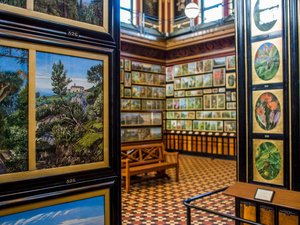 Marianne North Gallery
 Nature in Detail: A Guide to the Timeless Elegance of Botanical Realism Art


