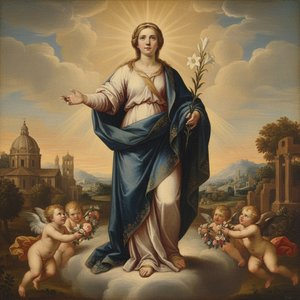
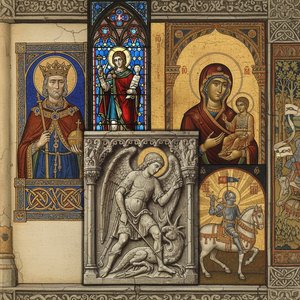
Early Christian art and architecture (or Paleochristian art) is the art produced by Christians, or under Christian patronage, from the earliest period of Christianity to, depending on the definition, sometime between 260 and 525. In practice, identif...
To look upon the history of Christian imagery is to witness a slow, deliberate evolution of identity. For centuries, the figure of Mary Magdalene has served as a vessel for the shifting theological currents of the Church. In the earliest days of the faith, before the grand cathedrals and the heavy gilding of the Middle Ages, her presence was often subtle, found in the quiet corners of Roman catacombs or within the symbolic language of the fish and the anchor. She was a witness, a follower, and a bearer of news, yet her specific character remained largely unadelineated by the sparse records of the first centuries.
As time passed, the simplicity of these early depictions gave way to more complex narratives. The transition from the hidden, often ambiguous symbols of Early Christian art to the structured iconography of the Byzantine era brought a new weight to her persona. We see this shift in how she was held in the eyes of the faithful—moving from a figure of quiet strength to one caught in the dramatic tension between her earthly origins and her spiritual destiny. This movement toward more defined, often more burdened, portrayals set the stage for the profound psychological explorations that would later define the Baroque era.
Light and Conversion: Caravaggio and Early Christian Symbolism
The Conversion of Mary Magdalen (also known as Martha and Mary Magdalen) Caravaggio’s *Martha and Mary Magdalene*, completed around 1598, stands as an emblem of Baroque artistry—a dramatic tableau that transcends mere depiction to embody profound the...
The arrival of the Baroque period brought a revolution in how we perceive the divine through the medium of paint. No artist captured this shift with more visceral intensity than Caravaggio. In his work, The Conversion of Mary Magdalen (also known as Martha and Mary Magdalene), completed around 1598, the light does not merely illuminate; it confronts. The painting, currently held at the Detroit Institute of Arts, presents a moment of profound theological weight: Mary persuading her sister Martha to turn away from worldly duties toward a life of piety.
This use of light finds its echo in the very foundations of the faith. Just as early Christians used symbols like the dove or the lamb to communicate truths that were often too dangerous to state plainly, Caravaggio uses chiaroscuro to reveal the internal struggle of the soul. The dramatic contrast between deep shadow and sudden brightness serves as a visual metaphor for the moment of grace. In this painting, the inclusion of a convex mirror reflecting a window bathed in light acts as a conduit for divine presence, suggesting that even in the midst of human tension, grace is actively penetrating the darkness.
The Texture of Penance: Medieval Legend Meets Baroque Realism
Penitent Magdalene (also called Repentant Madalene) is a 16th-century oil on canvas painting by Italian Baroque painter Caravaggio. The painting portrays a repentant Mary Magdalene bowed in penitent sorrow as she leaves behind her dissolute life, its...
The image of the Magdalene as a repentant sinner is one of the most enduring, yet historically contested, legacies in art history. Much of this perception stems from the eleventh-century influence of Pope Gregory I, whose homilies conflated Mary Magdalene with other biblical women, such as the unnamed sinner who anointed Christ's feet. This created a narrative of a fallen woman seeking redemption through asceticism—a theme that would dominate much of Western art for centuries.
Caravaggio’s Penitent Magdalene offers a stark, almost unsettling departure from the more idealized, flowing depictions found in earlier traditions. Instead of the ethereal, weightless figures of the Renaissance, we encounter a young woman kneeling in heavy, tangible sorrow. The realism is so profound that contemporaries famously complained she looked like an ordinary girl from the streets. By placing discarded jewelry and a stoppered bottle beside her, Caraviente brings the weight of her past into the immediate present. This groundedness reminds us that the struggle for redemption is not a distant, mythic event, but one lived in the flesh, amidst the very textures of everyday life.
Flesh and Spirit: Artemisia Gentileschi and the Byzantine Legacy
Captivating Subject and Spiritual Significance This exquisite painting captures the intense spiritual ecstasy of Mary Magdalene, a revered biblical figure symbolizing penitence, divine love, and mystical union. Depicted in a moment of profound transc...
While Caravaggio explored the weight of sin, Artemisia Gentileschi turned her gaze toward the heights of spiritual ecstasy. In her 1620 work, Mary Magdalene in Ecstasy, the figure is not slumped in sorrow but reclining in a moment of profound transcendence. Her eyes are closed, her face illuminated by an inner glow that suggests a direct, mystical union with the divine. The technique here is equally masterful, using bold light to accentuate the naturalistic anatomy and the soft textures of her hair, creating a sense of intimacy that draws the viewer into her private revelation.
This focus on the internal, spiritual state finds a distant ancestor in the Byzantine tradition, where the emphasis was often on the icon—a window into the eternal. While the Byzantine style utilized stylized, elongated forms to emphasize the otherworldly, Gentileschi uses the realism of the Baroque to achieve a similar end. She does not need to abandon naturalism to portray the supernatural; rather, she uses the palpable reality of skin and light to make the experience of divine love feel undeniably real.
Mirrors of the Soul: Reflecting on Vanity and Virtue through the Ages
The use of symbolic objects in these works provides a silent dialogue between the subject and the viewer. In many depictions of the Magdalene, we see the presence of items that signify her former life—pearls, perfumes, or mirrors. These are not merely decorative; they are tools of introspection. A mirror, as seen in Caravaggio’s Martha and Mary Magdalene, serves as a symbol of both vanity and self-reflection, forcing the subject (and the observer) to confront the image of the self against the backdrop of eternity.
This tradition of using material objects to represent spiritual truths is a thread that runs through all of Christian art history. Whether it is the skull held by El Greco in his The Penitent Mary Magdalene—a stark reminder of mortality—or the orange blossom representing purity, these elements ground the abstract concept of faith in something we can touch and see. These objects act as anchors, preventing the spiritual narrative from drifting into pure abstraction and ensuring that the lesson of the painting remains tethered to the human condition.
Reclaiming the Apostle: From the Gospels to the Baroque Canvas
Mary Magdalene (sometimes called Mary of Magdala, or simply the Magdalene or the Madeleine) was a woman who, according to the four canonical gospels, travelled with Jesus as one of his followers and was a witness to his crucifixion and resurrection. ...
In recent years, a more nuanced understanding of Mary Magdalene has begun to emerge, one that seeks to peel back the layers of medieval legend to find the historical figure beneath. Scholars now point to her role as the "Apostle to the Apostles," a title given by St. Thomas Aquinas, emphasizing her authority as a witness to the Resurrection. This version of her—upright, composed, and influential—stands in stark contrast to the weeping, disheveled figure often found in later Baroque compositions.
Yet, even as we reclaim her historical agency, the power of the Baroque depictions remains undiminant. The tension between the "fallen woman" and the "faithful disciple" is precisely what gives these paintings their enduring strength. They do not merely document a biography; they capture the eternal human struggle between our earthly attachments and our spiritual aspirations. In the works of Caravaggio, Gentileschi, and El Greco, we find a profound respect for the complexity of faith—a faith that is never simple, but always deeply, beautifully human.
At OriginalUniqueArt.com, we appreciate the depth found in these historical narratives. Whether you are drawn to the dramatic shadows of the Baroque or the luminous textures of the Impressionists, our collection of hand-painted reproductions and custom commissions is designed to bring the weight and wisdom of art history into your own space.
Explore the captivating history of divine grace in Western art! Discover masterpieces by Holbein, Raphael & Fra Angelico. Expert analysis for collectors and enthusiasts at OriginalUniqueArt.
Explore the life & art of Simon Vouet, a pivotal French Baroque painter who introduced Italian styles to France. Discover his masterpieces and lasting influence on 17th-century art.
Explore the rich history of Medieval Art (c. 500 – c. 1500) with OriginalUniqueArt. Discover Byzantine mosaics, Gothic cathedrals & Renaissance masterpieces. Expert insights & museum-quality reproductions.
Explore the revolutionary realism of Caravaggio! Discover his mastery of light & shadow (tenebrism), dramatic religious scenes, and lasting influence on Baroque art history. A comprehensive guide for art enthusiasts.

 Early Christian art and architecture
 The Conversion of Mary Magdalen (also known as Martha and Mary Magdalen)
 Penitent Magdalene (Caravaggio)
 Mary Magdalene in Ecstasy
 Mary Magdalene