Belle-Ile, Rain Effect: A Symphony of Impressionism Claude Monet’s Belle-Ile, Rain Effect isn't merely a landscape painting; it’s a distillation of atmosphere itself—a testament to Monet’s revolutionary approach to capturing the fleeting beauty of na...
The mid-19th century art world was held captive by the heavy, studio-bound traditions of the French Academy, where precise lines and historical allegories reigned supreme. The Académie des Beaux-Arts functioned as a gatekeeper, valuing religious themes and polished surfaces that hid the artist's hand behind a thick, golden varnish. To look at an academic painting was to see a world of controlled shadows and finished perfection, far removed from the raw textures of reality.
A group of rebels, including Claude Monet and Pierre-Auguste Renoir, began to dismantle these constraints. They turned their gaze away from mythological grandeur toward the en plein air experience, seeking to capture the sensory perception of a scene as it unfolded. This shift was not merely a change in subject matter but a fundamental alteration in how we perceive existence. By prioritizing optical truth over photographic accuracy, they traded the dark, controlled shadows of the past for a luminous palette that celebrated the immediate, breathing world.
This rebellion finds its most profound expression in works like Belle-Ile, Rain Effect. In this 1886 canvas, Monet does not seek to replicate the granite boulders or the turbulent ocean with clinical precision. Instead, he uses loose, broken brushstrokes of blue and gray to convey the dampness of the air and the weight of the rain. The painting captures a moment suspended between light and shadow, proving that the true essence of a landscape lies in its atmosphere rather than its outlines.
Optical Precision: The Scientific Emergence of Neo-Impressionism
Neo-Impressionism is a term coined by French art critic Félix Fénéon in 1886 to describe an art movement founded by Georges Seurat. Seurat's most renowned masterpiece, A Sunday Afternoon on the Island of La Grande Jatte, marked the beginning of this ...
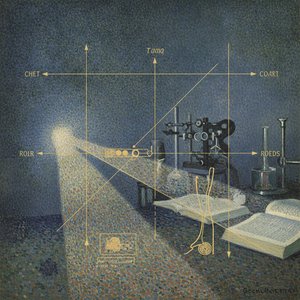
As the 1880s progressed, the spontaneous energy of Impressionism began to encounter a new, more calculated form of expression. While the Impressionists chased the fleeting light, a new generation sought to ground their observations in the burgeoning scientific understandings of color theory. This movement, known as Neo-Impressionism, moved away from the intuitive stroke toward a systematic approach to light and pigment.
The foundation for this change lay in the work of scientists like Michel Eugène Chevreul, whose theories on color contrast provided a roadmap for artists to achieve greater luminosity. Rather than blending pigments on a palette—a process that often leads to muddy, darkened tones—Neo-Impressionists like Georges Seurat and Paul Signac applied tiny dabs of pure, unmixed color directly to the canvas. This technique, often called Pointillism or Divisionism, relied on the viewer's eye to perform the mixing, creating an optical vibration that felt far more brilliant than traditional methods.
This scientific rigor is evident in the works presented at the 1886 Salon des Indépendants. By using precise, geometric shapes and a disciplined application of color, these artists aimed to derive a harmonious vision from modern science. It was a pursuit of a grand synthesis between the essential and the real, transforming the canvas into a structured field of light where every dot of pigment contributed to a larger, more intense perception of brilliance.
Beyond the Ephemeral: Post-Impressionism and the Search for Permanence
The Great Transition: Moving Beyond the Fleeting Moment Beyond the Brush: How Post-Impressionism Recharged Modern Art with Bold Color and Raw Emotion The Impressionist Breakup: Why Light Wasn't Enough Anymore Beyond Light & Color: Impressionism vs. P...
While the Impressionists succeeded in recording the momentary sensation of a sunbeam, their canvases were often perceived as lacking structural permanence. There was a growing sense that by chasing only the transient, the deeper, more lasting essence of reality was being left behind. This tension between the ephemeral nature of light and the human desire for enduring form became the catalyst for Post-Impressionism.
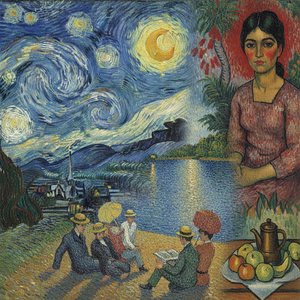
Artists such as Paul Cézanne, Vincent van Gogh, and Paul Gauguin sought to extend the boundaries of their predecessors by adding emotional weight and formal structure. Cézanne, often regarded as the father of this movement, aimed to make Impressionism something solid and durable, like the art of museums. He achieved this by reducing objects to their basic geometric shapes while retaining the saturated colors that had been pioneered by Monet. Meanwhile, Van Gogh used thick impasto and expressive, swirling brushstrokes to convey a psychological depth that went far beyond mere observation.
This search for subjectivity is beautifully captured in Théo van Rysselberghe’s Olive Trees near Nice. Painted in 1905, the work moves beyond the simple depiction of a Mediterranean landscape. Through bold brushstrokes and an emphasis on form, the artist uses color as a tool for emotional resonance. The trees are not just botanical specimens; they are parted by a deliberate, energetic application of paint that prioritates the artist's internal response to the sun-drenched field over a literal transcription of nature.
Navigating Progress: Maritime Landscapes in an Industrial Age
James Bell: The Master of the Moving Sea James Bell (1850-1910) wasn’t merely a marine artist; he was a conduit to the very soul of the sea. Born in Glasgow, Scotland, into a family steeped in trade and commerce – his father a customs collector – Bel...
The late 19th century was defined by the Second Industrial Revolution, a period of massive urbanization and unprecedented technological expansion. As railways linked European cities and steam power transformed global trade, the very nature of movement changed. This era of rapid change found a unique mirror in the maritime art of the period, where the rugged reality of the sea met the growing prosperity of international commerce.
The work of artists like James Bell provides an intimate glimpse into this maritime evolution. Born into a family involved in trade, Bell possessed a deep understanding of the vessels that connected nations. Unlike the romanticized naval scenes of earlier eras, Bell embraced the turbulent realities of seafaring—the spray of waves and the weathered textures of working ships. His canvases were not merely records of vessels but conduits to the power of the sea, capturing the motion and drama of an age defined by expansion.
In his depictions of merchantmen and warships, one sees the intersection of nature's raw force and human industry. These paintings reflect a world in flux, where the expansion of British maritime trade was matched by the technological shifts of the era. The sea remained a constant, yet through the eyes of artists like Bell, it became a stage for the progress and the perils of a modernizing world.
The Belle Époque Aesthetic: Prosperity and Urban Transformation
A Glimpse into Provençal Life: Pierre-Auguste Renoir’s *La Poste at Cagnes* Pierre-Auguste Renoir's *La Poste at Cagnes*, painted in 1905, is more than just a depiction of a rural scene; it’s an evocative distillation of the French Impressionist aest...
Following the end of the Franco-Prussian War, Europe entered the Belle Époque, an era characterized by optimism, regional peace, and significant cultural innovation. In Paris, this period saw the construction of landmarks like the Eiffel Tower and the expansion of the Métro, as Haussmann’s renovations transformed the city into a walkable, cosmopolitan center. It was a golden age of joie de vivre, where the arts flourished alongside economic prosperity.
This era of refinement and light is perhaps best encapsulated in the works of Pierre-Auguste Renoir. In La Poste at Cagnes, painted in 1905, we see the quintessential Impressionist aesthetic at its zenith. The scene is bathed in a warm, golden light that suggests the tranquility of a quiet afternoon in Provence. Renoir avoids grand narratives, choosing instead to find beauty in the ordinary—the way sunlight filters through foliage and rests upon stone.
The Belle Époque was not merely about the outward display of wealth; it was an era where the boundaries of art were being pushed by the very prosperity that funded them. From the bustling cabarets of Montmartre to the lush, sun-drenched landscapes of the South, the period left a legacy of light and color that continues to define our understanding of modern beauty. At OriginalUniqueArt.com, we honor this heritage through our meticulous hand-painted reproductions, ensuring that the texture, depth, and soul of these historical movements are preserved for the contemporary collector.
Explore the scientific brilliance of Neo-Impressionism. Discover how masters like Georges Seurat revolutionized art through optical mixing, color theory, and the precision of Pointillism to capture the true essence of light.
Explore the revolutionary world of Impressionism! Discover its history, key artists like Monet & Renoir, defining techniques, and lasting impact on modern art. A comprehensive guide for art lovers.
Explore the captivating world of Impressionism! Discover its history, key artists, techniques & enduring legacy with OriginalUniqueArt. Find museum-quality reproductions and expert art consultation.
Discover how Impressionist masters captured history through light and color. Explore the profound legacy of Monet and Renoir with our expert-curated insights into these luminous masterpieces and timeless art history.

 Belle-Ile, Rain Effect
 Neo-Impressionism
 Beyond Impressionism: A Definitive Guide to the Bold Revolution and Emotional Depth of Post-Impressionist Art
 James Bell
 La Poste at Cagnes