Introduction
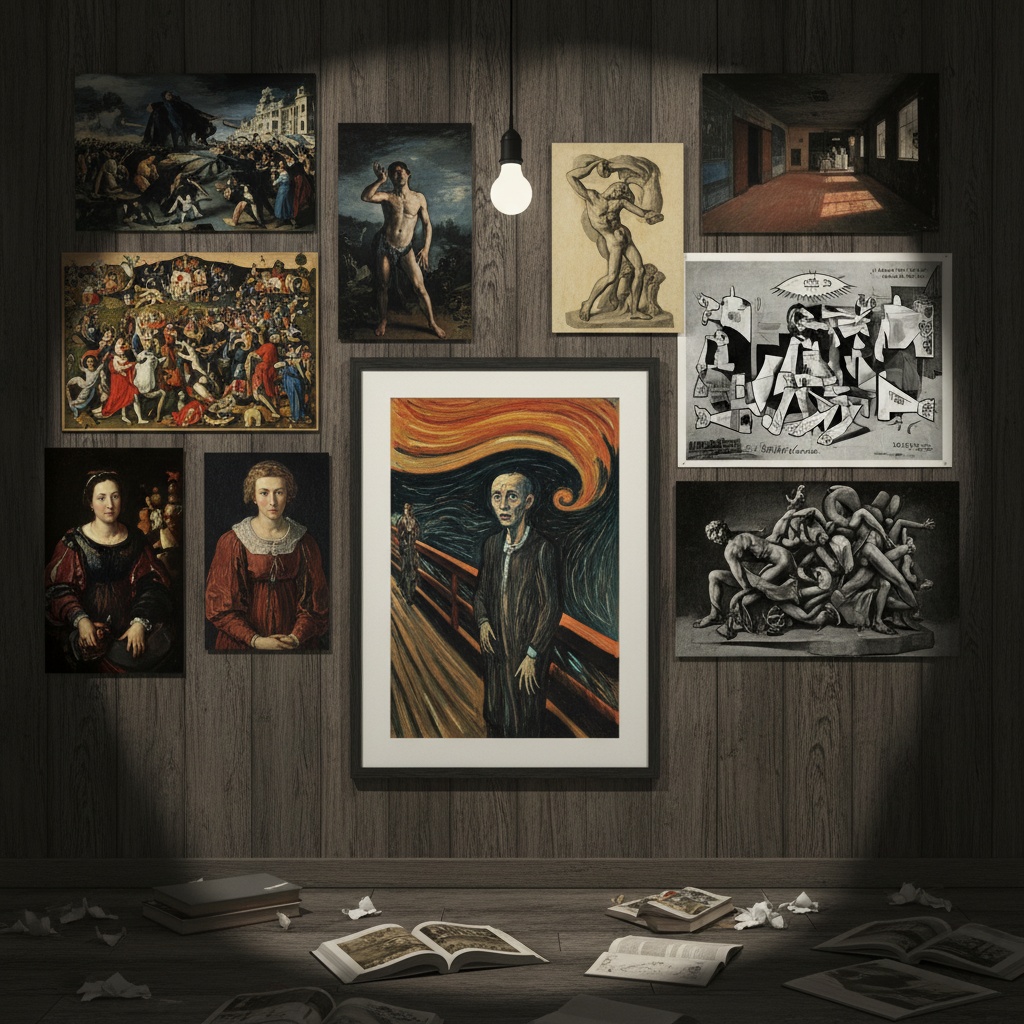
Art has always been a mirror reflecting humanity’s deepest experiences – joy, sorrow, peace, and, perhaps most powerfully, tension. It's in those moments of unease, of unresolved emotion, that art truly grips us, forcing introspection and sparking dialogue within our own souls. This collection, 'Top 10 Artworks That Evoke Deep “Tense” Emotions,' isn’t about beauty in the traditional sense; it’s about confronting the complexities of the human condition through visual storytelling.
Throughout history, artists have grappled with portraying difficult truths – societal anxieties, personal struggles, and existential questions. From the raw emotionality of Baroque painting to the psychological depths explored by Expressionists, art has served as a vessel for processing trauma, challenging norms, and expressing the inexpressible. The works we’ve selected span centuries and movements, originating from diverse cultural contexts—Renaissance Italy, 19th-century Scandinavia, post-war America—yet they share a common thread: an ability to unsettle, provoke, and linger long after you've turned away.
Why do these pieces continue to resonate so profoundly? Perhaps it’s because the emotions they depict are universal. The fear of mortality, the pain of loss, the weight of societal pressure—these are experiences that transcend time and geography. Moreover, these artworks often tap into a collective unconscious, reflecting shared anxieties and unspoken truths about our world. They remind us that we are not alone in our struggles, offering a space for empathy and understanding.
Prepare to embark on a journey through ten exceptional works, each chosen for its unique ability to evoke a sense of tension—a feeling that may be uncomfortable, challenging, or even disturbing. But it is within this discomfort that we find the greatest opportunities for growth, reflection, and connection with ourselves and the world around us. We invite you to approach these artworks with an open mind and heart, allowing their power to unfold and reveal its layers of meaning.
The Dance of Life - Edvard Munch
 The Dance of Life - Edvard Munch
Imagine a summer evening, the air thick with anticipation, music swirling and figures blurring into a vibrant dance against a darkening sea. This is the world of Edvard Munch’s “The Dance of Life” (1899), a painting that doesn't merely depict a social gathering but embodies the very pulse of human connection—and its inherent anxieties.
Munch, a pioneer of Expressionism, masterfully captures this tension through a symphony of color and movement. The woman in red, a beacon of passion, draws the eye amidst a sea of swirling forms. Her dress isn’t just fabric; it's a visual echo of life’s energy, contrasted by the somber tones surrounding her. The figures aren’t static portraits but fleeting impressions, suggesting the ephemeral nature of joy and intimacy.
What sets this work apart is its raw honesty. Inspired by Helge Rode’s play Dansen gaar , Munch explores love, loss, and the stages of life with unflinching vulnerability. The painting isn't simply beautiful; it’s a visceral experience—a reminder that even in moments of connection, there exists an undercurrent of melancholy.
“The Dance of Life” can elevate any space, inviting contemplation and sparking conversation. Its bold colors and dynamic composition offer a powerful focal point, while its underlying emotional depth encourages reflection on the complexities of our own relationships and experiences. It’s a piece that doesn't just decorate a wall; it resonates within the soul—a timeless exploration of what it means to be alive.
Street Scene in Berlin - Ernst Ludwig Kirchner
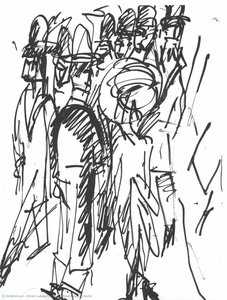 Street Scene in Berlin - Ernst Ludwig Kirchner
A restless energy pulses from the page—a city breathing, teeming with life and a subtle undercurrent of unease. Ernst Ludwig Kirchner’s 1914 Street Scene in Berlin isn't merely an image; it’s a visceral echo of pre-WWI anxieties, a masterpiece that continues to resonate with our own modern sense of alienation.
What sets this work apart is its raw immediacy. Kirchner doesn’t offer us polished realism but a fragmented, distorted view of Berlin life—a swirling mass of figures rendered in bold, expressive lines. The central figure, lost within the crowd, embodies our own vulnerability in an increasingly overwhelming world.
This sketch, deceptively simple in its execution, is a testament to Kirchner’s mastery of line and form. He captures not just what he *sees* but how it *feels* to be enveloped by the city's relentless energy. The stark contrast between black and white amplifies the dramatic tension, mirroring the social anxieties simmering beneath the surface.
“Street Scene in Berlin” can subtly elevate a modern space—a reminder of the beauty found within chaos. Its dynamic composition and expressive lines inspire a sense of movement and introspection, inviting us to contemplate our own place within the collective experience. It’s a piece that doesn't just decorate; it provokes, challenges, and ultimately, connects.
Portrait of Hans Frisch - Ernst Ludwig Kirchner
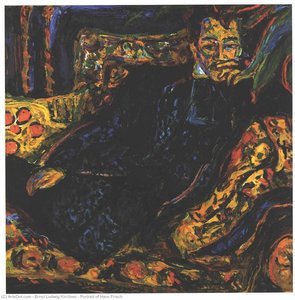 Portrait of Hans Frisch - Ernst Ludwig Kirchner
A gaze that holds a world of unspoken anxieties—Ernst Ludwig Kirchner’s “Portrait of Hans Frisch” (1917) isn't simply a likeness, but an excavation of the human psyche. Painted during a period of profound social upheaval following WWI, this work embodies the raw emotional intensity at the heart of German Expressionism.
Kirchner’s masterful use of color and texture transforms Frisch into something more than a subject; he becomes a vessel for our own inner turmoil. The swirling brushstrokes and bold palette—deep blues colliding with fiery yellows—create a sense of unease, mirroring the fractured state of the world around him.
What sets this portrait apart is its unflinching honesty. Kirchner doesn’t shy away from portraying discomfort; instead, he embraces it, inviting us to confront our own vulnerabilities. The thick impasto and distorted forms aren't flaws but deliberate choices that amplify the emotional weight of the piece.
“Portrait of Hans Frisch” can subtly infuse a modern space with a sense of depth and introspection. Its dynamic composition and expressive style inspire contemplation, reminding us that beauty often lies in imperfection—and that true connection requires embracing the complexities within ourselves and others. It’s a piece that doesn't just decorate; it resonates.
Self-Portrait - Joan Miró
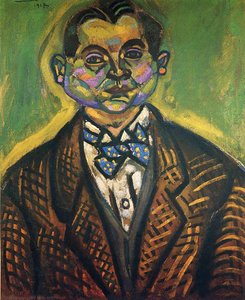 Self-Portrait - Joan Miró
Joan Miró’s 1917 “Self-Portrait” isn't a search for physical resemblance, but an audacious exploration of identity itself—a glimpse into the artist’s evolving psyche at a pivotal moment in modern art. This work transcends traditional portraiture, becoming a vibrant symbol of self-discovery and artistic rebellion.
What elevates this piece to our Top 10 is its fearless embrace of distortion and abstraction. Miró doesn't simply *show* us his face; he reveals the complexities beneath it through bold colors, thick impasto brushstrokes, and a deliberately unsettling composition. The stark green background amplifies the emotional intensity, creating a sense of isolation and introspection.
The unconventional palette—earthy browns colliding with vibrant blues and purples—isn’t arbitrary; it's a symbolic language that speaks to Miró’s inner world. This portrait invites us to question our own perceptions of selfhood, challenging the notion of a fixed identity.
“Self-Portrait” can subtly infuse a modern space with a sense of playful mystery and intellectual curiosity. Its dynamic composition and expressive style inspire contemplation, reminding us that true beauty often lies in imperfection—and that embracing our own complexities is essential to self-understanding. It’s a piece that doesn't just decorate; it provokes dialogue.
Black Fire I - Barnett Newman
 Black Fire I - Barnett Newman
There’s a quiet power in stillness—a sense of profound contemplation that emanates from Barnett Newman’s “Black Fire I” (1963). This monumental canvas isn't about what is *represented*, but rather what is *felt*. The stark division between black and beige, seemingly simple at first glance, unlocks a universe of emotion.
Newman’s work earns its place among the Top 10 for its radical simplicity and unwavering commitment to abstraction. He stripped away all extraneous elements, leaving only color and form—a testament to his belief that art could transcend representation and speak directly to the human soul. The subtle texture of the paint, meticulously applied, invites us closer, encouraging a deeper connection with the artwork.
“Black Fire I” evokes a sense of duality—darkness versus light, stillness versus movement—a tension that resonates deeply within us all. It’s a reminder that beauty can be found in the most unexpected places, and that sometimes, less truly is more.
At OriginalUniqueArt, we believe everyone deserves to experience the power of art firsthand. Our faithful reproductions capture not just the colors and forms of “Black Fire I,” but also the subtle texture and emotional weight of Newman’s original masterpiece—allowing you to bring this profound work into your own space and ignite a conversation within your home.
Torpedo los - Roy Lichtenstein
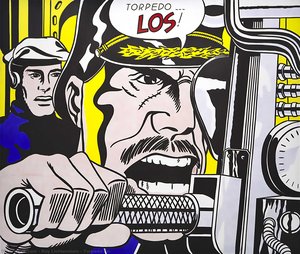 Torpedo los - Roy Lichtenstein
To encounter Roy Lichtenstein’s “Torpedo…Los!” (1963) is to step into a world of vibrant tension—a moment frozen in the dramatic narrative of Cold War anxieties. This isn't merely a painting; it’s an icon, a bold statement that redefined the boundaries between high art and popular culture.
Its inclusion among the Top 10 is testament to Lichtenstein’s revolutionary approach—his appropriation of comic book aesthetics, his meticulous technique, and his ability to distill complex emotions into striking visual form. The iconic Ben-Day dots aren't just a stylistic flourish; they are a commentary on mass production and the very nature of perception.
“Torpedo…Los!” evokes a sense of urgency and unease—a feeling heightened by its dynamic composition and bold color palette. It’s a work that doesn’t shy away from conflict, but rather confronts it head-on, inviting us to contemplate the complexities of heroism, technology, and the human condition.
This piece can subtly elevate a modern interior—a conversation starter that speaks to refined taste and intellectual curiosity. Its bold lines and vibrant colors add a touch of playful energy, while its underlying emotional depth invites contemplation and reflection. It’s a timeless work that continues to resonate with audiences today.
Dalí soft construction with boiled beans - premonition of civ - Salvador Dalí
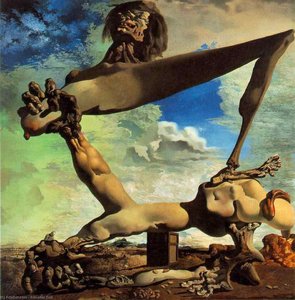 Dalí soft construction with boiled beans - premonition of civ - Salvador Dalí
A premonition rendered in flesh and bone—Salvador Dalí’s “Soft Construction with Boiled Beans - Premonition of Civil War” (1936) isn't simply a painting; it’s a visceral cry from the heart, a haunting vision of impending conflict. This masterpiece embodies the anxieties of a nation on the brink, translated into a surreal landscape of distorted forms and unsettling symbolism.
Its place among the Top 10 is earned through its profound emotional intelligence and groundbreaking approach to representation. Dalí doesn’t depict war directly; he evokes it—through fragmented bodies, looming shadows, and a chaotic composition that mirrors the disintegration of order.
The muted palette and dramatic lighting create a sense of unease, while the distorted figures invite contemplation on themes of vulnerability and power. “Soft Construction” isn’t merely unsettling; it's deeply human—a reminder of the fragility of peace and the enduring scars of conflict.
This piece can subtly infuse a modern space with a sense of mystery and intellectual depth. Its bold forms and evocative imagery inspire conversation, while its underlying emotional weight adds a layer of sophistication and intrigue. It’s a timeless work that continues to resonate with audiences today—a testament to the power of art to capture the darkest corners of the human experience.
The wedding - Fernand Léger
 The wedding - Fernand Léger
Imagine a moment suspended—a fractured glimpse into the complexities of human connection, rendered not with clarity but with deliberate discord. Fernand Léger’s “The Wedding” isn't a celebration in the traditional sense; it’s an exploration of intimacy and tension, captured through the lens of Cubist abstraction.
Its inclusion among the Top 10 stems from its profound emotional resonance and groundbreaking approach to form. Léger doesn’t simply depict figures; he deconstructs them—fragmenting bodies into geometric shapes that mirror the multifaceted nature of love, loss, and vulnerability.
The muted palette and dynamic composition evoke a sense of unease, while the layered forms invite contemplation on themes of memory, identity, and internal conflict. “The Wedding” isn’t merely unsettling; it's deeply human—a reminder that even in moments of joy, there exists an undercurrent of complexity.
This piece can subtly infuse a modern space with a sense of intellectual depth and quiet sophistication. Its bold forms and evocative imagery inspire conversation, while its underlying emotional weight adds a layer of intrigue. It’s a timeless work that continues to resonate with audiences today—a testament to the power of art to capture the nuances of the human experience.
Three Studies for Figures at the Base of a Crucifixion - Francis Bacon
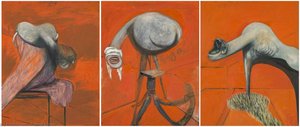 Three Studies for Figures at the Base of a Crucifixion - Francis Bacon
Born from the ashes of war, Francis Bacon’s “Three Studies for Figures at the Base of a Crucifixion” (1944) isn't merely a painting; it’s a raw, visceral scream—a confrontation with the darkest corners of human existence. The triptych embodies the existential angst of a generation scarred by conflict, rendered in distorted forms and unsettling imagery.
Its place among the Top 10 is earned through its profound historical influence and artistic mastery. Bacon doesn’t offer solace or beauty; he presents us with the grotesque—a fragmented reflection of our own primal instincts and vulnerabilities.
The vivid orange background creates a fiery, almost apocalyptic atmosphere, while the distorted figures evoke feelings of anguish, fury, and isolation. “Three Studies” isn't merely unsettling; it’s deeply human—a reminder that even in moments of peace, there exists an undercurrent of chaos.
This piece can subtly infuse a modern space with a sense of intellectual depth and quiet contemplation. Its bold forms and evocative imagery inspire conversation, while its underlying emotional weight adds a layer of intrigue. It’s a timeless work that continues to resonate with audiences today—a testament to the power of art to confront uncomfortable truths.
painting, 1946 - Francis Bacon
 painting, 1946 - Francis Bacon
A silence hangs heavy—a moment frozen in time within Francis Bacon’s “Painting, 1946,” a work that transcends mere representation to become an embodiment of existential dread. This masterpiece isn't simply seen; it is *felt*—a visceral response to the anxieties and uncertainties of a post-war world.
Its inclusion among the Top 10 stems from its unparalleled balance of beauty, emotion, and innovation. Bacon doesn’t shy away from the grotesque; he embraces it—transforming distorted forms into hauntingly beautiful expressions of human vulnerability.
The limited palette of deep reds, purples, and blacks creates a dramatic tension, while the textured surface amplifies emotional impact. “Painting, 1946” isn't merely unsettling; it’s deeply human—a reminder that even in moments of opulence, there exists an undercurrent of chaos.
This piece can subtly infuse a modern space with a sense of intellectual depth and quiet sophistication. Its bold forms and evocative imagery inspire conversation, while its underlying emotional weight adds a layer of intrigue. It’s a timeless work that continues to resonate with audiences today—a testament to the power of art to confront uncomfortable truths.
Conclusion
As the light fades, and these visions begin to recede—like echoes of a powerful dream—we are left with something more than just images on canvas. These ten masterpieces aren’t relics of history; they are living forces, breathing with the same raw emotion that compelled their creation centuries ago.
They remind us that beauty isn't always serene, and meaning often resides in the shadows—in the fractured lines, the distorted forms, the unspoken anxieties that connect us across generations. To gaze upon them is to confront our own vulnerabilities, to acknowledge the complexities of the human spirit, and to find solace in shared experience.
And perhaps most importantly, these artworks invite us to bring a touch of that profound emotion into our own lives—to curate spaces that resonate with meaning, to surround ourselves with beauty that challenges and inspires. If you’ve found yourself moved by this exploration of tense emotions in art, we invite you to discover even more within our full collection .
For at OriginalUniqueArt.com, we believe that every home deserves a touch of the extraordinary—a whisper of history, a surge of emotion, and a timeless connection to the human heart.