The Renaissance Awakening: Dissection and the Birth of Anatomical Art
The early Renaissance witnessed a profound shift in intellectual curiosity, a reawakening that extended its gaze to the very fabric of human existence. No longer content with inherited dogma, scholars and artists alike turned towards direct observation as the cornerstone of knowledge. This burgeoning spirit of inquiry found particularly fertile ground in the study of anatomy – the meticulous unraveling of the body’s intricate architecture. Prior to this period, anatomical understanding was largely based on Galenic texts, often filtered through centuries of interpretation and lacking empirical grounding. The practice of dissection, though occasionally undertaken in medieval universities, remained shrouded in taboo and limited in scope. The 15th and 16th centuries, however, saw a dramatic increase in the accessibility of cadavers, fueled by a growing demand for accurate representation in both art and medicine. This wasn’t merely about clinical precision; it was a quest to understand God's creation through its most complex manifestation – humankind.
Artists, traditionally trained in idealized forms derived from classical sculpture, found themselves increasingly drawn to the nuances of real human musculature and skeletal structure. Early examples demonstrate a tentative exploration, often blending observed details with established conventions. But as dissection became more commonplace, a new level of realism began to emerge. Figures gained weight, volume, and a sense of dynamic tension previously absent from artistic depictions. This wasn’t simply about replicating external appearances; it was about grasping the underlying mechanics that governed movement and expression. The desire for verisimilitude wasn't solely aesthetic—it reflected a deeper philosophical impulse: to capture the essence of human life itself.
Artists as Anatomists: Collaboration, Observation, and the Pursuit of Realism
Human anatomy (gr. ἀνατομία, "dissection", from ἀνά, "up", and τέμνειν, "cut") is primarily the scientific study of the morphology of the human body. Anatomy is subdivided into gross anatomy and microscopic anatomy. Gross anatomy (also called macrosc...
The relationship between artist and anatomist during the Renaissance was often symbiotic. Physicians required skilled draughtsmen to document their findings accurately, while artists sought expert guidance in understanding the complexities they encountered during dissection. This collaboration fostered a unique exchange of knowledge and technique. Artists like Leonardo da Vinci weren’t merely passive observers; they actively engaged with anatomical study, meticulously sketching muscles, bones, and organs with an almost scientific precision. His notebooks are replete with detailed drawings, annotated observations, and even explorations of the body's internal workings – testaments to his insatiable curiosity.
Matthias Grünewald’s ‘Forearm Study’ (1512) exemplifies this dedication to anatomical detail. The stark black and white drawing isn’t concerned with beauty or narrative; it is a focused exploration of tendons, bones, and the interplay of muscle fibers. Similarly, Leonardo da Vinci's preparatory sketches, featuring architectural studies alongside anatomical details, reveal a mind constantly seeking connections between form and function. This pursuit of realism wasn’t without its challenges. The ethical considerations surrounding dissection were significant, and artists often worked in secrecy or faced social disapproval. Yet, the desire to accurately represent the human body proved a powerful motivator.
Vesalius's 'De Humani Corporis Fabrica': A Revolutionary Visual Treatise
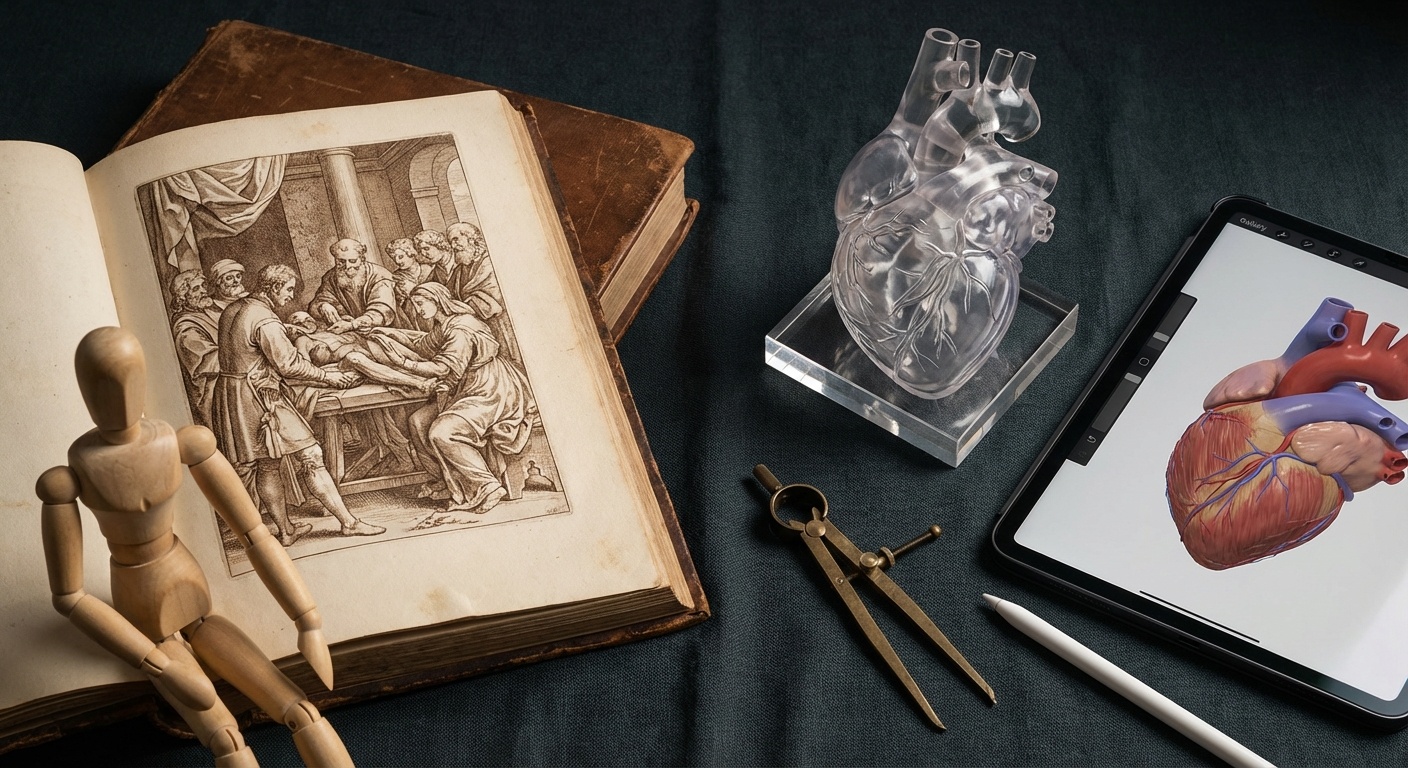
Andreas Vesalius’s ‘De Humani Corporis Fabrica’ (1543) stands as a monumental achievement in the history of both anatomy and art. This groundbreaking treatise wasn’t simply a collection of anatomical observations; it was a visually stunning work that revolutionized the field. Vesalius, a professor of surgery at Padua, challenged many of Galen's long-held assumptions through meticulous dissection and detailed illustration. The book’s impact stemmed not only from its scientific accuracy but also from its artistic quality. Vesalius employed skilled artists to create exquisitely rendered woodcuts that depicted the human body with unprecedented clarity and detail.
The illustrations in ‘De Humani Corporis Fabrica’ weren't merely functional diagrams; they were works of art in their own right, imbued with a sense of classical elegance and anatomical precision. The figures are often posed dramatically, reminiscent of ancient sculpture, yet grounded in the reality of observed anatomy. Vesalius understood the power of visual communication – that accurate representation was crucial for disseminating knowledge and challenging established beliefs. His work marked a turning point in medical illustration, establishing new standards for accuracy and artistic quality.
From Scientific Illustration to Artistic Expression: The Evolution of Anatomical Representation
Following Vesalius’s groundbreaking work, anatomical illustration continued to evolve as both a scientific discipline and an artistic practice. The 17th and 18th centuries saw the rise of detailed atlases and textbooks that aimed to provide comprehensive visual guides to human anatomy. Artists like Jean Cousin the Younger contributed significantly to this field, producing meticulously rendered illustrations for his father’s ‘Livre de Perspective,’ which also included anatomical studies. These works often emphasized clarity and precision, prioritizing scientific accuracy over artistic embellishment.
However, even within these more scientifically focused illustrations, a sense of artistry remained evident. The careful rendering of muscles, bones, and organs demonstrated a deep understanding of form and structure. Furthermore, artists continued to explore the aesthetic possibilities of anatomical representation, creating works that blended scientific accuracy with artistic expression. Arnould Eloi Gautier Dagoty’s idealized depictions of Apollo and Venus, for example, showcase his mastery of human musculature while also embodying classical ideals of beauty.
The Body in Modernity: Challenging Conventions and Exploring New Perspectives
The 19th and 20th centuries witnessed a radical shift in artistic representation, with movements like Realism challenging traditional conventions and exploring new perspectives on the human body. Artists began to question idealized forms, embracing imperfections and depicting the body with unflinching honesty. This period also saw advancements in medical imaging technologies – X-rays, MRIs, and CT scans – that provided artists with unprecedented access to the internal workings of the human form.
The exploration of anatomy wasn’t limited to traditional depictions of muscles and bones; it extended to the study of psychological states, emotional expression, and the body's vulnerability. Artists like Egon Schiele and Francis Bacon used distorted forms and visceral imagery to convey the complexities of human experience. This period also saw a renewed interest in the relationship between art and science, with artists collaborating with medical professionals to explore new ways of representing the body.
Anatomy’s Continued Influence: Contemporary Artists and the Human Form
Today, anatomy continues to exert a powerful influence on contemporary art. Artists are utilizing a wide range of techniques – from traditional painting and sculpture to digital media and performance art – to explore the human form in innovative ways. The legacy of Renaissance anatomists like Vesalius and da Vinci remains palpable, inspiring artists to delve deeper into the complexities of the body and its relationship to consciousness, identity, and mortality.
At OriginalUniqueArt, we celebrate this enduring fascination with the human form by offering high-quality reproductions of iconic anatomical illustrations and artworks. From Vesalius’s groundbreaking treatise to the masterpieces of Michelangelo and Leonardo da Vinci, our collection provides a window into the rich history of art and science. Whether you are an avid collector, a student of anatomy, or simply someone who appreciates the beauty of the human body, we invite you to explore our curated selection and discover the timeless allure of anatomical art. Explore High Renaissance Masterpieces and bring the legacy of these great artists into your home.