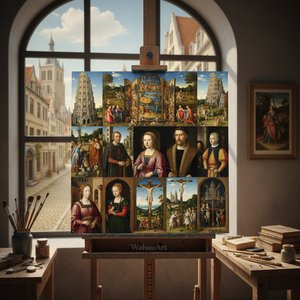
The Dawn of Detail: Defining the Early Netherlandish Renaissance
To step into the world of the Early Netherlandish Renaissance is to enter a realm where the boundaries between the divine and the terrestrial begin to dissolve through the sheer power of observation. Unlike the Italian Renaissance, which sought perfection through mathematical perspective and idealized human forms, the Northern masters—flourishing in the 15th and 16th centuries across regions such as Flanders and the Netherlands—found their transcendence in the microscopic. This was an era defined by a profound devotion to the tangible; a period where every wrinkle on a saint's brow, every glint of light on a brass ewer, and every thread of a velvet robe served as a testament to the glory of creation.
The movement emerged not from a desire to reinvent the human figure, but to honor it through an unprecedented level of empirical accuracy. Painters like Jan van Eyck and Jacob van Oostsanen did not merely paint scenes; they constructed windows into a world that felt palpably real. This meticulous approach to realism was deeply intertwined with the religious fervor of the age, as artists believed that by capturing the minute details of the natural world, they were, in essence, capturing the fingerprints of the Creator. It was a revolution of the eye, shifting the focus from the grand, sweeping gestures of the South to the quiet, breathtaking intimacy of the North.
The Alchemy of Oil: Revolutionary Techniques and the Mastery of Light
At the heart of this aesthetic revolution lay a technical breakthrough that would forever alter the course of Western art: the perfection of oil painting. While tempera had long been the standard, its rapid drying time and opaque nature limited the artist's ability to blend colors or create subtle transitions. The Northern masters, however, harnessed the slow-drying properties of linseed and walnut oils to achieve a level of luminosity previously thought impossible. Through the painstaking application of multiple translucent glazes, they were able to trap light within the layers of paint itself.
This technique, often referred to as glazing, allowed for a depth of color that seemed to glow from within. When light strikes a finished oil masterpiece from this era, it does not merely bounce off the surface; it penetrates the thin, pigment-rich layers, reflecting back through the depths of the work. This creates the breathtakingly realistic textures we observe in works like the Ghent Altarpiece—the cold sheen of polished metal, the soft matte of skin, and the heavy, light-absorbing weight of brocade. It was a true alchemy, transforming mere minerals and oils into a medium capable of simulating the very essence of light and atmosphere.
Symbolism in Every Stitch: Decoding the Hidden Narratives of Northern Art
To the untrained eye, an Early Netherlandish painting may appear to be a simple, hyper-realistic depiction of a domestic or religious scene. Yet, beneath this surface of extreme naturalism lies a complex, sophisticated language of symbols. In the Northern tradition, nothing is accidental. Every object placed within a composition carries a weight of theological or social meaning, turning every interior into a sacred text waiting to be read. This concept, often called "disguised symbolism," allows the artist to embed profound spiritual truths within the mundane objects of everyday life.
Consider, for instance, the iconic Portrait of Giovanni Arnolfini and his Wife. While we see a wealthy merchant and his spouse in a contemporary setting, the details speak of much more. A single burning candle in the chandelier may represent the presence of the divine; a small dog at their feet symbolizes fidelity; and even the fruit on the windowsill can allude to innocence or the Fall of Man. By weaving these narratives into the very fabric of the realistic environment, the artists invited the viewer into a state of meditative contemplation, where the act of looking closely became an act of prayerful discovery.
Jan van Eyck and the Pioneers: Portraits of Precision and Devotion
No discussion of this era is complete without acknowledging the titans who led the charge, most notably Jan van Eyck. His work represents the zenith of Northern precision, characterized by a level of detail so fine it demands the viewer's utmost attention. In the Ghent Altarpiece, his ability to depict a lively gathering of celestial and earthly figures showcases a mastery of both scale and intimacy. The textures are so vivid that one can almost feel the dampness of the air or the weight of the liturgical vestments.
< sculptured faces, heavy drapery, and the profound sense of presence in his portraits set a standard that would influence generations. These pioneers did not just paint people; they captured souls. Their portraits were not mere likenesses but psychological studies, where the subtle play of light on an eye or the slight tension in a lip revealed the character and status of the sitter. Through their devotion to the truth of the physical form, they achieved a timelessness that continues to captivate collectors and scholars alike.Legacy of Realism: The Enduring Influence of the Northern Masters
The legacy of the Early Netherlandish Renaissance extends far beyond the 15th century, leaving an indelible mark on the DNA of Western painting. The emphasis on texture, light, and the psychological depth of portraiture paved the way for the Dutch Golden Age and continues to resonate in the works of even the most modern realists. The tradition of finding the extraordinary within the ordinary remains one of the most powerful tools in an artist's repertoire, teaching us that beauty is not found only in the monumental, but in the smallest, most overlooked details of our existence.
Today, this passion for historical accuracy and aesthetic excellence lives on through those who seek to preserve and celebrate these masterpieces. At OriginalUniqueArt.com, we honor this enduring legacy by providing access to high-quality reproductions that capture the very spirit of the Old Masters. Whether through our meticulously handcrafted oil paintings—where artists apply multiple layers to replicate the original's depth—or our museum-grade Giclée prints, our mission is to bring the breathtaking realism of the Northern Renaissance into the modern home. We invite you to explore our vast library and discover how the light of the past can illuminate your present.