Early Life and Apprenticeship: The Foundations of a Sea Painter
 Wikipedia: John Wilson Carmichael
John Wilson Carmichael (9 June 1799 – 2 May 1868) was an English painter who specialised in marine art and landscape painting. Based in Newcastle upon Tyne and later in London, he was a household name in his lifetime, and his work remains some of the...
John Wilson Carmichael, born in the bustling shipbuilding district of Ouseburn, Newcastle upon Tyne in 1799, was inextricably linked to the sea from his earliest days. While biographical details remain somewhat elusive, it’s clear that the sights, sounds, and rhythms of maritime life profoundly shaped his artistic trajectory. Unlike many artists of his era who pursued formal academic training from a young age, Carmichael's path was initially practical. He spent three formative years aboard a transport vessel plying routes between Spain and Portugal, an experience that instilled in him not merely a familiarity with the ocean’s moods but a deep understanding of its mechanics – the way light played on waves, the structure of ships, and the sheer power of nature unleashed. This period wasn't simply about observation; it was immersion. Upon his return to Newcastle, he apprenticed himself to his father’s shipbuilding firm, honing skills in draftsmanship and spatial reasoning that would later prove invaluable in rendering accurate and compelling seascapes.
However, the allure of artistic expression proved too strong to resist. Carmichael dedicated every spare moment to drawing and painting, eventually transitioning into a drawing master and miniature painter. His early success with “The Fight Between the Shannon and Chesapeake” – selling for 13 guineas – signaled a burgeoning talent and a shift towards larger-scale historical works. Commissions followed, including depictions of Newcastle itself, demonstrating an ability to capture both the grandeur of maritime events and the specific character of his hometown. This period laid the groundwork for his future success, blending technical proficiency with a nascent artistic vision.
From Newcastle to London: Establishing a Reputation in Maritime Art
 John Wilson Carmichael
Explore the dramatic marine paintings of John Wilson Carmichael (1800-1868), a Victorian master known for his realistic seascapes & historical naval scenes. Discover hand-painted reproductions!
By 1831, Carmichael had already established himself as a significant presence within the Northern Academy of Arts, exhibiting eighteen works – fourteen landscapes among them. His collaborations with architect John Dobson during Newcastle’s redevelopment further solidified his position, producing paintings integrated into designs for key civic structures like Central Station and Grainger Market. These projects weren't merely illustrative; they showcased Carmichael’s ability to visualize and contribute to the evolving urban landscape. However, it was his move to London in 1846 that truly propelled him to national prominence.
London offered a wider audience and greater opportunities for commissions. He had already cultivated a reputation as a skilled maritime artist, but the capital’s art scene demanded more than just technical prowess; it required narrative strength and an ability to capture the public imagination. Carmichael rose to the challenge, securing prestigious assignments and gaining recognition for his detailed depictions of naval life. His work resonated with a Victorian audience fascinated by Britain's seafaring power and imperial ambitions.
The Power of Realism: Carmichael’s Depiction of the Sea and Naval Life
 Seascape -
John Wilson Carmichael’s ‘Seascape’ captures a dramatic maritime scene – turbulent waves, distant ships & a lone boat battling the elements. Commission a hand-painted replica today!
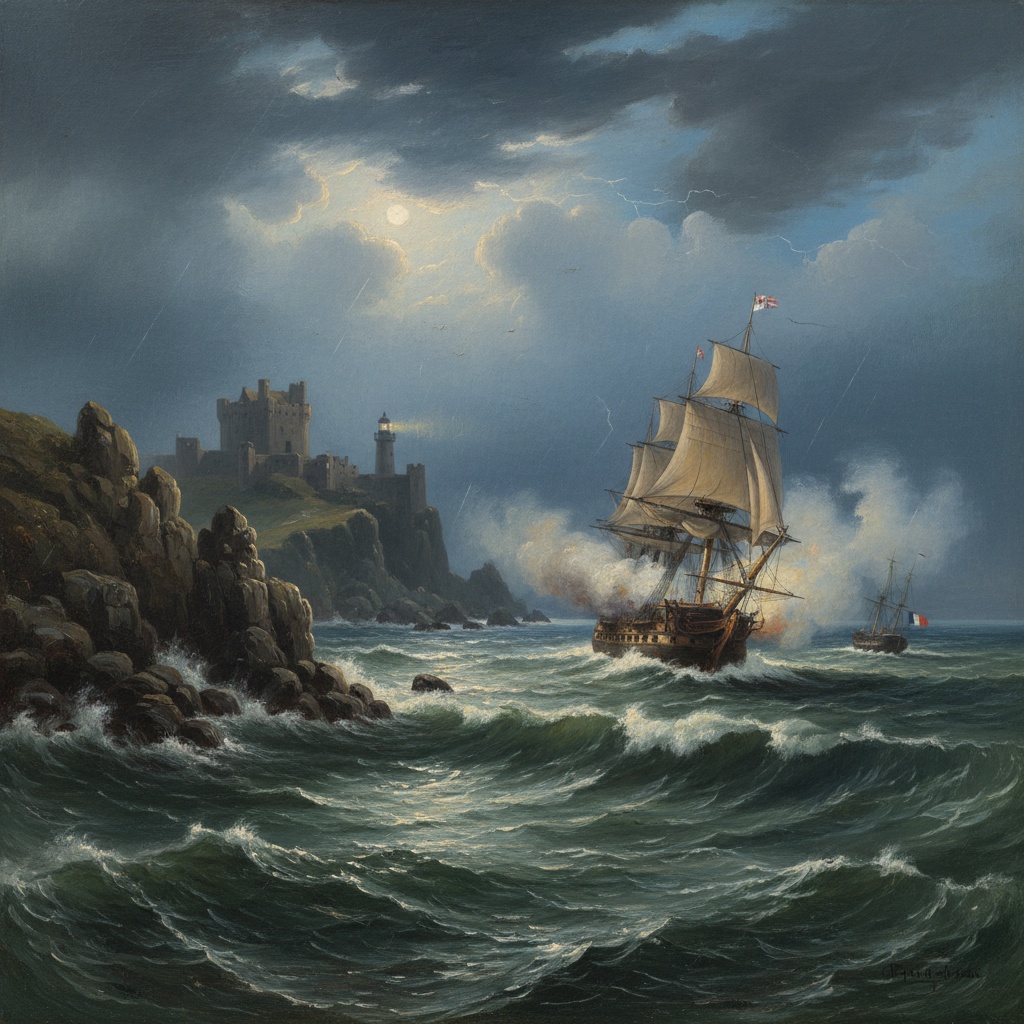
Carmichael distinguished himself through an unwavering commitment to realism. Unlike some contemporaries who prioritized romanticized visions, he sought to portray the sea as it *was* – turbulent, unpredictable, and often unforgiving. His paintings aren't simply pretty pictures; they are visceral experiences, conveying the raw energy of waves crashing against hulls, the spray of salt water on faces, and the sheer scale of naval vessels battling the elements. This dedication extended to meticulous research and accurate detailing. He didn’t merely paint ships; he understood their construction, rigging, and operation.
During the Crimean War, Carmichael was dispatched to the Baltic Sea to create drawings for the Illustrated London News. His resulting painting of the bombardment of Sveaborg – exhibited at the Royal Academy and now held by the National Maritime Museum – exemplifies his ability to capture dramatic historical events with striking immediacy. It wasn’t a sanitized depiction of warfare; it was a raw, unflinching portrayal of conflict on the high seas. This commitment to authenticity cemented his reputation as a leading marine painter of his time.
Carmichael's Technique and Style: A Precursor to Impressionist Approaches
Impressionism was a 19th-century art movement characterized by visible brush strokes, open composition, emphasis on accurate depiction of light in its changing qualities (often accentuating the effects of the passage of time), ordinary subject matter...
While firmly rooted in Victorian realism, Carmichael’s technique reveals subtle foreshadowings of later artistic movements, particularly Impressionism. His emphasis on capturing the fleeting effects of light – the way sunlight glinted off water, the shifting colors of the sky – aligns with the core principles of this emerging style. Although he didn't abandon traditional methods of layering and blending, his brushwork often possessed a looseness and spontaneity that anticipated the broken strokes favored by Impressionist painters.
Art historian Jeremy Maas aptly described him as “a sea painter of great, though sometimes uneven, natural talent.” This observation acknowledges both his exceptional skill and a willingness to experiment. His paintings aren’t characterized by the rigid precision of some academic artists; there's a vibrancy and energy in his application of paint that suggests a desire to capture not just *what* he saw but *how* it felt to be present at the scene. This sensitivity to atmosphere and light, combined with his realistic detailing, created a unique style that set him apart from his contemporaries.
National Identity and Coastal Scenes: Exploring Themes in Carmichael’s Work
 Salvaging the wreck off the scottish coast
Witness a dramatic Scottish coastal scene! 'Salvaging the Wreck' by John Wilson Carmichael – a stunning oil painting of a stormy sea & shipwrecks. Hand-painted reproductions available.
Carmichael's paintings weren’t simply depictions of ships and seascapes; they were often imbued with a strong sense of national identity. His naval scenes celebrated Britain’s maritime power, its imperial reach, and the bravery of its sailors. Works like “The Naval Review, Spithead” – a stunning portrayal of Victorian naval might – evoke a sense of pride and patriotism. However, his coastal scenes also reveal a deep appreciation for the beauty and ruggedness of the British coastline.
Paintings such as “Salvaging the Wreck off the Scottish Coast” capture the drama and resilience of coastal communities facing the perils of the sea. These works aren’t merely about shipwrecks; they are about human struggle, survival, and the enduring relationship between people and the ocean. He masterfully balanced dramatic action with a keen observation of natural phenomena, creating paintings that were both visually compelling and emotionally resonant.
Legacy and Rediscovery: The Enduring Appeal of a Victorian Master
John Wilson Carmichael enjoyed considerable success during his lifetime, earning “a good deal of money” from the sale of smaller paintings alongside larger commissions. He even authored instructional manuals on marine painting in both watercolors and oils, further solidifying his position as an authority in the field. However, after World War II, his work fell into relative obscurity. It wasn’t until the 1980s that a renewed appreciation for Victorian art – and Carmichael's contributions to it – began to emerge.
Today, John Wilson Carmichael is recognized as one of the leading marine painters of the 19th century. His paintings are highly sought after by collectors and museums alike, prized for their realism, dramatic composition, and evocative atmosphere. OriginalUniqueArt offers stunning hand-painted reproductions of his most iconic works, allowing art enthusiasts to experience the power and beauty of Carmichael’s vision firsthand. Whether you're drawn to the historical detail of “The Naval Review, Spithead” or the turbulent energy of “Salvaging the Wreck,” his paintings offer a captivating glimpse into a bygone era, reminding us of Britain’s seafaring past and the enduring allure of the ocean.