The Precursor: Boudin’s Early Life & Artistic Foundations
Eugène Louis Boudin, born in 1824 in the bustling port town of Honfleur, France, wasn't initially destined for a life wielding brush and palette. His early years were steeped in the maritime world – his father was a harbor pilot, and young Eugène spent formative time aboard steamboats plying the routes between Le Havre and Honfleur. This immersion in the sea’s ever-changing moods would prove to be profoundly influential, shaping not only the subject matter of his art but also its very essence. While he briefly followed in his father's footsteps, a burgeoning artistic sensibility drew him towards the world of painting. He apprenticed with local artists, opening a small shop selling paintings and frames, which served as a crucial early exposure to the works of Constant Troyon and Jean-François Millet – figures who would encourage his pursuit of a full-time artistic career. Boudin’s initial training was conventional, yet it was his inherent connection to the natural world, particularly the coastline he knew so intimately, that set him apart. He wasn't merely depicting scenes; he was capturing an experience, a feeling evoked by the sea and sky.
Plein Air Pioneer: Embracing the Ephemeral Effects of Light and Weather
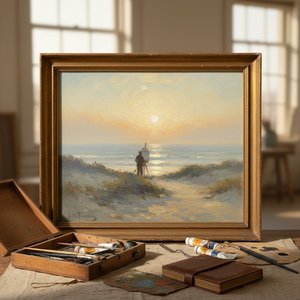
The mid-19th century art world was largely dominated by academic traditions – studio painting reigned supreme. Boudin, however, became one of the first French landscape painters to wholeheartedly embrace plein air painting—working directly outdoors, confronting the challenges of shifting light and atmospheric conditions. This wasn’t simply a matter of convenience; it was a radical shift in perspective. He recognized that capturing the true essence of a scene required being *in* the scene, observing its nuances firsthand. Influenced by Dutch 17th-century masters and, crucially, his friendship with Johan Jongkind, Boudin dedicated himself to rendering the fleeting moments of light on water and along the shores. This dedication wasn’t without difficulty; early paint technology limited portability, but Boudin persevered, developing a technique that prioritized immediacy and capturing the transient beauty of nature. His pastels, lauded by Baudelaire for their summary yet evocative power, became synonymous with this approach.
Trouville and Beyond: Capturing Seaside Leisure in an Evolving Style
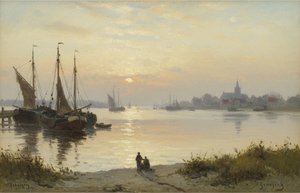
The seaside resort town of Trouville-sur-Mer became a central motif in Boudin’s oeuvre. Paintings like “Trouville” (1866) and “The Beach at Trouville” (1869) aren't simply depictions of a picturesque location; they are studies in atmosphere, capturing the rhythm of daily life – families strolling along the beach, boats bobbing on the waves, the subtle drama of a rainy day. His loose brushwork, increasingly evident during this period, wasn’t a lack of skill but rather a deliberate attempt to convey the *impression* of light and movement. He moved beyond precise detail, focusing instead on capturing the overall visual effect – the cool palette of a cloudy sky, the warmth of sunlight filtering through the mist. “Beach Scene, Villers” (1894) exemplifies this mature style, showcasing his ability to evoke a sense of place and time with remarkable economy and grace. These scenes weren’t idealized visions; they were honest portrayals of seaside leisure, reflecting the changing social landscape of 19th-century France.
A Mentor to Monet: Boudin's Profound Influence on Impressionism
Perhaps one of Boudin’s most significant contributions was his mentorship of a young Claude Monet. In the late 1850s, Monet, then a budding caricaturist, met Boudin and was profoundly impacted by his approach to landscape painting. Boudin actively encouraged Monet to abandon his earlier style and embrace plein air techniques, instilling in him a love for bright hues and the play of light on water. This wasn’t merely technical instruction; it was a philosophical shift – a move away from academic constraints towards a more direct engagement with nature. Monet later credited Boudin as being instrumental in his artistic development, acknowledging that he had learned “everything” from him. While Monet would ultimately become the most famous figure associated with Impressionism, Boudin’s influence is undeniable—he laid much of the groundwork for the movement's core principles.
The Essence of Atmosphere: Examining Boudin’s Brushwork & Color Palette
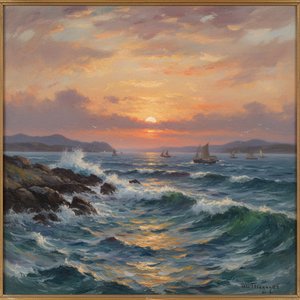
Boudin’s mastery lies in his ability to capture atmosphere. His brushwork is characteristically loose and expressive, prioritizing the overall impression over meticulous detail. He employed a technique of broken color – applying short strokes of pure, unmixed pigment that allowed light to play across the canvas, creating a vibrant and dynamic surface. His color palette, while often subdued, is remarkably nuanced—he skillfully used cool tones to depict overcast skies and warm hues to capture sunlight. This wasn’t about replicating colors exactly; it was about conveying the *feeling* of light and atmosphere. He understood that the sea and sky are constantly changing, and his paintings reflect this fluidity – a sense of movement and ephemerality is central to his work. The textures in his oil paintings aren't merely aesthetic choices; they’re integral to capturing the sensation of wind, waves, and the ever-present moisture in the air.
Boudin’s Legacy: A Lasting Impact on the Course of Modern Art
Eugène Boudin may not be as widely recognized as some of his Impressionist contemporaries, but his contribution to the development of modern art is immeasurable. He was a true pioneer, embracing plein air painting at a time when it was considered radical and paving the way for a new generation of artists who sought to capture the fleeting moments of light and atmosphere. His influence on Claude Monet alone secures his place in art history. Boudin’s work continues to resonate today, offering viewers a glimpse into the beauty of the natural world and a reminder of the power of observation. He wasn't simply painting landscapes; he was capturing an experience—a feeling evoked by the sea, sky, and the simple pleasures of life. Discover the timeless appeal of Eugène Boudin’s art at OriginalUniqueArt.com, where museum-quality reproductions bring his masterpieces to your home.