
Early Life and Artistic Foundations: Shaping a Scottish Vision
William McTaggart, born in the remote coastal village of Aros near Campbeltown in 1835, was inextricably linked to the rugged beauty of the Scottish landscape from his earliest days. The son of a crofter, he didn’t emerge from an established artistic lineage but rather from a deep connection to the land and sea – a heritage that would profoundly shape his aesthetic sensibility. This upbringing instilled in him not merely an appreciation for nature's grandeur, but a visceral understanding of its power, its transience, and its often-unforgiving character. His initial artistic training at the Trustees’ Academy in Edinburgh provided him with foundational skills, yet it was arguably his inherent sensitivity to light and color that truly distinguished him from his peers. While initially focused on figure painting, particularly scenes involving children, a yearning for something more expansive began to take root – a desire to capture the very essence of the Scottish coastline and its ever-changing moods.
The early works, though demonstrating technical proficiency, lacked the emotional resonance that would come to define his mature style. It was during this formative period that McTaggart began to recognize the limitations of studio work in conveying the true spirit of a place. He sought a more direct engagement with nature, foreshadowing his later embrace of plein air painting and a commitment to capturing fleeting moments of light and atmosphere.
The Embrace of Impressionism: Capturing Transient Light and Atmosphere
Impressionism was a 19th-century art movement characterized by visible brush strokes, open composition, emphasis on accurate depiction of light in its changing qualities (often accentuating the effects of the passage of time), ordinary subject matter...
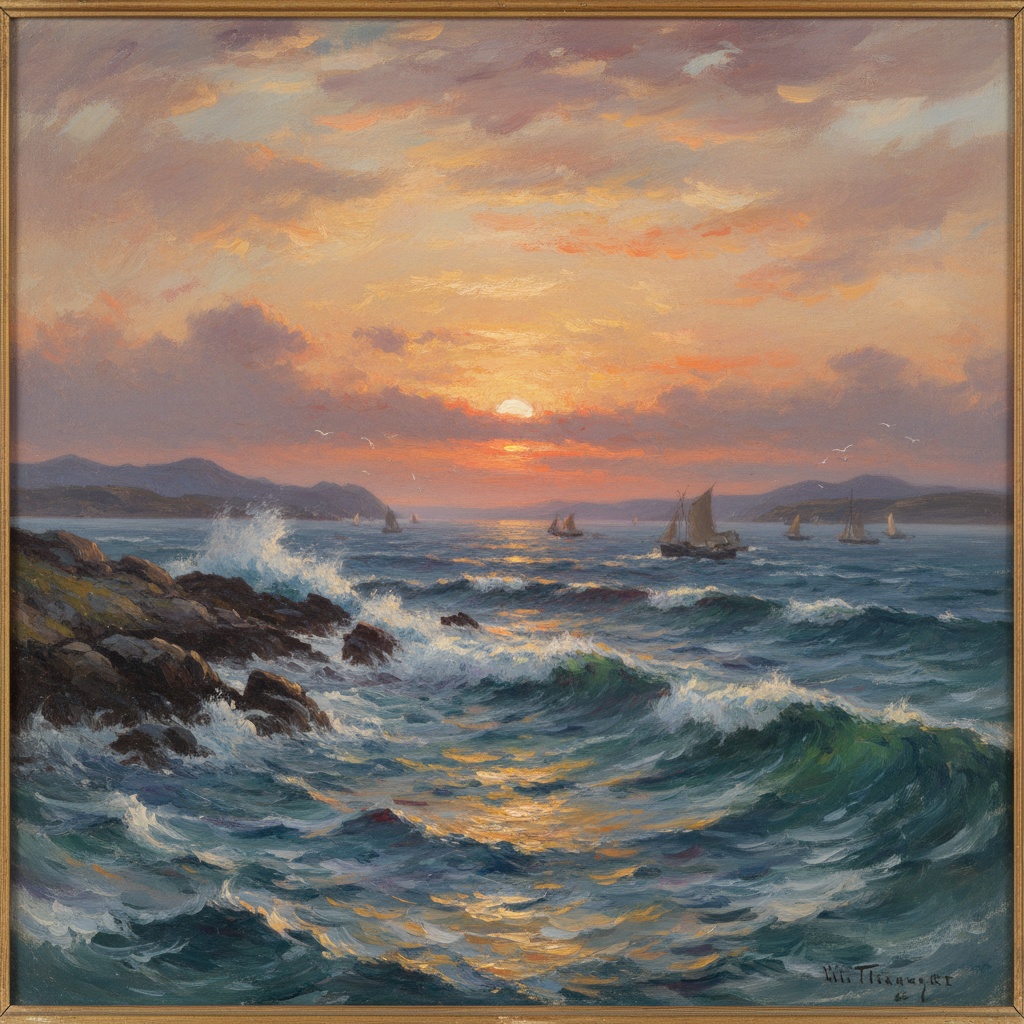
Though often labelled as the “Scottish Impressionist,” McTaggart’s relationship with the broader European movement was nuanced. He wasn't a direct follower of Monet or Renoir, but rather developed his own unique approach to capturing the effects of light – an approach deeply rooted in the specific qualities of the Scottish environment. Unlike the Parisian Impressionists who often focused on urban life and leisure, McTaggart turned his attention to the wilder aspects of nature: crashing waves, windswept beaches, and the dramatic skies over the Scottish countryside. He admired artists like J.M.W. Turner and John Constable, recognizing their ability to convey emotion through atmospheric effects, but he forged a path that was distinctly his own.
His canvases began to vibrate with color, employing bold brushstrokes and an increasingly liberated palette. This wasn’t simply about replicating what he *saw*, but rather conveying the *sensation* of being present in a particular landscape at a specific moment in time. The influence of Impressionism lay not in mimicking its techniques wholesale, but in adopting its core principle: prioritizing the accurate depiction of light and its transformative power. He strived to capture the ephemeral qualities of sunlight on water, the shifting hues of the sky, and the overall visual impression created by these fleeting effects.
Painting 'En Plein Air': McTaggart's Direct Engagement with the Landscape
En plein air (pronounced [ɑ̃ plɛ.n‿ɛʁ]; French for 'outdoors'), or plein-air painting, is the act of painting outdoors. This method contrasts with studio painting or academic rules that might create a predetermined look. The theory of 'En plein air' ...
Central to McTaggart’s artistic evolution was his adoption of en plein air painting – the practice of working directly from nature, outdoors. This wasn’t merely a technical shift; it represented a fundamental change in his approach to artmaking. By immersing himself in the landscape, he could better capture the nuances of light and atmosphere that were impossible to replicate in the studio. The invention of portable canvases and easels facilitated this practice, allowing him to work with greater freedom and spontaneity.
The challenges of painting outdoors – unpredictable weather, shifting light conditions, and the logistical difficulties of transporting materials – only served to heighten his sensitivity to the environment. He embraced these challenges, recognizing that they were integral to capturing the true essence of a place. This direct engagement with nature resulted in paintings that possessed an immediacy and vitality rarely found in studio works. The Barbizon School’s influence is evident here, but McTaggart pushed beyond their tonal qualities, embracing a brighter, more vibrant palette reflective of the Scottish light.
Themes and Motifs: Sea, Land, and the Human Connection to Nature
While McTaggart painted landscapes in both Kintyre and East Lothian, the sea remained a constant source of inspiration throughout his career. His seascapes are not merely depictions of waves and coastline; they are imbued with a sense of drama, power, and even spirituality. He often depicted scenes of fishermen at work, highlighting their connection to the natural world – a relationship characterized by both respect and vulnerability.
The Moorfoot Hills, visible from his house near Lasswade, also became a recurring motif in his later works. These landscapes are less overtly dramatic than his seascapes, but they possess a quiet intensity, capturing the subtle nuances of light and shadow across the rolling hills. Throughout his oeuvre, McTaggart explored themes of human connection to nature, often portraying figures as small and insignificant against the vastness of the landscape – emphasizing the power and enduring beauty of the natural world. His paintings are not simply representations of places; they are meditations on the relationship between humanity and the environment.
McTaggart’s Legacy and Influence on Scottish Art
William McTaggart is rightly regarded as one of the great interpreters of the Scottish landscape, a painter who captured its beauty, power, and emotional resonance with unparalleled sensitivity. His influence on subsequent generations of Scottish artists is undeniable. He helped to establish a distinctively Scottish brand of Impressionism – one that was rooted in the specific qualities of the local environment.
His work continues to captivate audiences today, offering a poetic vision of Scotland’s natural beauty. OriginalUniqueArt.com provides access to high-quality reproductions of McTaggart's masterpieces, allowing art lovers and collectors to experience his captivating paintings firsthand. From the dramatic seascapes to the quiet intensity of his landscapes, McTaggart’s work remains a testament to the power of observation, the beauty of light, and the enduring connection between humanity and nature.



