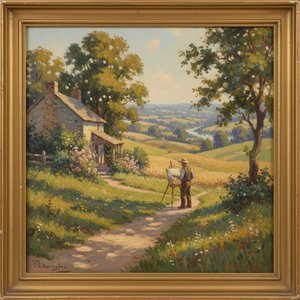
Early Life & Academic Foundations: The Genesis of an American Impressionist
The Belle Époque (French pronunciation: [bɛlepɔk]) or La Belle Époque (French for 'The Beautiful Era') was a period of French and European history that began after the end of the Franco-Prussian War in 1871 and continued until the outbreak of World W...
Charles Courtney Curran, a name perhaps less immediately recognizable than those of Monet or Cassatt, nevertheless occupies a significant and deeply charming corner within the landscape of American Impressionism. Born in Hartford, Kentucky, in 1861 – a year that echoed with the nascent tensions leading to the Civil War – his early life was marked by relocation and a burgeoning artistic sensibility. His father’s profession as a schoolteacher instilled a value for education, but it was the move to Sandusky, Ohio, nestled on the shores of Lake Erie, that truly began to shape Curran's visual world. The vastness of the lake, the changing seasons, and the everyday rhythms of rural life provided an initial wellspring of inspiration. While formal training commenced at the McMicken School in Cincinnati, a brief sojourn proved insufficient; the pull towards New York City’s burgeoning art scene was too strong.
At the National Academy of Design and the Art Students League, Curran immersed himself in the academic traditions of the time, studying under Walter Satterlee. His early works reflect this grounding – carefully composed scenes often featuring young women engaged in modest tasks. Yet even within these more conventional pieces, a lyrical quality emerges, hinting at the delicate touch and atmospheric sensitivity that would become hallmarks of his mature style. These initial explorations weren’t merely exercises in technique; they were the foundational steps towards capturing not just *what* he saw, but *how* it felt to see it – a crucial shift for an artist destined to embrace the Impressionist ethos.
Parisian Influences & the Embrace of Plein Air Painting
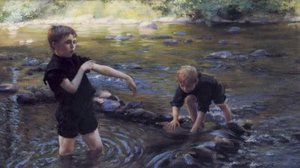 Cooling Off
Capture the joy of childhood with Charles Courtney Curran's 'Cooling Off.' This idyllic American Impressionist painting depicts boys playing by a stream – a timeless scene of nature and innocence.
Like so many aspiring American artists of his generation, Curran recognized Paris as the epicenter of artistic innovation. In 1889, he enrolled at the Académie Julian, a prestigious institution that offered a gateway to the latest trends in painting. It was here, amidst the vibrant energy of the French capital, that Curran truly began to absorb the principles of Impressionism and Symbolism. While he didn’t abandon his commitment to draftsmanship – a characteristic that distinguishes him from some of his more radical contemporaries – he wholeheartedly embraced the *en plein air* approach, taking his easel outdoors to capture the fleeting effects of light and atmosphere.
His Parisian canvases reveal this transformation: looser brushwork, a brighter palette, and a focus on modern women enjoying leisurely pursuits. Paintings like “In the Luxembourg (Garden)” (1889) demonstrate a newfound freedom in capturing movement and color. The experience wasn’t merely technical; it was a broadening of perspective, an understanding that art could be about capturing a moment's sensation rather than meticulous representation. His participation in the Paris Salons further solidified his presence on the international stage, signaling a growing confidence and artistic maturity.
The Cragsmoor Colony: A Sanctuary for Light and Leisure
Upon returning to the United States in the early 1890s, Curran found himself drawn to the idyllic beauty of Cragsmoor, New York. This small artists’ colony, nestled within the scenic Shawangunk Mountains approximately 100 miles northwest of New York City, would become his artistic sanctuary for the next four decades. The spectacular scenery – rolling hills, lush vegetation, and abundant sunlight – provided a constant source of inspiration. It was here that Curran developed the signature style for which he is best known: depictions of young women, often dressed in white or pastel colors, posed amidst vibrant landscapes.
Cragsmoor wasn’t simply a picturesque location; it fostered a sense of community and artistic exchange. Curran and his wife, Grace, became central figures within the colony, not only creating their own artwork but also teaching painting and editing the student art publication. The atmosphere encouraged experimentation and collaboration, allowing Curran to refine his techniques and explore new approaches to capturing light and color. This period marked a shift towards a more personal and poetic vision of American Impressionism.
Curran’s Signature Style: Women, Landscapes, and the Pursuit of Serenity
Charles Courtney Curran's artistic voice is most powerfully expressed in his paintings of women within natural settings. These are not portraits in the traditional sense; rather, they are idealized representations of youth, contemplation, and serenity. His subjects – often young girls dressed in flowing white garments – seem to exist in a dreamlike state, bathed in golden sunlight and surrounded by wildflowers. Paintings such as “On the Heights” (1909) and “Sunshine and Haze” (1915) exemplify this aesthetic. The women are not passive figures; they possess an inner dignity and intelligence, suggesting a quiet strength and independence.
Curran’s masterful use of light is central to the emotional impact of his work. He skillfully captures the subtle nuances of sunlight filtering through trees, illuminating skin tones, and creating a sense of warmth and tranquility. His brushwork is loose yet precise, conveying both texture and atmosphere. The landscapes themselves are not merely backdrops; they are integral components of the composition, contributing to the overall mood of peaceful contemplation. He wasn’t simply painting *pictures* of women in nature; he was evoking a feeling – a sense of escape, innocence, and the beauty of the natural world.
Legacy and Lasting Influence: Curran's Place in American Art History
While Charles Courtney Curran may not enjoy the same level of widespread recognition as some of his more avant-garde contemporaries, his work holds a unique and enduring appeal. He remained committed to an art of clarity, harmony, and quietude throughout his career, refusing to embrace the radical styles that emerged after World War I. This steadfast dedication to his vision resulted in a body of work characterized by its consistent quality and emotional resonance.
Curran’s paintings were widely exhibited during his lifetime, earning him numerous accolades and establishing him as a respected figure within the American art world. His legacy extends beyond his own artwork; he played an important role in fostering artistic communities and mentoring young painters. Today, his canvases continue to captivate audiences with their serene beauty and timeless elegance. OriginalUniqueArt offers a curated selection of Curran’s masterpieces, allowing you to experience the luminous vision of this remarkable American Impressionist firsthand. Explore our collection and discover the enduring power of his art – a testament to the pursuit of serenity in an ever-changing world.