Contemporary Art · 1985
People (Yi Eungro, 1985)
Yi Eungro (1904–1989) made People. It dates from 1985. It belongs to the Contemporary Art movement. It is made in ink on paper. It is kept at Lee Ungno Museum in Daegu, South Korea. It measures 268 × 223 cm (105.5 × 87.8 in).
- 1985
- Ink On Paper
- 268 × 223 cm (105.5 × 87.8 in)
- Lee Ungno Museum, Daegu

 Preview

 Hand Made Oil Painting
 Send
 Share
 Fact sheet


 Download
 Similars
 X-Ray
 Diaporama
 Q&A

 Stats
People, in brief
- Title
- People
- Artist
- Yi Eungro (1904–1989)
- Artist born in
- Seoul, South Korea
- Date
- 1985
- Medium
- Ink On Paper
- Dimensions
- 268 × 223 cm (105.5 × 87.8 in)
- Where to see it
- Lee Ungno Museum, Daegu, South Korea
- Movement
- Contemporary Art
- Period
- Modern
- Subject
- people, silhouettes, human figures, abstract ink, movement, crowd painting
What does People depict?
The Pulse of Humanity: A Symphony of Silhouettes
In the vast, evocative expanse of Yi Eungro’s 1985 masterpiece, "People," we are invited into a profound meditation on the collective human experience. This monumental work, measuring an imposing 268 x 223 cm, transcends mere portraiture to capture the very essence of movement and existence. Through a mesmerizing array of silhouettes, the artist orchestrates a dance of shadows that feels both deeply personal and universally shared. Each figure, though stripped of individual facial features, possesses a distinct vitality; some appear caught in mid-stride, while others linger in moments of quiet contemplation. The composition breathes with a rhythmic energy, as if the paper itself is vibrating with the silent whispers of a crowd gathered in a timeless, ethereal space.
The technique employed in "People" is a masterful bridge between Eastern tradition and Western abstraction. Utilizing the delicate yet powerful medium of ink on paper, Yi Eungro utilizes the fluid properties of the ink to create varying depths of tone. This creates a sense of atmospheric perspective where certain figures emerge from the void with striking clarity, while others recede into a misty, dreamlike background. The stark contrast of the black and white palette strips away the distractions of color, forcing the viewer to focus on the raw geometry of form and the emotional weight of the silhouettes. It is a sophisticated interplay of light and shadow that demands attention, making it an extraordinary focal point for any curated collection or high-end interior space.
A Legacy of Modernity and Emotion
To understand the profound impact of this work, one must look to the life of Yi Eungro himself. A pioneer who navigated the complex intersection of Korean heritage and French modernism, his journey was one of constant evolution. Having mastered the classical "four gentlemen" style of Korean inkwash painting, he eventually sought to modernize these traditions, infusing them with the expressive freedom of Western abstraction. "People" stands as a testament to this late-career mastery, where the calligraphic precision of his youth meets a mature, soulful exploration of social connectivity. The piece does not merely depict individuals; it symbolizes the interconnectedness of humanity, reflecting a world that is simultaneously fragmented and unified.
For the discerning collector or interior designer, a reproduction of "People" offers more than just aesthetic beauty; it brings an intellectual and emotional depth to a room. The artwork’s large-scale presence and dynamic composition provide a sense of movement that can transform a static environment into one of inspiration and thought. Whether placed in a minimalist contemporary gallery setting or as a sophisticated anchor in a grand living space, the painting serves as a window into the human soul. It invites onlookers to pause, to observe the dance of the shadows, and to find their own reflection within the beautiful, swirling crowd of Yi Eungro’s vision.
Which museum holds People?
Lee Ungno Museum
Daegu, South Korea
A Symphony of Ink and Modernity: The Legacy of Lee Ungno In the heart of Daejeon’s cultural landscape, the Lee Ungno Museum stands as a profound testament to the transformative power of artistic vision. This institution serves as a bridge between eras, offering a rare glimpse into the soul of a man who successfully synthesized the meditative weight of Eastern ink wash painting with the bold, experimental frontiers of Western modernism. To step into this museum is to enter a space where the ancient traditions of Korean calligraphy meet the electric energy of European abstract expressionism, creating a dialogue that resonates across generations.
High-resolution images of People

Protected by copyright: these files are for personal reference, not a licence to republish.
Yi Eungro, People (1985).
Yi Eungro (1904–1989), People, 1985, ink on paper, Lee Ungno Museum, Daegu, South Korea. Image: OriginalUniqueArt.com.
Questions on People, answered
Where is "People" by Yi Eungro on display today?
"People" by Yi Eungro is on display at the Lee Ungno Museum, Daegu, South Korea. The museum listing refers to the original work, not to reproductions.
What is "People" made with?
What size is "People" by Yi Eungro in real life?
What is "People" about?
Is "People" free of copyright?
Which artist is "People" attributed to?
What art movement does "People" by Yi Eungro belong to?
"People" is a work of Contemporary Art. The movement indicates the artistic tradition the work is part of.
About the artist, Yi Eungro

1904–1989, South Korea
Yi Eungro
**early life and training** lee ungno, also known as yi eungro, was a korean-born french painter and printmaker born in séoul, south korea in 1904. his early life was marked by a brief stint at the hongseong botong hakyo (홍성보통학교, 홍城초등학교, 洪城普通學校), after which he dedicated himself to studying painting under yeomjae song tae-hoe from 1920. **artistic career in korea and japan** lee ungno's artistic career began in earnest when he moved to seoul in 1922, becoming an apprentice to celebrated calligrapher-painter-photographer haegang kim gyu-jin. he primarily learned to paint the four gentlemen in the 'haegang style.' notably, his inkwash painting of a bamboo, mukjuk (묵죽, 墨竹, ink bamboo), won a prize in the 3rd annual joseon art exhibition.
Also by Yi Eungro
 Untitled1969
 Composition1970
 I Ching 64 Hexagrams Sequence (火風鼎)1974
 The travels of Marco Polo Series1980
Essays around People
 Spontaneity and Matter: Distinguishing CoBrA from Art InformelJean Dubuffet mixed sand, tar, and gravel into his 1947 works to create sculptural surfaces. Why did post-war artists reject traditional or…
 25 Masterpieces by Egon Schiele: The Raw Power of Expressionism1890s Vienna was a city caught between decadent splendor and the shadows of a fractured era. How did Schiele use jagged lines to map the so…
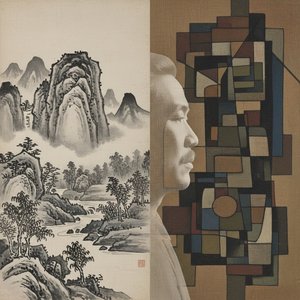 Yi Eungro: Bridging East & West in the Landscape of Korean ModernismExplore the captivating world of Yi Eungro (Lee Ungno), a pivotal figure in Korean modernism. Discover his unique fusion of Eastern and Wes…