Preview
 Send
Send Share
Share
 Details
 Guide
Guide

 Download
 Similars
 X-Ray
X-Ray Diaporama
 Stats
StatsKatharina


 Read More
Giclée / Art Print
Museum-quality giclée or canvas print with fast production and flexible finish options. ( Buy Hand Made Painting Switch to Digital Image)




P118B $10

P118H $10

P118W $10

P438Z $10

P508JH $12

P508YH $12

P805H $10

P805Z $10

P919BZ $10

P919G $10

P919XJ $10

P959ZH $10

P968JZ $12

W106C $8

W218G $10

W218JH $8

W218Y $10

W307PJ $10

W316G $10

W316PJ $8

W316Y $10

W398PJ $8

W4111J $10

W500HY $15

W500JH $15

W692G $12

W849H $8

W940BG $15

W953PJ $8




Pick from our preset sizes that match the artwork's original proportions.

Type the width and the height you need, to fit your frame or your wall. A print can only be cut, never made bigger than the picture, so a size with a different shape loses a part of the image. We send you a digital mockup to approve before we print anything. The picture shown on this page does not show the real cut — only the mockup does.
Worldwide Delivery () in 2 weeks instead of standard 4/5 weeks. (22 October)

Free Worldwide Express Shipping

High-Quality Linen Canvas

Full Shipping Insurance

Customs Tax Refund Guarantee

True Color Matching Guarantee

100-Day Return Policy (Defects Only)

100% Money-Back Guarantee

Bulk Discount Offer
 Glass option is only available in size under 110 CM

Katharina
Giclée / Art Print
Reproduction Size
-


Total Price
$ 81
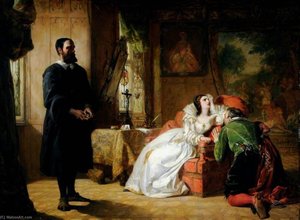
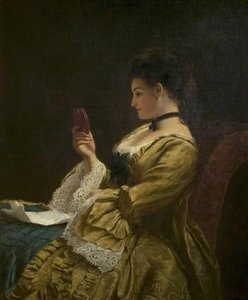
A Portrait of Melancholy: William Powell Frith’s “Katharina”
William Powell Frith's "Katharina," painted circa 1851, is more than just a portrait; it’s a carefully constructed tableau of Victorian theatricality and subtle emotional depth. This captivating work, housed within the collections of the University of Cambridge, offers a glimpse into the social fabric of mid-19th century London through the eyes of one enigmatic figure. Frith, a master of genre painting and panoramic narrative scenes, meticulously crafted this image to capture not just likeness but also atmosphere and implied story.
The subject herself is shrouded in an air of quiet contemplation. Dressed in a lavish, yet somewhat faded, theatrical costume—a rich crimson gown adorned with intricate lace and a delicate veil—Katharina appears poised on the cusp of performance or perhaps, simply lost in her own thoughts. Her gaze, directed slightly downward, suggests introspection rather than outward engagement. The lighting, soft and diffused, is crucial to the painting’s effect; it avoids harsh contrasts, instead creating subtle shadows that define the contours of her face and clothing, lending a sense of both vulnerability and dignity.
The Romantic Palette and Precise Technique
Frith's masterful command of oil paint is immediately apparent. He employs a rich, layered technique, building up color gradually to achieve remarkable textural detail. The fabric of the gown appears almost tactile—one can practically feel the weight of the velvet and the delicate rustle of the lace. The artist’s use of line is equally deliberate; precise outlines define the figure's features and drapery, creating a sense of solidity and volume that anchors the composition. Notice how he uses short, broken brushstrokes to capture the shimmer of light on the fabric and the intricate details of the veil.
The background, deliberately blurred and indistinct, serves not as a distraction but as an integral part of the painting’s narrative. It hints at an outdoor setting—perhaps a stage or garden—but ultimately emphasizes the central figure. The atmospheric perspective – the subtle fading of colors in the distance – adds depth without overwhelming the viewer's attention.
A Victorian Stage and Symbolic Resonance
"Katharina" is deeply rooted in the conventions of Victorian theatricality, reflecting Frith’s fascination with public life and social rituals. The costume itself is laden with symbolic meaning; it speaks to the world of performance, role-playing, and the constructed identities that were prevalent within Victorian society. The melancholic expression on Katharina's face suggests a deeper emotional complexity beneath the surface – perhaps a longing for something unattainable or a recognition of the transient nature of beauty and fame.
Considering Frith’s broader artistic output, “Katharina” aligns with his penchant for depicting scenes of social interaction and moral commentary. His meticulous attention to detail and his ability to capture both the outward appearance and the underlying emotions of his subjects make this painting a compelling example of Victorian genre art. It invites us to contemplate not only the beauty of the portrait but also the broader cultural context in which it was created.
Further Exploration & Legacy
For those seeking deeper insights into Frith’s work and “Katharina,” resources such as the Art UK website (
Questions & Answers
Is "Katharina" more bright or more dark overall?
The recorded values for "Katharina" by William Powell Frith are: shadow brightness, dark luminance.
Is "Katharina" by William Powell Frith in the public domain?
"Katharina" by William Powell Frith is in the public domain - its copyright has expired. This status governs how the image of the work may be reproduced.
What space is suggested for "Katharina" by William Powell Frith?
The recommended space for "Katharina" by William Powell Frith is a living room. The suggestion can of course be adapted to your interior.
Artist Biography
Early Life and Training
- Born: January 9, 1819, Aldfield, near Ripon, North Yorkshire, England
- Died: November 2, 1909, London
- William Powell Frith’s father was a hotelier in Harrogate.
- He initially intended to be an auctioneer but his father recognized his artistic talent.
- Frith studied at Sass's Academy in Charlotte Street, London and later attended the Royal Academy Schools.
- Early career focused on portrait painting and literary subjects (Shakespeare, Scott).
Career Highlights and Artistic Style
- Membership: Member of The Clique, a group of artists including Richard Dadd, Augustus Egg, Henry O’Neil, John Phillip, Edward Ward, and Thomas Creswick.
- Influences: Heavily influenced by Sir David Wilkie's domestic subjects.
- Genre Painting & Panoramic Narrative: Frith became renowned for his detailed genre scenes and panoramic narrative works depicting Victorian life in public places.
- Notable Works:
- Ramsgate Sands (1854): Depicts a lively scene at the seaside resort of Ramsgate.
- The Derby Day (1858): Captures the atmosphere and social interactions at Epsom Downs Racecourse. This painting was incredibly popular, requiring railings to manage crowds viewing it.
- The Railway Station (1862): A detailed depiction of Paddington Station.
- The Sleeping Model (1853): Presented as his Diploma work at the Royal Academy.
- The Crossing Sweeper (1858): Explores the contrast between wealth and poverty in London.
- Photographic Influence: Frith utilized photographic studies by Robert Howlett to achieve remarkable detail and accuracy in his paintings, particularly in works like The Derby Day.
- Style: Characterized by meticulous observation, a large number of figures, and a focus on capturing the details of everyday life. He was known for his realism and attention to social commentary within his scenes.
Development and Later Years
- Autobiographies: Frith wrote two autobiographies, My Autobiography (1887) and Further Reminiscences (1888), providing insights into Victorian art and society.
- Artistic Views: He was a traditionalist and expressed his aversion to modern art developments.
- Royal Academician: Elected as a Royal Academician in 1853.
- Longevity: Frith lived a remarkably long life, witnessing significant changes in the art world during the Victorian era. He outlived many of his contemporaries from The Clique.
Historical Significance and Legacy
- Social Commentary: His paintings provided valuable documentation of Victorian society, capturing its social dynamics, fashion, and leisure activities.
- Popularity & Commercial Success: Frith was one of the most commercially successful artists of his time, with his works widely admired and sought after.
- Influence on Genre Painting: He significantly contributed to the development of genre painting in Britain, elevating it to a respected art form.
- Detailed Realism: His meticulous attention to detail set a standard for realism in Victorian art.
- Legacy: Frith’s paintings continue to be exhibited and studied, offering a unique window into 19th-century life and solidifying his place as a significant figure in British art history.

William Powell Frith
1819 - 1909 , United Kingdom
Quick Facts
- Full Name: William Powell Frith
- Nationality: English
- Date Of Birth: 1819
- Date Of Death: 1909
- Place Of Birth: Aldfield, United Kingdom
- Notable Artworks:
- Ramsgate Sands (Life at the Seaside)
- The Derby Day
- The Railway Station
- The Sleeping Model
- The Crossing Sweeper
- Artistic Movement Or Style: Genre painting, panoramic narrative
- Artists Who Influenced This Artist: ['Sir David Wilkie']
Related Articles

19th Century Masterpieces: 10 Paintings That Defined an Era | OriginalUniqueArt
Journey through 19th century art with OriginalUniqueArt! Explore 10 iconic paintings – from Monet & Renoir to Courbet – and discover the stories behind Romanticism, Realism & Impressionism. Find museum-quality reproductions for your home decor. Explore the full collection online!
R.A. Benjamin Williams: Victorian Genre Painting & Social Commentary
Explore the captivating world of Benjamin Williams Leader's Victorian genre paintings. Discover his mastery of naturalism, social commentary & lasting influence on British art. Expert insights at OriginalUniqueArt.

William Powell Frith: Narratives of Victorian Society & the Rise of Realist Painting
Explore the life & works of William Powell Frith, the 'greatest British painter of social scenes.' Discover his iconic Victorian genre paintings and learn about his lasting impact on realist art. Hand-painted reproductions available.

Romantic Realism's Finest: 10 Masterpieces for Your Home | OriginalUniqueArt
Explore 10 defining masterpieces of Romantic Realism! Discover Courbet, Millet & Daumier's powerful paintings—capturing emotion and social realities. Find museum-quality reproductions for your home at OriginalUniqueArt.com.

William Salter: A Life Immersed in Colour – Victorian Botanical Art & Social Vision
Explore the life & art of William Salter (1804-1875), a Victorian master renowned for his botanical illustrations and striking portraits. Discover his social vision & legacy at OriginalUniqueArt.