
 Preview
 Send
Send Share
Share
 Details
 Guide
Guide

 Download
 Similars
 X-Ray
X-Ray Diaporama
 Stats
StatsConflict


 Read More
The artwork displayed on this page is protected by copyright law, which means we cannot legally create or sell an identical reproduction. This protection is enforced under international agreements such as the Berne Convention and by national laws, including those outlined by the U.S. Copyright Law - Title 17.
This method fully complies with copyright regulations because it does not involve copying or duplicating the protected artwork. Instead, it is a creative reinterpretation - a new painting that is influenced by the original but not identical to it.
Giclée / Art Print
Museum-quality giclée or canvas print with fast production and flexible finish options. ( Buy Hand Made Painting Switch to Digital Image)




































Pick from our preset sizes that match the artwork's original proportions.

Type the width and the height you need, to fit your frame or your wall. A print can only be cut, never made bigger than the picture, so a size with a different shape loses a part of the image. We send you a digital mockup to approve before we print anything. The picture shown on this page does not show the real cut — only the mockup does.
Worldwide Delivery () in 2 weeks instead of standard 4/5 weeks. (22 October)

Free Worldwide Express Shipping

High-Quality Linen Canvas

Full Shipping Insurance

Customs Tax Refund Guarantee

True Color Matching Guarantee

100-Day Return Policy (Defects Only)

100% Money-Back Guarantee

Bulk Discount Offer
 Glass option is only available in size under 110 CM

Conflict
Giclée / Art Print
Reproduction Size
-


Total Price
$ 81
Artistic Style and Technique
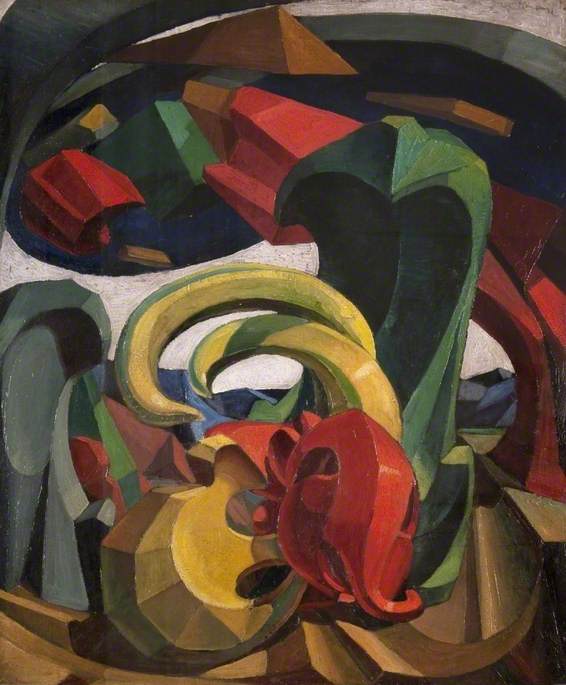
The painting features a colorful and intricate composition, with various shapes and colors that create an interesting visual experience for viewers. The main focus of the painting appears to be on a red bird or animal figure, which is surrounded by other geometric shapes and patterns. This style is reminiscent of other artists, such as Kazimir Severinovich Malevich, who was known for his contributions to the Cubism movement. For example, Malevich's painting The Triumph of Heaven can be found on OriginalUniqueArt.com.Historical Context and Significance
The Conflict painting can be seen as a representation of the turmoil and upheaval of the early 20th century. The use of bold colors and geometric shapes creates a sense of tension and conflict, which is reflective of the artistic and cultural movements of the time. Other artists, such as Sir George Clausen, also explored themes of loss and grief in their work, as seen in his painting Youth Mourning, which can be found on OriginalUniqueArt.com.- The painting is a significant example of modern art and its ability to evoke emotions and spark conversation.
- The use of oil on canvas creates a rich and vibrant texture that adds depth to the overall composition.
- The Glasgow Museums Resource Centre is home to a diverse collection of artworks, including pieces by other notable artists such as Eugène Delacroix.
The Conflict painting by William Mccance is a captivating and thought-provoking artwork that showcases the artist's unique style and technique. As a handmade oil painting reproduction, it can be found on OriginalUniqueArt.com, along with other notable artworks from history's most famous artists.
Questions & Answers
Who sells hand-painted copies of "Conflict" by William Mccance?
"Conflict" is available as a hand-painted oil reproduction on linen canvas. The order can be placed on its Hand-Painted Reproduction page, with a choice of sizes.
How many people view "Conflict"?
Statistics about "Conflict" by William Mccance are on the artwork's Stats page: monthly visits of the artwork, visits of the artist's works, and country and language breakdowns of recent visitors.
Which artist and which style stand behind "Conflict"?
Behind "Conflict" stand William Mccance and the Cubism movement.
Artist Biography
The Architect of Cubist Vision: The Life and Legacy of William McCance
In the vibrant, turbulent landscape of early twentieth-century British modernism, few figures possessed the singular, transformative vision of William McCance. Born in 1894 in Cambuslang, Scotland, McCance emerged not merely as a painter, but as a pioneer who dared to bridge the gap between traditional Scottish sensibilities and the radical, fractured aesthetics of European Cubism. His journey was one defined by profound moral conviction and an unyielding pursuit of new visual languages, moving through the halls of the Glasgow School of Art and into the very heart of the avant-garde movement in Wales and London.
McCance’s early years were marked by a rigorous academic foundation, yet his spirit was shaped as much by social upheaval as by formal training. As a conscientious objector during the First World War, he endured imprisonment—an experience that undoubtedly deepened the emotional gravity found within his later compositions. Following his release, his life became an intricate tapestry of artistic collaboration and intellectual exploration. His marriage to the talented illustrator and engraver Agnes Miller Parker created a formidable creative partnership, one that saw them navigate the bustling art scenes of London and eventually settle into influential roles within the Welsh artistic community.
A Revolution in Form and Color
The true metamorphosis of McCance’s style occurred during the 1920s, a decade when he became one of Scotland's most daring proponents of Cubism. Rejecting the comfortable boundaries of representational art, McCance embraced the revolutionary techniques of masters like Picasso and Braque. He began to dismantle the physical world into a series of overlapping planes, geometric shapes, and rhythmic patterns. This was not merely an exercise in abstraction; it was an attempt to capture the complex visual sensations and the underlying energy of a modernizing world.
His works from this period, such as the striking Conflict (1922), demonstrate a masterful command of color and tension. In these pieces, dark blues and greens often collide with sudden, vibrant accents, creating a sense of movement and psychological depth. His technique frequently utilized layered impasto and expressive lines to give weight to his geometric explorations. Whether depicting a figure in Woman Reading or the quiet stillness of a domestic scene, McCance infused his subjects with a machine-inspired precision and a modern, fractured perspective that challenged the viewer to look beyond the surface.
The Gregynog Legacy and Typographic Mastery
Beyond the canvas, McCance’s influence extended into the very fabric of book design and typography. His tenure as the second Controller of the renowned Gregynog Press in Powys, Wales, allowed him to merge his painterly eye with the precision of printmaking. This period of his life represents a vital intersection of fine art and functional design, where his understanding of form and space found new expression in the medium of the printed word. His work at Gregynog solidified his reputation as a polymath—a man capable of translating the radical energy of Cubism into the delicate, structured world of book production.
As his career progressed, McCance continued to educate and inspire, serving as a lecturer in typography and book design at the University of Reading. His contributions were not limited to his own brushstrokes; he was a vital voice in the intellectual currents of his time, working as an art critic for The Spectator and engaging with the luminaries of the Scottish Renaissance movement.
Today, the significance of William McCance lies in his role as a bridge-builder. He connected the traditionalist roots of Scottish art to the burgeoning internationalism of the modern era. His legacy is preserved in the collections of the National Galleries of Scotland and the Dundee Art Gallery, serving as a testament to an artist who saw the world not as a static image, but as a dynamic, beautiful, and ever-shifting mosaic of form.

William Mccance
1894 - 1970
Quick Facts
- Artistic Movement Or Style: Cubist Art
- Artists Or Movements Influenced By This Artist: ['Modern Scottish Art']
- Artists Who Influenced This Artist:
- Pablo Picasso
- Georges Braque
- Date Of Birth: 1894
- Date Of Death: 1970
- Full Name: William McCance
- Nationality: Scottish
- Notable Artworks:
- Conflict
- Woman Reading
- Place Of Birth: Cambuslang, Scotland
Related Articles

Neo-Abstract Art: The High-Impact Evolution of Modern Visual Energy and Geometric Sophistication
Discover the power of Neo-Abstract art. Explore how bold geometric forms and high-impact visual energy are redefining modern design. Learn to curate sophisticated, high-energy spaces with the latest trends in contemporary abstraction and structural color.
Fernand Léger's Masterpieces: 25 Iconic Paintings & The Machine Age Aesthetic | OriginalUniqueArt
Explore 25 iconic Fernand Léger paintings that defined the Machine Age & Cubism. Discover the stories behind his bold colors, geometric forms & avant-garde style. Find museum-quality art reproductions on OriginalUniqueArt.com.

Geometric Abstraction's 10 Defining Masterpieces | Art for Your Home - OriginalUniqueArt
Explore 10 defining masterpieces of Geometric Abstraction! Discover Kandinsky, Mondrian & Malevich’s iconic works. Find museum-quality art reproductions and curated decor ideas to elevate your home at OriginalUniqueArt.com.
Beyond the Lines: The High-Impact Trend Forecast of Geometric Abstraction
Discover the high-impact world of Geometric Abstraction. From Cubist roots to modern urban trends, explore how bold shapes and colors redefine contemporary design. Elevate your space with expert art insights and custom-made abstract masterpieces.

Kandinsky's Masterpieces: 25 Paintings That Define Abstract Art | OriginalUniqueArt
Journey through Wassily Kandinsky's 25 most iconic abstract paintings. Explore his revolutionary use of color, form & spiritual expressionism. Find museum-quality Kandinsky reproductions and elevate your home decor with OriginalUniqueArt.com. Discover all masterpieces on OriginalUniqueArt.com!


