Preview
 Send
Send Share
Share
 Details

 Download
 Similars
 X-Ray
X-Ray Diaporama
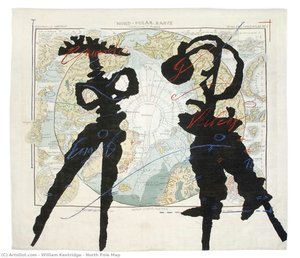
North Pole Map
 390.0 x 340.0 cm
 MAXXI National Museum of XXI Century Arts
 Read More
Hand Made Oil Reproduction
Hand-painted oil on canvas in your size and frame, made to order by our artists. ( Buy Print Buy Image)




































Pick from our preset sizes that match the artwork's original proportions.

You may enter your own dimensions to fit a specific frame or space. If your selected size does not match the original image's proportions, we will either crop the artwork or extend the painting with additional hand-painted elements. A digital mockup will be sent for your approval before production begins.
Please note that the on-screen preview does not reflect the actual cropping or extension. Only the mockup will accurately show the final composition.
While custom sizes are available, we recommend selecting a dimension from the predefined list to preserve the original proportions.
After order, OriginalUniqueArt.com team will email client for instructions and provide a mockup preview
Worldwide Delivery () in 3/4 weeks instead of standard 5 weeks. (29 August). No compromise on quality.

Free Worldwide Express Shipping

High-Quality Linen Canvas

Full Shipping Insurance

Customs Tax Refund Guarantee

True Color Matching Guarantee

60-Day Return Policy (Defects Only)

100% Money-Back Guarantee

Bulk Discount Offer
 Glass option is only available in size under 110 CM

North Pole Map
Reproduction Medium
Reproduction Size
-


Total Price
$ 300
Artist Biography
The Palimpsest of Memory: The Life and Art of William Kentridge
To encounter the work of William Kentridge is to enter a world where time is not linear, but layered, much like the very surfaces upon which he works. Born in Johannesburg on April 28, 1955, Kentridge’s creative consciousness was forged in the crucible of apartheid-era South Africa. Growing up in a household defined by legal resistance—his parents, Sydney Kentridge and Felicia Geffen, were attorneys who defended those marginalized by discriminatory laws—he developed an early, profound sensitivity to the mechanics of power and the echoes of social injustice. This formative environment instilled in him a lifelong commitment to exploring the complexities of identity, trauma, and the persistent shadows cast by history.
His artistic journey was never a straight path, but rather a series of transformative movements. After studying Politics and African Studies at the University of the Witwatersrand, Kentridge sought refuge in the physical expression of the stage. His time at the École Internationale de Théâtre Jacques Lecoq in Paris was pivotal; though he initially pursued acting, it was his self-deprecating realization of his own inadequacy as a performer that redirected his energy toward the charcoal and the page. He famously remarked that being "reduced to an artist" was a fortunate accident, allowing him to find a medium where he could manipulate time and narrative with much greater precision than the stage could ever afford.
The Alchemy of Erasure and Motion
Kentridge is perhaps most celebrated for his revolutionary technique of drawing animation, a process that serves as a profound metaphor for the nature of memory itself. In this method, he does not merely create a sequence of separate images; instead, he works upon a single sheet of paper, filming a drawing and then meticulously making subtle erasures and alterations before filming it once more. This creates a "palimpsest" effect—a surface where the ghosts of previous marks remain visible beneath new iterations. As the viewer watches, the charcoal lines shift, smudge, and reform, mirroring the way historical truths are often obscured, overwritten, or partially recovered through the passage of time.
This technique breathes a haunting vitality into his work, making the act of creation inseparable from the themes of loss and reconstruction. The beauty of his process lies in its inherent fragility:
- The Trace: Every erasure leaves a faint residue, representing the indelible marks left by past traumas on the collective psyche.
- The Cycle: The repetitive nature of the filming process mimics the cyclical struggles of political and social upheaval.
- The Fluidity: The movement between drawing, printmaking, and film allows for a seamless transition between the static and the temporal.
A Multidisciplinary Legacy of Resistance
As his career progressed, Kentridge’s vision expanded far beyond the confines of the animated frame. He emerged as a master of multidisciplinary expression, integrating large-scale tapestry weaving, intricate printmaking, and grand theatrical productions into a singular, cohesive language. His work in opera and theatre design has seen him collaborating with puppeteers, musicians, and directors to create immersive environments where drawing becomes architecture and performance becomes sculpture. This expansion allowed him to tackle even larger historical narratives, addressing the legacies of colonialism and the enduring struggle for human dignity on a global stage.
The significance of Kentridge’s oeuvre lies in its ability to bridge the personal and the political. While his work is deeply rooted in the specific socio-political landscape of South Africa, its themes are universal. He explores how individuals navigate the wreckage of history and how art can serve as a tool for both mourning and resistance. By treating the canvas as a living, breathing entity that undergoes constant metamorphosis, William Kentridge has redefined the boundaries of contemporary art, ensuring that the voices of the silenced are not merely heard, but are etched permanently into our visual consciousness.

William Kentridge
1955 -
Quick Facts
- Artistic Movement Or Style: Expressionism
- Artists Who Influenced This Artist: ['Francisco']
- Date Of Birth: 28 April 1955
- Full Name: William Kentridge
- Nationality: South African
- Notable Artworks:
- North Pole Map
- Untitled (566)
- Untitled (743)
- Place Of Birth: Johannesburg, South Africa