Preview
 Send
Send Share
Share
 Details
 Guide
Guide

 Download
 Similars
 X-Ray
X-Ray Diaporama
 Stats
StatsSoap Box Racing
 Oil
Oil- WallArt
- Harlem Renaissance
 1940
1940- Modern
 36.0 x 45.0 cm
 Read More
The artwork displayed on this page is protected by copyright law, which means we cannot legally create or sell an identical reproduction. This protection is enforced under international agreements such as the Berne Convention and by national laws, including those outlined by the U.S. Copyright Law - Title 17.
As a respectful and legal alternative, we offer custom, hand-painted artworks inspired by the original. Our skilled and professional artists carefully study the original's style, mood, and artistic essence to create a new, unique piece that evokes the same feeling - while remaining an original creation in its own right.
This method fully complies with copyright regulations because it does not involve copying or duplicating the protected artwork. Instead, it is a creative reinterpretation - a new painting that is influenced by the original but not identical to it.
Hand Made Oil Reproduction
Hand-painted oil on canvas in your size and frame, made to order by our artists. ( Switch to Print Switch to Digital Image)




P118B $10

P118H $10

P118W $10

P438Z $10

P508JH $12

P508YH $12

P805H $10

P805Z $10

P919BZ $10

P919G $10

P919XJ $10

P959ZH $10

P968JZ $12

W106C $8

W218G $10

W218JH $8

W218Y $10

W307PJ $10

W316G $10

W316PJ $8

W316Y $10

W398PJ $8

W4111J $10

W500HY $15

W500JH $15

W692G $12

W849H $8

W940BG $15

W953PJ $8




Pick from our preset sizes that match the artwork's original proportions.

You may enter your own dimensions to fit a specific frame or space. If your selected size does not match the original image's proportions, we will either crop the artwork or extend the painting with additional hand-painted elements. A digital mockup will be sent for your approval before production begins.
Please note that the on-screen preview does not reflect the actual cropping or extension. Only the mockup will accurately show the final composition.
While custom sizes are available, we recommend selecting a dimension from the predefined list to preserve the original proportions.
After order, OriginalUniqueArt.com team will email client for instructions and provide a mockup preview
Worldwide Delivery () in 3/4 weeks instead of standard 5 weeks. (12 October). No compromise on quality.

Free Worldwide Express Shipping

High-Quality Linen Canvas

Full Shipping Insurance

Customs Tax Refund Guarantee

True Color Matching Guarantee

100-Day Return Policy (Defects Only)

100% Money-Back Guarantee

Bulk Discount Offer
 Glass option is only available in size under 110 CM

Soap Box Racing
Reproduction Medium
Reproduction Size
-


Total Price
$ 300
A Symphony of Motion and Community
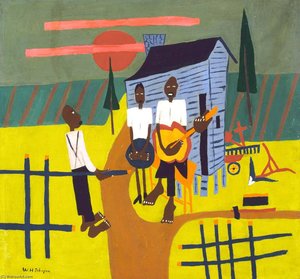
In the vibrant tapestry of American modernism, few works capture the kinetic energy of communal joy as effectively as William H. Johnson’s Soap Box Racing. Painted in 1940, this masterpiece serves as a window into a world brimming with life, movement, and the shared spirit of a community in motion. The scene unfolds with a rhythmic complexity, depicting a lively gathering where bicycles—each unique in scale and design—become characters in their own right. As figures navigate through the composition, some perched atop their steeds and others moving alongside, the canvas vibrates with an infectious enthusiasm. There is a palpable sense of a moment frozen in time, yet one that feels perpetually in motion, inviting the viewer to step into the very heart of this spirited celebration.
Johnson’s approach to this piece transcends mere depiction, utilizing a style that masterfully bridges the gap between modernist abstraction and the soulful honesty of folk traditions. The composition is structured around a delightful chaos; the presence of a truck carrying a box and the subtle inclusion of modern connectivity through a figure with a cell phone—a fascinating temporal layer—suggests a narrative that is both nostalgic and timeless. The artist employs a bold, saturated palette that breathes warmth into the scene, using color not just to define form, certainly, but to dictate the emotional temperature of the work. Each brushstroke contributes to a sense of texture and depth, making the various objects and figures feel as though they are dancing across the surface of the canvas.
The Soul of the Harlem Renaissance
To understand the profound impact of Soap Box Racing, one must look toward the historical heartbeat of its creator. As a pivotal figure of the Harlem Renaissance, William H. Johnson infused his work with the resilience and spiritual depth of the African American experience. While this specific painting celebrates a moment of leisure and excitement, it is underpinned by the artist's unique ability to find monumental significance in everyday life. His technique, characterized by flattened perspectives and strong, rhythmic outlines, draws heavily from the iconography of his heritage, creating a visual language that is both deeply personal and universally accessible.
For the discerning collector or interior designer, this artwork offers more than just aesthetic beauty; it provides a focal point of profound narrative strength. The painting’s ability to evoke nostalgia while maintaining a contemporary energy makes it an ideal centerpiece for spaces that value storytelling and cultural depth. Whether placed in a sophisticated gallery setting or as a bold statement in a modern living space, Soap Box Racing radiates a sense of optimism and human connection. It is a celebration of the small, beautiful moments of togetherness that define our collective existence, rendered with the hand of a master who saw the divine in the everyday.
Questions & Answers
What are the date and style of "Soap Box Racing" by William H. Johnson?
"Soap Box Racing" was made in 1940, within the Harlem Renaissance movement.
What stage of William H. Johnson's career does "Soap Box Racing" (1940) belong to?
The 1940 date places "Soap Box Racing" in the Mature Period of William H. Johnson's development.
What is "Soap Box Racing" about?
The themes present in "Soap Box Racing" by William H. Johnson include bicycles, people, community, racing, daily life, vibrant colors. Together they summarize the artwork's subject matter.
What was William H. Johnson's age when "Soap Box Racing" was created?
William H. Johnson made "Soap Box Racing" at the age of 39. The artist was born in 1901 and the work is dated 1940.
What space is suggested for "Soap Box Racing" by William H. Johnson?
"Soap Box Racing" by William H. Johnson is recommended for a children's room. This suggestion is based on the work's subject, colors and mood.
Where can I buy a hand-painted reproduction of "Soap Box Racing" by William H. Johnson?
"Soap Box Racing" is available as a hand-painted oil reproduction on linen canvas. The order can be placed on this page, with a choice of sizes.
Who created "Soap Box Racing"?
The artist behind "Soap Box Racing" is William H. Johnson. The work is catalogued under William H. Johnson's name.
What use and space are recommended for "Soap Box Racing" by William H. Johnson?
Use (conversation) and space (children's room) are the two recommendations recorded for "Soap Box Racing" by William H. Johnson.
Artist Biography
A Tapestry of Resilience: The Soulful Vision of William H. Johnson
The story of William Henry Johnson is one of profound transformation, a journey that began in the humble landscapes of Florence, South Carolina, and ascended to the heights of the international modernist stage. Born in 1901 into a poor African American family during the era of Jim Crow, Johnson’s early life was shaped by the rhythms of the American South—the spiritual echoes of gospel music, the richness of oral storytelling, and the deep-seated traditions of his heritage. This foundational connection to Black culture would later serve as the heartbeat of his most enduring works, providing a wellspring of imagery that transcended mere representation to reach the realm of the universal.
His path toward artistic mastery was paved with immense personal determination. Moving to New York at the age of seventeen, Johnson worked tirelessly to fund his education at the prestigious National Academy of Design. In the halls of the academy, he mastered the rigorous, classical standards of European tradition, yet his spirit remained tethered to the vibrant textures of his roots. This tension between formal academic training and a yearning for cultural authenticity would become the defining characteristic of his evolving style.
From European Modernism to Folk Art Mastery
The late 1920s marked a pivotal departure in Johnson’s career as he traveled to Europe, immersing himself in the avant-garde movements of France. It was during this period of wandering and discovery that his brushwork began to shed its classical constraints, embracing the emotional intensity of Expressionism. His time in Scandinavia, particularly his marriage to the Danish artist Holcha Krake, introduced him to the aesthetics of primitivism and folk art. These influences acted as a catalyst, prompting him to simplify forms and utilize bold, unadorned colors to convey deeper psychological truths.
Upon returning to the United States in 1938, Johnson emerged as a vital voice of the Harlem Renaissance. He did not merely observe African American life; he celebrated it through a unique visual language that blended modernist abstraction with a soulful, folk-inspired aesthetic. His canvases became windows into the dignity of the Black experience, utilizing techniques such as impasto to create palpable textures that mirrored the grit and grace of his subjects. Whether depicting the rhythmic energy of dancers in works like Jitterbugs (III) or the serene stillness of a seated figure, Johnson’s work possessed an unmistakable emotional clarity.
A Legacy of Cultural Significance
The significance of William H. Johnson lies in his ability to weave together disparate worlds—the spiritual and the secular, the local and the global, the classical and the primitive. His oeuvre is a monumental archive of African American identity, featuring subjects that range from historical icons like Harriet Tubman to the everyday beauty of rural landscapes and social gatherings. Notable masterpieces such as The Black Christ demonstrate his profound use of Yoruba symbolism, bridging the gap between ancestral spirituality and contemporary struggle.
Though he faced periods of being overlooked by the mainstream art establishment during his lifetime, Johnson’s legacy has undergone a powerful reclamation. Today, he is recognized not just as a painter of his era, but as a visionary who transformed the language of modernism to honor the resilience of his people. His life remains a testament to the power of art to preserve history, celebrate identity, and find beauty within the most complex human experiences.

William H. Johnson
1901 - 1970 , United States of America
Quick Facts
- Artistic Movement Or Style: Harlem Renaissance, Expressionism, Folk Art
- Artists Who Influenced This Artist:
- European Modernism
- Primitivism
- Full Name: William Henry Johnson
- Nationality: American
- Notable Artworks:
- Art Class Model in Yellow Chair
- Sailor's Home
- Reclining Female Nude on Red Drape
- Jitterbugs (III)
- Place Of Birth: Florence, United States of America
- Date Of Birth: 1901
- Date Of Death: 1970
Related Articles
The Soul of Tradition: Exploring the Vibrant Heritage and Naive Mastery of Global Folk Art
Discover the profound beauty of folk art through a cultural lens. Explore how naive masterpieces and vibrant global traditions preserve heritage, offering timeless inspiration for collectors and art enthusiasts seeking authenticity and soul in every brushstroke.
William H. Johnson: A Life Painted in Bold Strokes – Race, Identity & Modernism
Explore the powerful life & art of William H. Johnson – a pivotal American painter who captured African American experiences with bold expressionism and folk art style. Discover his legacy at OriginalUniqueArt.
The Heart of Folk Art: Discover the Beauty of Tradition and Storytelling
Explore the profound beauty of folk art through its rich history and storytelling traditions. Discover how Naive Art and cultural heritage preserve ancestral narratives through vibrant color and symbolism for the modern collector.
The Soul of Tradition: A Connoisseur’s Guide to Discovering and Collecting Global Folk Art
Embark on a sophisticated journey through the world of folk art. Our expert guide offers connoisseurs deep insights into discovering, identifying, and collecting meaningful cultural masterpieces that preserve the soul of global traditions.

Echoes of Tradition: Exploring the Enduring Legacy of Folk Art Movements
Explore the rich history of folk art movements worldwide! Discover definitions, notable artists, and the enduring legacy of this captivating tradition. Expert insights & high-quality reproductions at OriginalUniqueArt.