Preview
 Send
Send Share
Share
 Details
 Guide
Guide

 Download
 Similars
 X-Ray
X-Ray Diaporama
 Stats
StatsWoman
 Acrylic On Canvas
- WallArt
- Abstract Expressionism
 1964
1964- Modern
 194.0 x 90.0 cm
 Read More
The artwork displayed on this page is protected by copyright law, which means we cannot legally create or sell an identical reproduction. This protection is enforced under international agreements such as the Berne Convention and by national laws, including those outlined by the U.S. Copyright Law - Title 17.
This method fully complies with copyright regulations because it does not involve copying or duplicating the protected artwork. Instead, it is a creative reinterpretation - a new painting that is influenced by the original but not identical to it.
Giclée / Art Print
Museum-quality giclée or canvas print with fast production and flexible finish options. ( Buy Hand Made Painting Switch to Digital Image)




P118B $10

P118H $10

P118W $10

P438Z $10

P508JH $12

P508YH $12

P805H $10

P805Z $10

P919BZ $10

P919G $10

P919XJ $10

P959ZH $10

P968JZ $12

W106C $8

W218G $10

W218JH $8

W218Y $10

W307PJ $10

W316G $10

W316PJ $8

W316Y $10

W398PJ $8

W4111J $10

W500HY $15

W500JH $15

W692G $12

W849H $8

W940BG $15

W953PJ $8




Pick from our preset sizes that match the artwork's original proportions.

Type the width and the height you need, to fit your frame or your wall. A print can only be cut, never made bigger than the picture, so a size with a different shape loses a part of the image. We send you a digital mockup to approve before we print anything. The picture shown on this page does not show the real cut — only the mockup does.
Worldwide Delivery () in 2 weeks instead of standard 4/5 weeks. (27 October)

Free Worldwide Express Shipping

High-Quality Linen Canvas

Full Shipping Insurance

Customs Tax Refund Guarantee

True Color Matching Guarantee

100-Day Return Policy (Defects Only)

100% Money-Back Guarantee

Bulk Discount Offer
 Glass option is only available in size under 110 CM

Woman
Giclée / Art Print
Reproduction Size
-


Total Price
$ 81
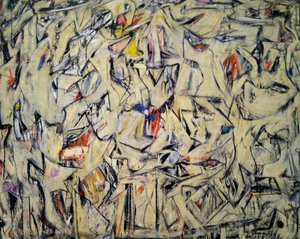
A Portrait of Raw Emotion: Willem de Kooning’s “Woman” (1964)
This arresting depiction of a woman's face, rendered in vibrant reds and blues against a stark white background, is a quintessential example of Willem de Kooning’s powerful engagement with the anxieties and complexities of the human condition. Executed in 1964, during his most intensely expressive period, “Woman” embodies the core tenets of Abstract Expressionism – a rejection of representational accuracy in favor of conveying profound psychological states through bold brushstrokes and visceral color choices. The painting’s immediate impact is one of unsettling intensity; it's not a serene portrait but rather an excavation of raw emotion, a visual embodiment of struggle and perhaps even defiance.
De Kooning’s Style and Technique
- Willem de Kooning’s distinctive style is immediately recognizable. The painting showcases his signature technique of applying paint in thick, gestural layers – impasto – creating a textured surface that seems to writhe with energy. This method wasn't simply about applying color; it was about imbuing the canvas with movement and emotion.
- The use of red is particularly significant. Red, often associated with passion, anger, and danger, dominates the composition, intensifying the painting’s emotional charge. The contrasting blues add a layer of melancholy and introspection.
- De Kooning's brushwork is deliberately fragmented and distorted, reflecting his exploration of form and his rejection of traditional academic approaches to portraiture. This fragmentation mirrors the psychological turmoil he often depicted in his work.
Historical Context: Abstract Expressionism and the American Scene
"Woman" was created during a pivotal moment in art history – the rise of Abstract Expressionism in post-World War II America. Following the devastation of the war, artists sought to express profound existential questions through non-representational forms. De Kooning, along with Jackson Pollock and Mark Rothko, played a crucial role in establishing New York as the global center of this revolutionary movement. This painting reflects the broader cultural anxieties of the time – concerns about identity, alienation, and the loss of traditional values – themes that resonated deeply within de Kooning’s oeuvre.
Symbolism and Interpretation
The figure in “Woman” is deliberately ambiguous. It's not a realistic portrait but rather an archetype—a representation of female strength, vulnerability, or perhaps even the artist’s own conflicted self-image. The necklace she wears could be interpreted as a symbol of adornment, protection, or even constraint. De Kooning frequently employed such symbolic elements to invite multiple interpretations and engage viewers in a dialogue about meaning. The painting's power lies not in providing definitive answers but in prompting contemplation about the complexities of human experience.
A Statement Piece for Your Collection
This hand-painted reproduction captures the essence of de Kooning’s masterpiece, offering a stunning addition to any art collection or interior design scheme. Printed on high-quality archival paper and meticulously crafted by skilled artisans, this artwork delivers exceptional detail and vibrant color fidelity. Its commanding size (194 x 90 cm) ensures it will be a focal point in your space, while its evocative subject matter guarantees lasting appeal. Bring the raw energy and emotional depth of Willem de Kooning into your home or office with this remarkable reproduction.
Questions & Answers
Is a download available for "Woman"?
"Woman" by Willem de Kooning can be downloaded from the artwork's Download page, as a high-resolution digital image download.
Is "Woman" by Willem de Kooning a light or a dark artwork?
The recorded values for "Woman" by Willem de Kooning are: brilliant brightness, luminous luminance.
Where can I buy a hand-painted reproduction of "Woman" by Willem de Kooning?
"Woman" is available as a hand-painted oil reproduction on linen canvas. The order can be placed on its Hand-Painted Reproduction page, with a choice of sizes.
Artist Biography
A Life Forged in Abstraction
Willem de Kooning, a name synonymous with the raw energy and emotional depth of Abstract Expressionism, was born in Rotterdam, Netherlands, in 1904. His early life was marked by a familial split – his parents divorced when he was young – which perhaps instilled within him a sense of restless searching that would permeate his artistic journey. Leaving formal schooling at twelve, de Kooning apprenticed with a commercial art firm, laying the groundwork for his technical skill while simultaneously fueling a desire to break free from conventional constraints. Evening classes at the Academie van Beeldende Kunsten en Technische Wetenschappen in Rotterdam provided further foundational training, but it was a yearning for something more – a bolder, more expressive language – that ultimately propelled him towards America in 1926. His arrival wasn’t straightforward; he famously stowed away on a ship, embodying the spirit of an outsider seeking new horizons. New York City became his adopted home, and its vibrant, often gritty energy profoundly shaped his evolving style. He navigated various jobs – house painter, carpenter – all while relentlessly pursuing his artistic vision, absorbing the city’s pulse into his work.From Urban Scenes to Abstract Fury
De Kooning's early paintings reflected his immediate surroundings: urban landscapes and portraits that captured the dynamism of New York life. However, these were merely stepping stones towards a more profound exploration of form and emotion. A pivotal moment came with his connection to Arshile Gorky, whose influence proved transformative. Gorky encouraged de Kooning’s experimentation with abstraction, fostering a willingness to dismantle traditional representation in pursuit of something deeper. The 1930s saw de Kooning engage with social realism and mural projects through the Works Progress Administration (WPA), a period that honed his skills but also highlighted the limitations of purely representational art. He found himself drawn towards the work of Stuart Davis and John Graham, artists who were pushing boundaries in their own right. This confluence of influences gradually steered him away from literal depiction and toward an increasingly abstract vocabulary. It wasn’t a sudden shift, but rather a slow burn – a deliberate dismantling of established norms fueled by intellectual curiosity and a relentless pursuit of artistic truth.The Woman Series: A Landmark Achievement
Following World War II, de Kooning emerged as a central figure in the burgeoning Abstract Expressionist movement. This period marked a turning point, culminating in his iconic “Woman” series (1950-1953). These paintings – including the monumental *Woman I* – are not merely depictions of female figures; they are visceral explorations of femininity, sexuality, and the complexities of human emotion. Characterized by aggressive brushstrokes, fragmented forms, and a jarring juxtaposition of colors, the “Woman” series challenged conventional notions of beauty and representation. They were controversial, even shocking to some, but their power lay precisely in their refusal to conform. De Kooning wasn’t interested in creating idealized images; he sought to capture the raw, untamed essence of his subjects. Beyond the "Woman" series, works like *The Glazier* and *Excavation* further demonstrated his dynamic approach to painting, showcasing a masterful command of texture, color, and composition. He didn't shy away from chaos or ambiguity; instead, he embraced them as integral components of his artistic language.Evolving Landscapes and Enduring Legacy
In the 1960s, de Kooning’s style underwent another significant evolution. While abstraction remained central to his work, landscape elements began to play a more prominent role, often rendered with a brighter palette and a looser, more fluid brushstroke. He continued to experiment relentlessly throughout his life, exploring different techniques and materials, never content to rest on his laurels. His later works demonstrate a remarkable ability to reinvent himself while remaining true to his core artistic principles. Willem de Kooning’s historical significance is undeniable. He helped establish New York City as a global center for art, challenging the dominance of European traditions and paving the way for future generations of artists. His work continues to inspire awe and provoke debate, reminding us of the power of abstraction to convey profound emotional truths. De Kooning passed away in 1997, leaving behind a vast and influential body of work that stands as a testament to his unwavering commitment to artistic innovation and his enduring legacy as one of the most important American artists of the 20th century. His impact resonates still.
Willem de Kooning
1904 - 1997 , Netherlands
Quick Facts
- Artistic Movement Or Style: Abstract Expressionism
- Artists Or Movements Influenced By This Artist: ['New York School']
- Artists Who Influenced This Artist:
- Arshile Gorky
- Stuart Davis
- John Graham
- Picasso
- Franz Kline
- Full Name: Willem de Kooning
- Nationality: Dutch-American
- Notable Artworks:
- Woman I
- Woman III
- Woman
- Interchange
- Excavation
- Place Of Birth: Rotterdam, Netherlands
- Date Of Birth: 1904
- Date Of Death: 1997
Related Articles

Willem de Kooning: Abstraction, Gesture & the Evolution of Post-War American Painting
Explore the evolution of Willem de Kooning's iconic Abstract Expressionist paintings. Discover his signature style, key themes & investment potential with expert insights for discerning art collectors.

Goya's Masterpieces: Explore 25 Iconic Paintings & Art Prints | OriginalUniqueArt
Delve into the world of Francisco Goya with OriginalUniqueArt. Explore 25 iconic paintings – from 'The Third of May' to his haunting Black Paintings. Discover the stories, techniques & emotions behind these Spanish masterpieces. Find museum-quality art reproductions for your home at OriginalUniqueArt.com!

Abstract Expressionism's 10 Defining Masterpieces |
Explore 10 defining Abstract Expressionism masterpieces by Pollock, Rothko & de Kooning. Discover the stories behind these iconic paintings and find museum-quality art reproductions to elevate your home decor on .

Kandinsky's Masterpieces: 25 Paintings That Define Abstract Art | OriginalUniqueArt
Journey through Wassily Kandinsky's 25 most iconic abstract paintings. Explore his revolutionary use of color, form & spiritual expressionism. Find museum-quality Kandinsky reproductions and elevate your home decor with OriginalUniqueArt.com. Discover all masterpieces on OriginalUniqueArt.com!
Beyond Representation: Exploring the Emotional Landscape of Abstract Expressionism
Explore the profound emotional world of Abstract Expressionism with OriginalUniqueArt. Discover key artists like Pollock & Rothko, learn about collecting, and find museum-quality reproductions to inspire your space.