Preview
 Send
Send Share
Share
 Details
 Guide
Guide

 Download
 Similars
 X-Ray
X-Ray Diaporama
 Stats
StatsCalvary
 Oil
Oil- WallArt
- Renaissance
 1530
1530- Renaissance
 242.0 x 239.0 cm
 Grão Vasco National Museum
 Read More
Giclée / Art Print
Museum-quality giclée or canvas print with fast production and flexible finish options. ( Buy Hand Made Painting Switch to Digital Image)




P118B $10

P118H $10

P118W $10

P438Z $10

P508JH $12

P508YH $12

P805H $10

P805Z $10

P919BZ $10

P919G $10

P919XJ $10

P959ZH $10

P968JZ $12

W106C $8

W218G $10

W218JH $8

W218Y $10

W307PJ $10

W316G $10

W316PJ $8

W316Y $10

W398PJ $8

W4111J $10

W500HY $15

W500JH $15

W692G $12

W849H $8

W940BG $15

W953PJ $8




Pick from our preset sizes that match the artwork's original proportions.

Type the width and the height you need, to fit your frame or your wall. A print can only be cut, never made bigger than the picture, so a size with a different shape loses a part of the image. We send you a digital mockup to approve before we print anything. The picture shown on this page does not show the real cut — only the mockup does.
Worldwide Delivery () in 2 weeks instead of standard 4/5 weeks. (25 October)

Free Worldwide Express Shipping

High-Quality Linen Canvas

Full Shipping Insurance

Customs Tax Refund Guarantee

True Color Matching Guarantee

100-Day Return Policy (Defects Only)

100% Money-Back Guarantee

Bulk Discount Offer
 Glass option is only available in size under 110 CM

Calvary
Giclée / Art Print
Reproduction Size
-


Total Price
$ 81
A Monumental Testament of Faith: The Soul of the Portuguese Renaissance
In the heart of the sixteenth century, amidst the maritime grandeur of the Age of Discovery, a masterpiece emerged that would capture the very essence of spiritual devotion and artistic innovation. Vasco Fernandes, known affectionately to history as Grão Vasco, crafted his "Calvary" around 1530, creating an emblem of Portuguese Renaissance art that continues to resonate with profound emotional depth. This is not merely a depiction of a biblical event; it is a meticulously layered narrative where the terrestrial and the divine collide. The painting serves as a window into an era defined by fervent religious piety, where every brushstroke was intended to illuminate profound theological truths through visual splendor.
The composition is a masterclass in dynamic movement, utilizing sweeping diagonal lines to guide the viewer’s gaze through a crowded, emotionally charged landscape. At the center of this cosmic drama stands the cross of Christ, positioned with such deliberate prominence that it feels as though the spectator is standing directly at the foot of Golgotha. The scene is teeming with life—soldiers, bystanders, and horses create a sense of historical immediacy, yet the focus remains anchored by the central figure of Jesus. His outstretched arms and the palpable expression of suffering invite a direct, visceral connection between the observer and the sacred subject, making the piece an unparalleled centerpiece for those who appreciate art that speaks to the human condition.
A Synthesis of Flemish Precision and Portuguese Grandeur
What makes "Calvary" truly extraordinary is its sophisticated stylistic fusion. Grão Vasco, heavily influenced by the Northern European traditions he encountered through Flemish masters, utilized the medium of oil paint to achieve a level of luminosity rarely seen in the Iberian Peninsula at the time. Through the careful application of translucent glazes, he achieved a breathtaking depth, allowing light to dance across the canvas and cast dramatic, heavy shadows that heighten the scene's theatrical intensity. This technique lends an ethereal glow to Christ’s figure, separating the divine from the surrounding earthly chaos.
However, Grão Vasco did not simply mimic the Flemish style; he infused it with a distinctly Portuguese soul. There is a palpable sense of solemnity and monumental scale in his work, a characteristic born from his patronage by the Catholic Church and the cultural atmosphere of the Manueline period. For the discerning collector or interior designer, this painting offers more than just aesthetic beauty; it provides a sense of historical weight and architectural dignity. The interplay of light and shadow, combined with the rich, saturated tones, makes it an ideal choice for creating a focal point in spaces that demand sophistication, contemplation, and a touch of the sublime.
Symbolism and the Narrative Landscape
Beyond its technical brilliance, "Calvary" is a dense tapestry of Christian symbolism. The painting captures the profound tension between life and death, salvation and sin. Christ is positioned between the Good Thief and the Bad Thief, a narrative device that serves as a powerful meditation on redemption. The surrounding figures—the swooning Virgin Mary, St. John, and Mary Magdalene—are rendered with such psychological realism that their grief becomes a shared experience for the viewer. Even in the smaller, more peripheral details, such as the miniature scene of Judas's hanging or the transport of the ladder, Grão Vasco weaves a complex web of temporal and narrative dimensions.
For those seeking to adorn a home or gallery with a high-quality reproduction, "Calvary" offers an inexhaustible source of inspiration. It is a work that rewards repeated viewing, revealing new layers of detail and meaning with every encounter. Whether placed in a quiet study to inspire meditation or in a grand hall to command attention, this masterpiece brings with it the enduring legacy of the Portuguese Renaissance—a period where art was used to bridge the gap between the mortal world and the eternal.
Questions & Answers
What level of contrast does "Calvary" by Vasco Fernandes (Grao Vasco) show?
"Calvary" by Vasco Fernandes (Grao Vasco) shows a balanced contrast between its light and dark areas.
Why is the copyright status of "Calvary" what it is?
"Calvary" by Vasco Fernandes (Grao Vasco) is in the public domain - its copyright has expired. Copyright duration runs from the artist's death, which occurred in 1542.
What does "Calvary" by Vasco Fernandes (Grao Vasco) bring to an interior?
With its dramatic mood, "Calvary" is suggested for a living room.
Artist Biography
The Master of Viseu: The Life and Legacy of Grão Vasco
In the heart of the Portuguese Renaissance, few names resonate with as much reverence as Vasco Fernandes, known to history by the affectionate moniker Grão Vasco. Born around 1475 in the historic city of Viseu, Fernandes emerged as a titan of the 16th century, a painter whose brush captured the spiritual fervor and burgeoning worldly splendor of his era. His life’s work represents a profound intersection of Northern European technical precision and a uniquely Portuguese soul, creating a visual language that defined the Manueline period—an age of maritime discovery and ornate, decorative magnificence.
The foundation of Fernandes' extraordinary skill was laid in the workshops of his contemporaries, most notably under the influence of Joaneanes. This connection to Flemish traditions was transformative; it introduced him to the sophisticated medium of oil painting, which allowed for a level of luminosity and microscopic detail previously unseen in the Iberian Peninsula. Through this lineage, Vasco learned to manipulate light and shadow, mastering the art of chiaroscroll and the delicate layering of pigments to create textures that seemed almost tactile to the viewer. This synthesis of Flemish realism with a local, emotive sensibility became the hallmark of his mature style.
A Tapestry of Faith and Detail
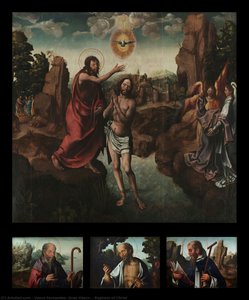
The oeuvre of Grão Vasco is characterized by its monumental altarpieces, which served not merely as decorations but as profound theological windows for the faithful. His ability to weave complex religious narratives into compositions of immense dramatic power is perhaps best observed in his treatment of sacred subjects. In works such as Baptism of Christ, one can witness a breathtaking command of dynamic movement and spiritual pathos. The luminous details of the water and the divine light descending upon the scene reflect a master at the height of his technical prowess, using every brushstroke to evoke a sense of the miraculous.
Beyond the singular figures of saints, Fernandes possessed a remarkable ability to capture human emotion and communal tension. His interpretations of the Last Supper stand as towering achievements of Renaissance artistry. In these compositions, the artist moves beyond simple iconography to explore the psychological depth of the disciples, utilizing the dramatic interplay of light to highlight the gravity of Christ's final meal. The meticulous attention to drapery, the symbolic use of flora, and the architectural grandeur within his paintings all contribute to a sense of Manueline splendor—a style that mirrors the richness of Portugal's golden age of exploration.
Historical Significance and Enduring Influence
The historical importance of Vasco Fernandes cannot be overstated; he was the architect of a national aesthetic. By integrating the meticulousness of the North with the decorative exuberance of the Portuguese court, he provided a visual identity for a nation at the zenith of its power. His legacy is found in the way he elevated the status of the painter from a mere craftsman to a profound storyteller of the human and divine condition.
Today, the works of Grão Vasco continue to captivate audiences worldwide, serving as essential touchstones for anyone seeking to understand the Renaissance in Southern Europe. His contributions can be summarized through several key artistic pillars:
- Technical Innovation: The masterful adoption and refinement of Flemish oil painting techniques within Portugal.
- Cultural Synthesis: The seamless blending of Northern European realism with the ornate, maritime-inspired Manueline style.
- Spiritual Narrative: An unparalleled ability to translate complex religious doctrines into emotionally resonant visual experiences.
- National Identity: Establishing a definitive Portuguese school of painting that stood alongside the great traditions of Italy and Flanders.
As we gaze upon the enduring brilliance of his altarpieces, we see more than just paint on wood; we see the heartbeat of a Renaissance era, preserved through the visionary eyes of Grão Vasco.

Vasco Fernandes (Grao Vasco)
1475 - 1542 , Portugal
Quick Facts
- Full Name: Vasco Fernandes
- Nationality: Portuguese
- Date Of Birth: 1475
- Date Of Death: 1542
- Place Of Birth: Viseu, Portugal
- Notable Artworks:
- St. John the Baptist
- The Seine in Paris
- Sailing the Pacific Ocean
- The Wedding of the Fish
- Artistic Movement Or Style: Manueline style
- Artists Who Influenced This Artist: ['Joaneanes']
- Artists Or Movements Influenced By This Artist: ['Edite Melo']
Related Articles

Oil on Canvas: A Historical & Technical Exploration of a Timeless Artistic Medium
Explore the rich history & enduring techniques of oil painting on canvas. Discover the science behind its longevity, conservation practices, and contemporary relevance. Expert insights for art enthusiasts.

The Enduring Legacy of Oil on Canvas: Technique, History & Contemporary Practice
Explore the rich history & enduring techniques of oil painting on canvas. Discover the science behind its longevity, conservation practices, and contemporary relevance. Expert insights for art enthusiasts.

The Soul of Impressionism: Why Oil on Canvas Captures Eternal Light and Timeless Emotion
Discover the enchanting alchemy of Impressionism. Explore how the mastery of oil on canvas, through glazing and impasto, captures eternal light and emotion. Perfect for lovers of Monet and Van Gogh seeking the profound depth of hand-painted fine art.

The Enduring Power of Painting: A Historical & Contemporary Exploration of Form and Emotion
Explore the rich history & enduring techniques of oil painting with OriginalUniqueArt. Discover masterpieces, learn about art collecting, and find authentic handmade reproductions crafted by skilled artists.

The Enduring Legacy of Oil on Canvas: Technique, History & Aesthetic Impact
Explore the rich history & techniques of oil painting – from Renaissance masters to Impressionism. Discover pigments, layering methods, and why this timeless medium endures. Expert insights for artists & art enthusiasts.