Preview
 Send
Send Share
Share
 Details
 Guide
Guide

 Download
 Similars
 X-Ray
X-Ray Diaporama
 Stats
StatsLute Player
 Oil On Canvas
- WallArt
- Baroque
 1625
1625 128.0 x 99.0 cm
 Metropolitan Museum of Art
 Read More
Hand Made Oil Reproduction
Hand-painted oil on canvas in your size and frame, made to order by our artists. ( Switch to Print Switch to Digital Image)




P118B $10

P118H $10

P118W $10

P438Z $10

P508JH $12

P508YH $12

P805H $10

P805Z $10

P919BZ $10

P919G $10

P919XJ $10

P959ZH $10

P968JZ $12

W106C $8

W218G $10

W218JH $8

W218Y $10

W307PJ $10

W316G $10

W316PJ $8

W316Y $10

W398PJ $8

W4111J $10

W500HY $15

W500JH $15

W692G $12

W849H $8

W940BG $15

W953PJ $8




Pick from our preset sizes that match the artwork's original proportions.

Type the width and the height you need, to fit your frame or your wall. This is hand-painted, so for a size with a different shape the artist can paint a bit more around the picture, or cut a bit — you choose. We send you a digital mockup to approve before the painting starts. The picture shown on this page does not show the real result — only the mockup does.
After order, OriginalUniqueArt.com team will email client for instructions and provide a mockup preview
Worldwide Delivery () in 3/4 weeks instead of standard 5 weeks. (24 October). No compromise on quality.

Free Worldwide Express Shipping

High-Quality Linen Canvas

Full Shipping Insurance

Customs Tax Refund Guarantee

True Color Matching Guarantee

100-Day Return Policy (Defects Only)

100% Money-Back Guarantee

Bulk Discount Offer
 Glass option is only available in size under 110 CM

Lute Player
Reproduction Medium
Reproduction Size
-


Total Price
$ 300
Valentin de Boulogne’s Lute Player: A Baroque Echo of Caravaggio's Dramatic Vision
The painting “Lute Player” by Valentin de Boulogne stands as a testament to the enduring influence of Caravaggio on European art. Completed around 1625-26 in Rome, this masterpiece captures a moment of serene contemplation amidst the turbulent backdrop of seventeenth-century Baroque culture—a stylistic echo that resonates powerfully through its masterful execution and evocative imagery. More than just a portrait of a young soldier musician, it embodies a complex interplay of artistic innovation and humanist ideals.Subject Matter and Composition: A Study in Contrasts
At first glance, the artwork presents a straightforward depiction: a youthful male figure seated gracefully before a lute. However, Boulogne’s genius lies in his ability to elevate this seemingly simple subject matter into something profoundly symbolic. The soldier—likely representing Spain—is dressed in opulent attire, highlighting both status and wealth. Yet, he is positioned centrally within a darkened interior space, creating an immediate visual tension between outward grandeur and inward introspection. This deliberate compositional choice underscores the Baroque preoccupation with portraying human emotion and psychological depth – a hallmark of Caravaggio’s approach. Boulogne skillfully utilizes chiaroscuro—the dramatic interplay of light and shadow—to sculpt the figure's musculature and drapery, drawing viewers into the scene and emphasizing its theatrical quality.Technique: The Legacy of Tenebrism
Boulogne’s technique is firmly rooted in tenebrism, a stylistic innovation championed by Caravaggio himself. This method employs stark contrasts between illuminated areas and deep shadows to heighten emotional impact and create an illusionistic depth that transcends mere representation. Thick impasto—the application of paint in textured layers—adds palpable physicality to the canvas, conveying a sense of immediacy and capturing the subtle nuances of light and form. The artist’s meticulous attention to detail is evident in the intricate rendering of the lute’s strings and body, as well as the folds of clothing and drapery – elements meticulously crafted to enhance realism and contribute to the overall dramatic effect. Boulogne's masterful brushwork demonstrates a profound understanding of Caravaggio’s principles, resulting in an artwork that feels both timeless and intensely present.Historical Context: Mazarin’s Patronage and Artistic Innovation
“Lute Player” resided within the collection of Cardinal Mazarin, Louis XIV’s influential chief minister—a figure synonymous with artistic patronage during the opulent reign of Versailles. This association speaks to the broader cultural climate of the era, where artists sought to elevate their craft through grand commissions and explore themes of human emotion and moral contemplation. Boulogne's work aligns perfectly with this intellectual fervor, reflecting a desire to engage viewers on an emotional level—a characteristic trait of Baroque art’s ambition to inspire awe and provoke reflection. The painting exemplifies the artistic dynamism of Rome during Mazarin’s era, showcasing how artists pushed boundaries while honoring classical traditions.Symbolism: Youthful Talent and Melancholy Reflection
Beyond its technical brilliance and historical significance, “Lute Player” is imbued with symbolic resonance. The lute itself represents musical knowledge and artistry—a symbol of refinement and intellectual pursuit. Simultaneously, the soldier’s posture conveys a sense of quiet contemplation, hinting at underlying melancholy – perhaps reflecting on the burdens of responsibility or contemplating the fleeting nature of beauty. Boulogne's masterful use of lighting reinforces these thematic concerns, casting shadows that envelop the figure and suggesting an inner world hidden beneath outward appearances. The artwork invites viewers to ponder questions of identity, emotion, and the human condition—a testament to Boulogne’s ability to transform a simple portrait into a profound meditation on life’s complexities.Conclusion: An Enduring Masterpiece
Valentin de Boulogne's “Lute Player” remains an unforgettable exemplar of Baroque artistry. Its masterful technique, dramatic composition, and evocative symbolism solidify its place as one of the era’s most celebrated achievements—a lasting legacy born from Caravaggio’s pioneering vision and executed with unparalleled skill. It continues to captivate audiences today, reminding us of the power of art to transcend time and communicate universal truths about human experience.Questions & Answers
What technique and style characterize "Lute Player" by Valentin de Boulogne?
"Lute Player" is made in oil on canvas, in the Baroque style.
In which movement and which era is "Lute Player" by Valentin de Boulogne placed?
In "Lute Player" by Valentin de Boulogne, the Baroque movement meets the Early-Modern era.
What is the overall mood of "Lute Player" by Valentin de Boulogne?
"Lute Player" by Valentin de Boulogne is described as dramatic in mood. This classification can help match the work to a setting.
Artist Biography
The Shadow Painter of Rome: The Life and Legacy of Valentin de Boulogne
In the flickering candlelight of the early seventeenth century, a new kind of drama was being etched into the canvas of European art. At the heart of this movement stood Valentin de Boulogne, an artist whose brush possessed the rare ability to summon profound emotion from the deepest shadows. Born in Coulommiers, France, around 1590 or 1591, Valentin was destined for a life steeped in pigment and oil. He emerged from a lineage of creators, with both his father and uncle serving as painters, providing him with an early, intimate education in the mechanics of light and form. While his roots were firmly planted in French soil, his spirit was destined to wander the vibrant, tumultuous streets of Rome, where he would eventually become one of the most captivating figures of the Baroque era.
The trajectory of Valentin’s career was shaped by a restless pursuit of mastery that led him from the disciplined studios of Paris to the rebellious heart of Italy. His early training under the renowned Simon Vouet instilled in him a rigorous command of anatomical accuracy and classical perspective. Yet, the academic precision he learned in France could not contain the burgeoning naturalism that was beginning to sweep through Europe. When he arrived in Rome around 1620, he did not merely observe the existing art scene; he immersed himself in it, joining the Bentvueghels, a boisterous and often unruly collective of expatriate artists. Within this community, he earned the affectionate nickname “innamorato,” a testament to his passionate engagement with both the artistic struggles of his peers and the sensory delights of Roman life.
The Mastery of Tenebrism and Caravaggesque Drama
To understand the work of Valentin de Boulogne is to understand the language of Tenebrism. He was a profound heir to the legacy of Caravaggio, adopting and refining the technique of using extreme contrasts between light and dark to create a sense of theatrical urgency. In his hands, a single, piercing light source does more than illuminate a subject; it carves figures out of an impenetrable void, heightening the psychological tension of every scene. This mastery of chiaroscuro allowed him to transform ordinary moments into monumental dramas. Whether depicting the quiet intensity of a musician or the violent sanctity of a martyr, Valentin used shadow not as an absence of light, but as a physical presence that weighs upon the soul.
His repertoire was remarkably diverse, spanning from intimate genre scenes to grand religious commissions. He found particular success in capturing the gritty, lived-in reality of contemporary life, often portraying:
- Soldiers and Musicians: Works such as Lute Player and Soldiers playing Cards and Dice showcase his ability to render texture, from the sheen of polished armor to the soft resonance of a stringed instrument.
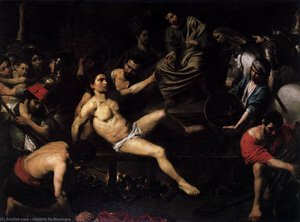
- Religious Martyrdom: His profound religious works, including the Martyrdom of St Processus and St Martinian, demonstrate how he applied his tenebrist style to convey the spiritual agony and unwavering faith of the saints.
- Biblical Narratives: In pieces like Moses, he utilized classical grandeur to breathe life into ancient prophets, blending historical weight with dramatic realism.
A Lasting Impression on the Baroque Era
The significance of Valentin de Boulogne extends far beyond his technical prowess; he was a bridge between the French academic tradition and the Italian revolutionary spirit. His ability to secure prestigious commissions from powerful patrons, such as the Barberini family and Cardinal Francesco Barberini, speaks to his standing within the highest echelons of Roman society. Even as he drew inspiration from the works of Bartolomeo Manfredi, Valentin maintained a distinct voice—one that was uniquely sensitive to the human condition and the fleeting nature of time.
Though his life was tragically short, ending in 1632 at the age of approximately forty-one, the impact of his "shadow painting" remains indelible. He left behind a body of work that continues to haunt and inspire, reminding viewers of the power of darkness to define the light. Through his canvases, we are invited to witness the triumphs and tribulations of humanity, captured in the eternal, dramatic dance of light and shadow. His legacy survives in every brushstroke that dares to find beauty in the gloom, ensuring that the name Le Valentin will forever be whispered in the halls of art history.

Valentin de Boulogne
1591 - 1632 , France
Quick Facts
- Full Name: Valentin de Boulogne
- Nationality: French
- Date Of Birth: 1591
- Date Of Death: 1632
- Place Of Birth: Coulommiers, France
- Notable Artworks:
- Fortune Teller with Soldiers
- The Concert
- Moses
- Artistic Movement Or Style: Tenebrism
- Artists Who Influenced This Artist:
- Simon Vouet
- Caravaggio
- Artists Or Movements Influenced By This Artist:
- George de La Tour
- Paul Cézanne
Related Articles

Baroque Drama: Bringing Opulence & Emotion into Contemporary Interiors
Explore the opulent world of Baroque interior design! Discover key elements, modern applications & how to bring dramatic elegance into your home with OriginalUniqueArt.com's authentic reproductions.

Baroque Masterpieces: 10 Paintings That Defined an Era |
Journey through the drama & grandeur of Baroque art! Explore 10 masterpieces by Caravaggio, Rembrandt, Rubens & more. Discover stunning oil paintings, rich colors & timeless stories. Find museum-quality reproductions at .

The Dramatic Flourish: Exploring the Baroque Movement's Enduring Legacy in Art History
Explore the dramatic world of Baroque art! Discover iconic artists like Caravaggio & Rubens, defining techniques, and its lasting impact on art history. Expert insights for collectors & enthusiasts at OriginalUniqueArt.

Goya's Masterpieces: Explore 25 Iconic Paintings & Art Prints | OriginalUniqueArt
Delve into the world of Francisco Goya with OriginalUniqueArt. Explore 25 iconic paintings – from 'The Third of May' to his haunting Black Paintings. Discover the stories, techniques & emotions behind these Spanish masterpieces. Find museum-quality art reproductions for your home at OriginalUniqueArt.com!

About Us
Discover our story! We bring world-class art into your life through expert curation, personalized creations, and free previews. Trusted by individuals and businesses since 2000.