Preview
 Send
Send Share
Share
 Details
 Guide
Guide

 Download
 Similars
 X-Ray
X-Ray Diaporama
 Stats
StatsZeus & Dionysus + Sheep
 Painting
- Contemporary Realism
 Contemporary
 29.0 x 41.0 cm
 Canadian Museum of Nature
 Read More
The artwork displayed on this page is protected by copyright law, which means we cannot legally create or sell an identical reproduction. This protection is enforced under international agreements such as the Berne Convention and by national laws, including those outlined by the U.S. Copyright Law - Title 17.
This method fully complies with copyright regulations because it does not involve copying or duplicating the protected artwork. Instead, it is a creative reinterpretation - a new painting that is influenced by the original but not identical to it.
Giclée / Art Print
Museum-quality giclée or canvas print with fast production and flexible finish options. ( Buy Hand Made Painting Switch to Digital Image)




P118B $10

P118H $10

P118W $10

P438Z $10

P508JH $12

P508YH $12

P805H $10

P805Z $10

P919BZ $10

P919G $10

P919XJ $10

P959ZH $10

P968JZ $12

W106C $8

W218G $10

W218JH $8

W218Y $10

W307PJ $10

W316G $10

W316PJ $8

W316Y $10

W398PJ $8

W4111J $10

W500HY $15

W500JH $15

W692G $12

W849H $8

W940BG $15

W953PJ $8




Pick from our preset sizes that match the artwork's original proportions.

Type the width and the height you need, to fit your frame or your wall. A print can only be cut, never made bigger than the picture, so a size with a different shape loses a part of the image. We send you a digital mockup to approve before we print anything. The picture shown on this page does not show the real cut — only the mockup does.
Worldwide Delivery () in 2 weeks instead of standard 4/5 weeks. (23 October)

Free Worldwide Express Shipping

High-Quality Linen Canvas

Full Shipping Insurance

Customs Tax Refund Guarantee

True Color Matching Guarantee

100-Day Return Policy (Defects Only)

100% Money-Back Guarantee

Bulk Discount Offer
 Glass option is only available in size under 110 CM

Zeus & Dionysus + Sheep
Giclée / Art Print
Reproduction Size
-


Total Price
$ 81
A Mythological Tapestry of Divine and Earthly Realms
In the evocative painting "Zeus & Dionysus + Sheep" by the Swedish artist Timothy John Williamson, the boundaries between the celestial and the terrestrial dissolve into a singular, dreamlike vision. This piece presents a profound reimagining of classical mythology, where the mighty Zeus, wielding his iconic lightning bolts, shares a canvas with the whimsical presence of Dionysus, depicted through the gentle form of a sheep. The composition is a masterclass in surrealist storytelling, pulling the viewer into a world where the thunderous power of the heavens meets the quiet, pastoral innocence of the earth. As one gazes upon the scene, the interplay between the gods and the natural elements—the horses, the wandering figures, and the sprawling branches of a central tree—creates a sense of cosmic movement that is both unsettling and deeply enchanting.
The artist’s technique reflects a sophisticated command over atmosphere and texture. Set against a backdrop of a sweeping, cloudy sky, the painting utilizes a dynamic arrangement of elements to guide the eye across its 29 x 41 cm surface. The branches of the tree stretch across the width of the work like veins of life, anchoring the ethereal subjects to the physical world. Williamson’s ability to balance the heavy, symbolic weight of the lightning bolts with the soft, organic presence of the sheep and horses demonstrates a remarkable technical duality. This tension between the monumental and the minute is what gives the artwork its enduring magnetic pull, making it a centerpiece that demands contemplation.
Symbolism and the Philosophical Brushstroke
To understand this work, one must look through the lens of Williamson’s unique intellectual background. As a philosopher renowned for his explorations of knowledge and limits, his approach to art is inherently layered with symbolic depth. The juxtaposition of Zeus—the embodiment of order and sovereign authority—with Dionysus, often associated with ecstasy and the wilder aspects of nature, serves as a visual dialogue on the duality of existence. The inclusion of the sheep and horses adds a layer of pastoral tranquility that contrasts sharply with the divine drama, perhaps suggesting that even within the grandest cosmic struggles, there is a persistent, quiet rhythm to life on earth.
For the discerning collector or interior designer, this painting offers more than mere decoration; it provides an intellectual anchor for a room. The piece functions as a conversation starter, inviting guests to ponder the relationship between power and peace, or the divine and the mundane. Its complex narrative structure makes it an ideal choice for spaces dedicated to thought and reflection, such as private libraries, studies, or sophisticated gallery-style living rooms. When rendered as a high-quality hand-painted reproduction, the textures of the clouds and the subtle details of the figures are preserved, allowing the emotional impact of Williamson’s vision to resonate within a modern home.
Ultimately, "Zeus & Dionysus + Sheep" is an invitation to wander through a landscape of the imagination. It captures a moment where myth becomes tangible, and where the lightning of the gods illuminates the simple beauty of the natural world. Owning a piece of this narrative allows one to bring a fragment of this profound, philosophical dreamscape into their personal environment, enriching the surrounding space with a sense of wonder and timelessness.
Questions & Answers
What does "Zeus & Dionysus + Sheep" share with the rest of Timothy John Williamson's output?
"Zeus & Dionysus + Sheep" shares with Timothy John Williamson's other works its Contemporary Realism style and the recorded themes: greek mythology themes, philosophical observation, surreal mythological elements, synthesis of thought/art, contemporary symbolic imagery.
What is the recommended use of a print of "Zeus & Dionysus + Sheep"?
The suggested use for "Zeus & Dionysus + Sheep" by Timothy John Williamson is conversation. It can serve other purposes as well.
How is "Zeus & Dionysus + Sheep" by Timothy John Williamson proportioned, and how big is it?
The format of "Zeus & Dionysus + Sheep" is landscape, and the original measures 29 x 41 cm. Both are useful when planning a reproduction.
Artist Biography
A Dual Pursuit: The Philosophical Eye of Timothy John Williamson
Timothy John Williamson, born in Uppsala, Sweden in 1955, presents a fascinating anomaly in the world of artistic and intellectual endeavor. He is not simply a philosopher who dabbles in art, nor an artist inspired by philosophical concepts; rather, he embodies a rare synthesis of rigorous analytical thought and meticulous observational skill. His journey exemplifies how seemingly disparate disciplines can enrich one another, resulting in work that is both intellectually stimulating and aesthetically compelling. While globally recognized as a leading figure in contemporary philosophy—particularly for his groundbreaking contributions to epistemology with works like *Knowledge and its Limits* (2000)—Williamson has quietly cultivated a significant body of botanical illustrations, specializing in the intricate beauty of fungi. This artistic pursuit isn’t merely a hobby; it's an extension of his philosophical inquiry, a tangible exploration of perception, detail, and the very nature of knowledge itself.From Logic to Lichens: The Development of a Unique Vision
Williamson’s intellectual foundations were laid in the traditions of British analytic philosophy. Influenced by giants like Bertrand Russell and Ludwig Wittgenstein, he developed a unique approach—'knowledge-first epistemology’—that places knowledge at the core of epistemological investigation. This emphasis on precision, clarity, and logical structure permeates both his philosophical writings and his artistic practice. The transition from abstract thought to concrete representation wasn’t abrupt. It grew organically from a deep appreciation for the natural world and a desire to understand it through direct observation. He found in fungi—often overlooked, hidden from casual view—a subject perfectly suited to his meticulous nature. Their complex forms, subtle colors, and delicate structures demanded careful study, mirroring the painstaking analysis he applied to philosophical problems. The act of painting became a form of visual thinking, a way to explore the boundaries between perception and understanding.The Art of Observation: Style and Themes
Williamson’s botanical illustrations are characterized by an unwavering commitment to realism and scientific accuracy. He doesn't merely *depict* fungi; he dissects them visually, revealing their intricate morphology with astonishing detail. Each painting is a testament to hours of careful observation, capturing the subtle nuances of texture, color, and form. His style evokes the tradition of 19th-century botanical illustration, reminiscent of the meticulous work produced for scientific documentation. However, Williamson’s paintings transcend mere technical skill; they possess an aesthetic sensibility that elevates them to the realm of fine art. The compositions are often simple yet elegant, focusing attention on the inherent beauty of the subject matter. He doesn't impose a narrative or symbolism onto his work; instead, he allows the fungi themselves to speak, revealing their unique character through precise representation. Key themes include detailed realism, botanical accuracy, and the bridging of art with scientific documentation.Notable Works and Growing Recognition
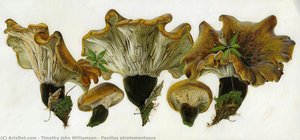
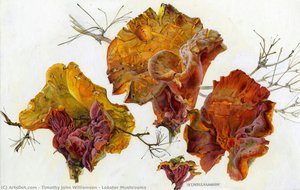
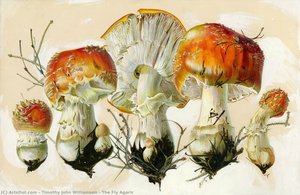
Williamson’s portfolio encompasses a diverse range of fungal studies, each demonstrating his exceptional skill and attention to detail. Paintings like *An Unknown Mahogany Cortinarius*, *The Lobster Mushroom*, and studies of *Boletinus porosu* showcase his ability to capture the subtle variations within species. Works such as *Clitocybe Multiceps*, *Paxillus atrotomentosus*, and *Cortinarius glaucopus* demonstrate a fascination with complex forms and textures. Perhaps one of his most iconic pieces is *The Fly Agaric*, a striking depiction of this well-known but often misunderstood fungus. While not widely exhibited in mainstream art galleries, Williamson’s work has gained recognition within specialized circles for its precision, beauty, and dedication to capturing the natural world. His paintings are increasingly sought after by collectors who appreciate the unique blend of scientific rigor and artistic sensibility they represent. The availability of his works through platforms like OriginalUniqueArt.com is bringing this exceptional talent to a wider audience.A Legacy Bridging Disciplines
Timothy John Williamson’s legacy lies not only in his philosophical contributions or his botanical illustrations, but in the very act of demonstrating the interconnectedness of seemingly disparate fields. He embodies the idea that rigorous intellectual inquiry can inform and enhance artistic expression, and vice versa. His work challenges us to reconsider the boundaries between science and art, logic and intuition, observation and understanding. In a world increasingly characterized by specialization, Williamson stands as a powerful advocate for interdisciplinary thinking and a holistic approach to knowledge. He reminds us that true insight often emerges from the intersection of different perspectives, and that beauty can be found in the most unexpected places—even within the intricate structures of a humble fungus.
Timothy John Williamson
1955 - , Sweden
Quick Facts
- Artistic Movement Or Style: Detailed Realism
- Artists Who Influenced This Artist:
- Bertrand Russell
- Ludwig Wittgenstein
- Date Of Birth: 1955
- Full Name: Timothy John Williamson
- Nationality: British
- Notable Artworks:
- An Unknown Mahogany Cortinarius
- The Lobster Mushroom
- Boletinus porosu
- Clitocybe Multiceps
- Paxillus atrotomentosus
- Place Of Birth: Uppsala, Sweden
Related Articles
Timeless Legends: A Curated Guide to the Eternal Allure of Mythological Masterpieces
Embark on a sophisticated journey through the eternal allure of mythological art. Discover how master painters breathe life into ancient legends, from Greek deities to Baroque masterpieces, and learn to curate these timeless narratives within your own exquisite art collection.
The Allure of Focal Points in Art: Composition, Psychology & History
Explore the art of composition! Discover how focal points, visual hierarchy & chiaroscuro shape perception. Uncover historical techniques & psychological impact for a deeper understanding of masterpieces.
The Eloquence of Arrangement: Exploring Compositional Strategies in Western Art
Explore the evolution of compositional strategies in Western art from the Renaissance to Modernism. Discover how masters like Raphael & Zurbaran used perspective, proportion, and dynamic arrangement to create timeless masterpieces. Enhance your art appreciation today!
The Eloquence of Arrangement: Compositional Strategies in Western Art from the Renaissance to Modernism
Explore the evolution of compositional strategies in Western art! Discover how masters like Raphael & Zurbaran used perspective, proportion, and dynamic arrangement to create timeless masterpieces. Enhance your art appreciation today!
Echoes of Olympus: Mythological Narratives in Western Art Through the Ages
Explore the captivating history of mythological narratives in Western art! From ancient Greece to modern masterpieces, discover iconic artworks & symbolism. Expert analysis and high-quality reproductions at OriginalUniqueArt.