Menu
Text size

() ·

A painting made for you, by hand

Boletus luridus

Hand Made Oil Reproduction

Hand-painted oil on canvas in your size and frame, made to order by our artists. ( Switch to Print Switch to Digital Image)

Collectible Description

Vibrant watercolor mushrooms in shades of red, yellow, and green bring the natural beauty of Timothy John Williamson's Boletus luridus to life, offering a delicate botanical treasure for your private collection.

Artist Biography

Timothy John Williamson (b. 1955): British philosopher & botanical artist renowned for detailed fungi paintings. Explore the intersection of science, art & philosophical inquiry!

from ·

Chapter 1

How large should it be?

Slide to change the size; the picture on the left shows the frame at its real width. The proportions of the original are kept.

Standard
custom
CM
INCH

Pick from our preset sizes that match the artwork's original proportions.

width
height

Type the width and the height you need, to fit your frame or your wall. This is hand-painted, so for a size with a different shape the artist can paint a bit more around the picture, or cut a bit — you choose. We send you a digital mockup to approve before the painting starts. The picture shown on this page does not show the real result — only the mockup does.

Chapter 2

How should it arrive?

Choose the edges of the stretched canvas

Choose your frame

Corner sample of the WhiteWrap canvas edge finish, stretched on solid wood bars
White $1
Corner sample of the BlurSideWrap canvas edge finish, stretched on solid wood bars
Blurside $1
Corner sample of the ExtendedWrap canvas edge finish, stretched on solid wood bars
Extended $1
Corner sample of the P118B picture frame: moulded polystyrene, 5 cm wide and 3 cm thick
P118B $10
Corner sample of the P118H picture frame: moulded polystyrene, 5 cm wide and 3 cm thick
P118H $10
Corner sample of the P118W picture frame: moulded polystyrene, 5 cm wide and 3 cm thick
P118W $10
Corner sample of the P438Z picture frame: moulded polystyrene, 5.5 cm wide and 3.5 cm thick
P438Z $10
Corner sample of the P508JH picture frame: moulded polystyrene, 7 cm wide and 3.5 cm thick
P508JH $12
Corner sample of the P508YH picture frame: moulded polystyrene, 7 cm wide and 3.5 cm thick
P508YH $12
Corner sample of the P805H picture frame: moulded polystyrene, 5 cm wide and 3.5 cm thick
P805H $10
Corner sample of the P805Z picture frame: moulded polystyrene, 5 cm wide and 3.5 cm thick
P805Z $10
Corner sample of the P919BZ picture frame: moulded polystyrene, 7 cm wide and 3.5 cm thick
P919BZ $10
Corner sample of the P919G picture frame: moulded polystyrene, 7 cm wide and 3.5 cm thick
P919G $10
Corner sample of the P919XJ picture frame: moulded polystyrene, 7 cm wide and 3.5 cm thick
P919XJ $10
Corner sample of the P959ZH picture frame: moulded polystyrene, 5 cm wide and 3 cm thick
P959ZH $10
Corner sample of the P968JZ picture frame: moulded polystyrene, 6 cm wide and 4 cm thick
P968JZ $12
Corner sample of the W106C picture frame: solid wood, 5 cm wide and 3 cm thick
W106C $8
Corner sample of the W218G picture frame: solid wood, 5 cm wide and 3 cm thick
W218G $10
Corner sample of the W218JH picture frame: solid wood, 5 cm wide and 3 cm thick
W218JH $8
Corner sample of the W218Y picture frame: solid wood, 5 cm wide and 3 cm thick
W218Y $10
Corner sample of the W307PJ picture frame: solid wood, 6 cm wide and 3 cm thick
W307PJ $10
Corner sample of the W316G picture frame: solid wood, 6 cm wide and 3 cm thick
W316G $10
Corner sample of the W316PJ picture frame: solid wood, 6 cm wide and 3 cm thick
W316PJ $8
Corner sample of the W316Y picture frame: solid wood, 6 cm wide and 3 cm thick
W316Y $10
Corner sample of the W398PJ picture frame: solid wood, 5 cm wide and 3 cm thick
W398PJ $8
Corner sample of the W4111J picture frame: solid wood, 6.5 cm wide and 3.5 cm thick
W4111J $10
Corner sample of the W500HY picture frame: solid wood, 7 cm wide and 5 cm thick
W500HY $15
Corner sample of the W500JH picture frame: solid wood, 7 cm wide and 5 cm thick
W500JH $15
Corner sample of the W692G picture frame: solid wood, 8 cm wide and 4 cm thick
W692G $12
Corner sample of the W849H picture frame: solid wood, 5 cm wide and 3 cm thick
W849H $8
Corner sample of the W940BG picture frame: solid wood, 7.5 cm wide and 4.5 cm thick
W940BG $15
Corner sample of the W953PJ picture frame: solid wood, 6 cm wide and 3.5 cm thick
W953PJ $8
Corner sample of the H24-GOLD picture frame: carved wood with gesso, 10 cm wide and 6 cm thick
H24-GOLD $30
Corner sample of the H24-SILVER picture frame: carved wood with gesso, 10 cm wide and 6 cm thick
H24-SILVER $30
Corner sample of the H36-GOLD picture frame: carved wood with gesso, 15 cm wide and 6.5 cm thick
H36-GOLD $45
Corner sample of the H36-SILVER picture frame: carved wood with gesso, 15 cm wide and 6.5 cm thick
H36-SILVER $45
Frame preview
Framed

Moulding: . Overall size with the frame: .

Chapter 3

Who paints it, and should anything change?

Examples of what can be changed: Replace face with customer photo; Add pet (e.g., replace cat with dog); Include hidden message in background; Change background landscape or elements.
After order, OriginalUniqueArt.com team will email client for instructions and provide a mockup preview

Worldwide Delivery () in 3/4 weeks instead of standard 5 weeks. (30 October). No compromise on quality.

Chapter 4

The finishing touches

A nameplate, as in a museum?

Engraved Bronze Plaque Details

This elegant plaque features the artist's name and the title of the artwork, finely engraved for a timeless presentation.

It is made from bronze with a refined, elegant finish. The text is precisely laser-engraved for a sharp and permanent result. Measuring 9x2 cm, the plaque is compact yet easy to read. It's built to be durable and scratch-resistant, offering a professional, museum-quality look. Mounting is simple thanks to the included adhesive backing.

Transparent Acrylic Plaque Details

The plaque includes essential engraved details such as the artist's name, the title of the artwork, the date it was created, the type of media used-like oil on canvas or watercolor-a brief description of the piece, and a QR code that links to the complete artwork information.

It is crafted from clear acrylic, offering a sleek, modern appearance. The text is UV-engraved in black to ensure strong visual contrast. With a size of 10x15 cm, it ensures optimal readability. It comes equipped with two metal hooks for secure wall mounting. The plaque is designed to be weather-resistant, making it suitable for various environments, and it includes interactive features that work seamlessly with smartphone scanning.

Black Acrylic Plaque Details

This elegant plaque includes engraved information such as the artist's name, the title of the artwork, the date it was created, the type of media used (like oil on canvas or watercolor), a short description of the artwork, and a QR code for quick access to more information.

The plaque itself is made from refined black acrylic with a premium finish. The text is laser-engraved in white for high contrast and readability. Its size is 10x15 cm, designed to be easy to read. It comes with two metal hooks for professional mounting. The design is sleek and fits any interior style. It is also weather-resistant and durable, with built-in digital integration for mobile compatibility.

A protective varnish?

When do you need it?

Chapter 5

Your painting, as you ordered it

Boletus luridus

Reproduction Medium

Reproduction Size

-

Elite Senior Artist

More detail, finesse, and extra production time

-

Reproduction Frame

-

-

For artworks or reproductions larger than 105 cm (approximately 41 inches) on any side, the frame will be shipped as a kit, disassembled. This method ensures safe delivery and prevents damage during transport.

Professional assembly required - this is not a DIY product.
The kit must be assembled and the canvas stretched by an experienced professional framer, using wood glue (not supplied), a canvas stretching plier and clamps to hold the bars square while the glue dries. Incorrect assembly or uneven canvas tension can permanently damage the artwork and is not covered by our warranty.

  • All solid wood bars are included, precisely cut to size.

  • Assembled with the screws provided, plus wood glue for the corner joints, which is not supplied and must be sourced by your framer.

  • Professional tools are required and not included: a canvas stretching plier (tensioner) and clamps to hold the bars square while the glue dries.

Important:
The corner joints require wood glue, the bars must be held with clamps until the glue is fully dry, and tightening the canvas on the assembled frame requires a canvas stretching plier. None of these are included in the kit. Please arrange an experienced professional framer before ordering this size.

Nameplate

-

-

Protective Varnish

Glossy Varnish (enhances colors, protects against light/moisture)

-

Customize My Artwork

Examples of what can be changed: Replace face with customer photo; Add pet (e.g., replace cat with dog); Include hidden message in background; Change background landscape or elements.

-

Urgent

Worldwide Delivery () in 3/4 weeks instead of standard 5 weeks. (30 October). No compromise on quality.

-

Express Shipping

Worldwide Delivery () in 5 weeks. (6 November).

Included

Total Price

$ 300

Total Price $ 300

Glass option is only available in size under 110 CM

Included with every order

  • Free Worldwide Express Shipping
  • High-Quality Linen Canvas
  • Full Shipping Insurance
  • Customs Tax Refund Guarantee
  • True Color Matching Guarantee
  • 100-Day Return Policy (Defects Only)
  • 100% Money-Back Guarantee
  • Bulk Discount Offer

A Botanical Symphony in Watercolor

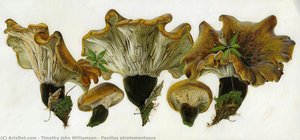
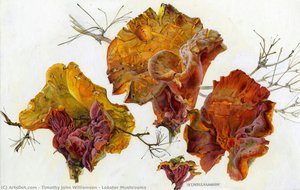
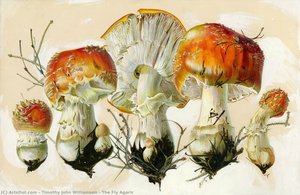
In the delicate intersection of scientific precision and artistic grace lies Timothy John Williamson’s Boletus luridus. This exquisite watercolor on paper serves as more than a mere botanical study; it is a vibrant window into the hidden, miniature worlds that thrive beneath the forest canopy. The painting captures a diverse assembly of fungi, rendered with a masterful command of color and light. Deep reds, sun-drenched yellows, earthy browns, and soft mossy greens dance across the composition, creating a sense of organic vitality. Each mushroom is depicted with a unique silhouette, some emerging boldly from the damp earth while others nestle quietly in the shadows, inviting the viewer to contemplate the complex biodiversity of the natural world.

The technique employed by Williamson is nothing short of mesmerizing. Utilizing the fluid, translucent properties of watercolor, the artist achieves a remarkable sense of depth and texture that mimics the moist, tactile reality of a forest floor. The way the pigments bleed into one another suggests the soft, porous flesh of the fungi, while sharper, more concentrated strokes define the intricate details of the caps and stems. This delicate balance between soft washes and precise linework allows the viewer to appreciate both the atmospheric mood of the woodland and the anatomical accuracy required of a true botanical illustrator.

The Intersection of Philosophy and Nature

To understand Boletus luridus, one must look toward the unique mind of its creator. Timothy John Williamson is a figure of rare intellectual duality; while he is celebrated globally as a titan of contemporary epistemology, his artistic output reveals a profound, meditative connection to the natural sciences. For Williamson, the act of painting fungi is an extension of philosophical inquiry—a way to observe the minute, often overlooked structures of existence with rigorous clarity. There is a quiet, contemplative symbolism embedded in this work; the mushrooms, which emerge and decay in cycles unseen by most, represent the profound beauty found in the ephemeral and the hidden layers of reality.

For the discerning collector or interior designer, this piece offers a sophisticated touch of organic elegance. Its intimate scale—measuring 15 x 29 cm—makes it an ideal focal point for a curated gallery wall or a refined addition to a study or library. The painting brings a sense of calm, scholarly prestige to any space, evoking the atmosphere of a classical natural history museum. Whether displayed as a standalone treasure or part of a larger collection of botanical art, Boletus luridus provides an enduring emotional impact, reminding us of the intricate, beautiful complexity that exists just beneath our feet.

Questions & Answers

Where can I buy a digital image of "Boletus luridus" by Timothy John Williamson?

"Boletus luridus" is available as a high-resolution digital image download, purchased directly on its Digital Image page.

What is the color identity of "Boletus luridus" by Timothy John Williamson?

"Boletus luridus" is defined by a neutrals palette led by driftwood (#9b833c).

Is there a slideshow for "Boletus luridus" by Timothy John Williamson?

The diaporama of "Boletus luridus" can be watched on the artwork's Diaporama page.

More about this painting

Preview AR preview Switch to Print Switch to Digital Image Send
Details Guide Add to favorites Download Similars X-Ray Diaporama Q&A Stats

In numbers

  • 29frames to choose from
  • standard sizes, in its own proportions
  • 5weeks to paint and deliver it

About the original

Timothy John Williamson

Timothy John Williamson

1955 - , Sweden

Quick facts about Timothy John Williamson

  • Artistic Movement Or Style: Detailed Realism
  • Artists Who Influenced This Artist:
    • Bertrand Russell
    • Ludwig Wittgenstein
  • Date Of Birth: 1955
  • Full Name: Timothy John Williamson
  • Nationality: British
  • Notable Artworks:
    • An Unknown Mahogany Cortinarius
    • The Lobster Mushroom
    • Boletinus porosu
    • Clitocybe Multiceps
    • Paxillus atrotomentosus
  • Place Of Birth: Uppsala, Sweden

Artist Biography

A Dual Pursuit: The Philosophical Eye of Timothy John Williamson

Timothy John Williamson, born in Uppsala, Sweden in 1955, presents a fascinating anomaly in the world of artistic and intellectual endeavor. He is not simply a philosopher who dabbles in art, nor an artist inspired by philosophical concepts; rather, he embodies a rare synthesis of rigorous analytical thought and meticulous observational skill. His journey exemplifies how seemingly disparate disciplines can enrich one another, resulting in work that is both intellectually stimulating and aesthetically compelling. While globally recognized as a leading figure in contemporary philosophy—particularly for his groundbreaking contributions to epistemology with works like *Knowledge and its Limits* (2000)—Williamson has quietly cultivated a significant body of botanical illustrations, specializing in the intricate beauty of fungi. This artistic pursuit isn’t merely a hobby; it's an extension of his philosophical inquiry, a tangible exploration of perception, detail, and the very nature of knowledge itself.

From Logic to Lichens: The Development of a Unique Vision

Williamson’s intellectual foundations were laid in the traditions of British analytic philosophy. Influenced by giants like Bertrand Russell and Ludwig Wittgenstein, he developed a unique approach—'knowledge-first epistemology’—that places knowledge at the core of epistemological investigation. This emphasis on precision, clarity, and logical structure permeates both his philosophical writings and his artistic practice. The transition from abstract thought to concrete representation wasn’t abrupt. It grew organically from a deep appreciation for the natural world and a desire to understand it through direct observation. He found in fungi—often overlooked, hidden from casual view—a subject perfectly suited to his meticulous nature. Their complex forms, subtle colors, and delicate structures demanded careful study, mirroring the painstaking analysis he applied to philosophical problems. The act of painting became a form of visual thinking, a way to explore the boundaries between perception and understanding.

The Art of Observation: Style and Themes

Williamson’s botanical illustrations are characterized by an unwavering commitment to realism and scientific accuracy. He doesn't merely *depict* fungi; he dissects them visually, revealing their intricate morphology with astonishing detail. Each painting is a testament to hours of careful observation, capturing the subtle nuances of texture, color, and form. His style evokes the tradition of 19th-century botanical illustration, reminiscent of the meticulous work produced for scientific documentation. However, Williamson’s paintings transcend mere technical skill; they possess an aesthetic sensibility that elevates them to the realm of fine art. The compositions are often simple yet elegant, focusing attention on the inherent beauty of the subject matter. He doesn't impose a narrative or symbolism onto his work; instead, he allows the fungi themselves to speak, revealing their unique character through precise representation. Key themes include detailed realism, botanical accuracy, and the bridging of art with scientific documentation.

Notable Works and Growing Recognition

Williamson’s portfolio encompasses a diverse range of fungal studies, each demonstrating his exceptional skill and attention to detail. Paintings like *An Unknown Mahogany Cortinarius*, *The Lobster Mushroom*, and studies of *Boletinus porosu* showcase his ability to capture the subtle variations within species. Works such as *Clitocybe Multiceps*, *Paxillus atrotomentosus*, and *Cortinarius glaucopus* demonstrate a fascination with complex forms and textures. Perhaps one of his most iconic pieces is *The Fly Agaric*, a striking depiction of this well-known but often misunderstood fungus. While not widely exhibited in mainstream art galleries, Williamson’s work has gained recognition within specialized circles for its precision, beauty, and dedication to capturing the natural world. His paintings are increasingly sought after by collectors who appreciate the unique blend of scientific rigor and artistic sensibility they represent. The availability of his works through platforms like OriginalUniqueArt.com is bringing this exceptional talent to a wider audience.

A Legacy Bridging Disciplines

Timothy John Williamson’s legacy lies not only in his philosophical contributions or his botanical illustrations, but in the very act of demonstrating the interconnectedness of seemingly disparate fields. He embodies the idea that rigorous intellectual inquiry can inform and enhance artistic expression, and vice versa. His work challenges us to reconsider the boundaries between science and art, logic and intuition, observation and understanding. In a world increasingly characterized by specialization, Williamson stands as a powerful advocate for interdisciplinary thinking and a holistic approach to knowledge. He reminds us that true insight often emerges from the intersection of different perspectives, and that beauty can be found in the most unexpected places—even within the intricate structures of a humble fungus.

Quick Facts

  • Location: Canadian Museum of Nature
  • Artist: Timothy John Williamson
  • Title: Boletus luridus
  • Medium: Watercolor on paper