Preview
 Send
Send Share
Share
 Details
 Guide
Guide

 Download
 Similars
 X-Ray
X-Ray Diaporama
 Q&A
Q&A Stats
StatsThe Recitation


 Read More
Giclée / Art Print
Museum-quality giclée or canvas print with fast production and flexible finish options. ( Buy Hand Made Painting Switch to Digital Image)




P118B $10

P118H $10

P118W $10

P438Z $10

P508JH $12

P508YH $12

P805H $10

P805Z $10

P919BZ $10

P919G $10

P919XJ $10

P959ZH $10

P968JZ $12

W106C $8

W218G $10

W218JH $8

W218Y $10

W307PJ $10

W316G $10

W316PJ $8

W316Y $10

W398PJ $8

W4111J $10

W500HY $15

W500JH $15

W692G $12

W849H $8

W940BG $15

W953PJ $8




Pick from our preset sizes that match the artwork's original proportions.

Type the width and the height you need, to fit your frame or your wall. A print can only be cut, never made bigger than the picture, so a size with a different shape loses a part of the image. We send you a digital mockup to approve before we print anything. The picture shown on this page does not show the real cut — only the mockup does.
Worldwide Delivery () in 2 weeks instead of standard 4/5 weeks. (31 October)

Free Worldwide Express Shipping

High-Quality Linen Canvas

Full Shipping Insurance

Customs Tax Refund Guarantee

True Color Matching Guarantee

100-Day Return Policy (Defects Only)

100% Money-Back Guarantee

Bulk Discount Offer
 Glass option is only available in size under 110 CM

The Recitation
Giclée / Art Print
Reproduction Size
-


Total Price
$ 81
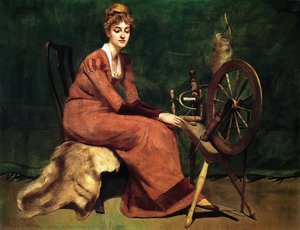
The Recitation by Thomas Wilmer Dewing: A Portrait of Quiet Contemplation
Thomas Wilmer Dewing’s “The Recitation,” completed in 1891, is more than just a depiction of two women seated on a veranda; it's an embodiment of the Aesthetic Movement’s fascination with mood and atmosphere. Painted in tonalist style—a technique championed by Dewing himself—the canvas exudes serenity and invites viewers into a moment suspended between observation and introspection. The artist meticulously captures the subtle nuances of light and shadow, prioritizing tonal gradations over sharp delineation to create an illusionistic depth that feels remarkably realistic despite its muted palette.- Subject Matter: Dewing’s subject matter consistently revolved around aristocratic women engaged in solitary pursuits—reading, playing instruments, or simply gazing out at the landscape. “The Recitation” exemplifies this preoccupation with feminine grace and inner life, portraying two figures bathed in diffused sunlight against a backdrop of lush greenery.
- Style & Technique: Dewing’s tonalist approach distinguishes him from Impressionists who sought to capture fleeting impressions of light. Instead, he aimed for a more profound emotional resonance by layering thin washes of color—primarily browns, greens, and ochres—to build up form and texture. This painstaking process resulted in paintings that possess an almost sculptural quality, reminiscent of Pre-Raphaelite art.
- Historical Context: The Aesthetic Movement flourished in Britain during the late Victorian era, reacting against materialism and industrialization. Artists like Dewing embraced a philosophy rooted in beauty for its own sake—rejecting didactic narratives in favor of evocative imagery that stirred the imagination. “The Recitation” reflects this ethos by prioritizing emotional experience over intellectual analysis.
- Symbolism: The positioning of the women—one seated, one observing—suggests a dynamic interplay between stillness and awareness. The veranda itself symbolizes refuge from the outside world, fostering contemplation and introspection. Dewing’s masterful use of color contributes to this symbolic dimension, conveying feelings of peace, melancholy, and perhaps even longing.
- Emotional Impact: “The Recitation” succeeds in transporting viewers to a tranquil setting where time seems to slow down. The painting's subdued colors and soft textures evoke a sense of quiet beauty—a testament to Dewing’s ability to capture the essence of human emotion through visual artistry. It speaks to themes of solitude, contemplation, and the appreciation of natural splendor.
Provenance & Reproduction Quality
This artwork originally resided in the collection of John Gellatly, a prominent Scottish art collector who championed tonalist painters like Dewing. Today, reproductions crafted by Detroit Institute of Arts Custom Prints uphold the highest standards of artistic fidelity. Utilizing state-of-the-art printing technology and archival inks on premium matte finish paper—a choice mirroring Dewing’s own meticulous attention to detail—these prints faithfully recreate the painting's luminous tonal gradations and textural subtleties. Each print is rolled with tissue paper for protection during shipping, ensuring that your acquisition arrives in pristine condition. Explore a stunning representation of this iconic piece – a timeless celebration of beauty and contemplation.Questions & Answers
What subjects appear in "The Recitation" by Thomas Wilmer Dewing?
The subjects of "The Recitation" are beach landscape, women figures, interior scene, piano music, quiet reflection, romantic mood, american art, tonalist painting.
Does the copyright of "The Recitation" by Thomas Wilmer Dewing allow reproductions?
The copyright status of "The Recitation" by Thomas Wilmer Dewing is clear: the work is in the public domain - its copyright has expired. Its presence at the Detroit Institute of Arts does not change that status.
Do the colors of "The Recitation" appear strong or soft?
The colors in "The Recitation" by Thomas Wilmer Dewing have a balanced intensity.
Artist Biography
**early life and training**
thomas wilmer dewing, an american painter, was born on may 4, 1851, in boston, massachusetts. his artistic journey began with a lithographic apprenticeship, which later led him to the prestigious académie julian in paris, where he studied under gustave boulanger and jules lefebvre starting from 1887.**artistic style and notable works**
dewing's artistic style is characterized by his tonalist paintings, a genre deeply rooted in english aestheticism. his preferred subjects were aristocratic women, often depicted in moody, dreamlike surroundings, playing instruments or engaging in introspective activities. * **woman in black: portrait of maria oakey dewing** (1887), a poignant oil on panel, showcases his wife, an accomplished painter with extensive formal art training. * **lady in gold** (1912), now at the brooklyn museum, exemplifies his mastery of capturing the essence of his subjects.**teaching and associations**
dewing was a founding member of the ten american painters in 1898 and taught at the art students league of new york. his association with the society of landscape painters, founded in 1899, further solidified his position within the tonalist movement.**legacy and collections**
* the freer gallery of art at the smithsonian institution has a dedicated room for dewing's works. * notable collectors include john gellatly and charles lang freer.- view thomas wilmer dewing's collection on OriginalUniqueArt
- more on thomas dewing at wikipedia
- explore the freer gallery of art at the smithsonian institution for more tonalist masterpieces.
**later life and death**
dewing's artistic output declined after 1920. he passed away in new york on november 5, 1938, leaving behind a legacy of captivating, ethereal portraits that continue to intrigue art enthusiasts. **key works and collections available for reproduction at OriginalUniqueArt:** * the white dress * woman in black: portrait of maria oakey dewing * lady in gold discover the world's most famous paintings with OriginalUniqueArt's extensive collection
Thomas Wilmer Dewing
1851 - 1938 , United States of America
Quick Facts
- Artistic Movement Or Style: Tonalism
- Artists Who Influenced This Artist:
- Gustave Boulanger
- Jules Lefebvre
- Full Name: Thomas Wilmer Dewing
- Nationality: American
- Notable Artworks:
- Woman in Black: Portrait of Maria Oakey Dewing
- Lady in Gold
- The White Dress
- Spring
- In the Garden
- Place Of Birth: Boston, United States of America
- Date Of Birth: 1851
- Date Of Death: 1938
Related Articles

Thomas Wilmer Dewing: Atmospheric Landscapes & the American Tonalist Vision
Explore the captivating world of Thomas Wilmer Dewing, a leading figure in American Tonalism. Discover his evocative paintings, artistic influences, and legacy with OriginalUniqueArt.

American Regionalism: A Crucible of Identity – Exploring Themes of Place, Labor & Social Commentary
Explore American Regionalism's powerful depiction of the American heartland during the Great Depression. Discover Grant Wood, Thomas Hart Benton & more. Expert analysis & high-quality art reproductions at OriginalUniqueArt.

Capturing a Nation's Light: Exploring the American Impressionist Movement
Explore the captivating world of American Impressionism! Discover key artists, techniques & its lasting impact on art history. Find museum-quality reproductions and expert guidance at OriginalUniqueArt.

Grant Wood & American Regionalism: Identity, Myth & the Rural Landscape
Explore the world of Grant Wood & American Regionalism with OriginalUniqueArt. Discover the symbolism behind 'American Gothic', recurring themes, and the movement's lasting impact on art history. High-quality reproductions available.

Frederick Childe Hassam: American Impressionism's Chronicler of Light & Modern Life
Explore the captivating world of Frederick Childe Hassam, a pioneer of American Impressionism. Discover his iconic paintings capturing light, urban life & coastal beauty. Learn about his legacy and influence on American art history.