Preview
 Send
Send Share
Share
 Details
 Guide
Guide

 Download
 Similars
 X-Ray
X-Ray Diaporama
 Stats
StatsLilac Dress
 Oil On Canvas
- WallArt
- American Tonalist Vision
 1919
1919 61.0 x 51.0 cm
 Metropolitan Museum of Art
 Read More
Giclée / Art Print
Museum-quality giclée or canvas print with fast production and flexible finish options. ( Buy Hand Made Painting Switch to Digital Image)




P118B $10

P118H $10

P118W $10

P438Z $10

P508JH $12

P508YH $12

P805H $10

P805Z $10

P919BZ $10

P919G $10

P919XJ $10

P959ZH $10

P968JZ $12

W106C $8

W218G $10

W218JH $8

W218Y $10

W307PJ $10

W316G $10

W316PJ $8

W316Y $10

W398PJ $8

W4111J $10

W500HY $15

W500JH $15

W692G $12

W849H $8

W940BG $15

W953PJ $8




Pick from our preset sizes that match the artwork's original proportions.

You may enter your own dimensions to fit a specific frame or space. If your selected size does not match the original image's proportions, we will either crop the artwork or extend the image with a mirrored or solid-fill edge. A digital mockup will be sent for your approval before production begins.
Please note that the on-screen preview does not reflect the actual cropping or extension. Only the mockup will accurately show the final composition.
While custom sizes are available, we recommend selecting a dimension from the predefined list to preserve the original proportions.
Worldwide Delivery () in 2 weeks instead of standard 4/5 weeks. (7 October)

Free Worldwide Express Shipping

High-Quality Linen Canvas

Full Shipping Insurance

Customs Tax Refund Guarantee

True Color Matching Guarantee

100-Day Return Policy (Defects Only)

100% Money-Back Guarantee

Bulk Discount Offer
 Glass option is only available in size under 110 CM

Lilac Dress
Giclée / Art Print
Reproduction Size
-


Total Price
$ 81
Lilac Dress: A Portrait of Delicate Beauty Amidst Moodiness
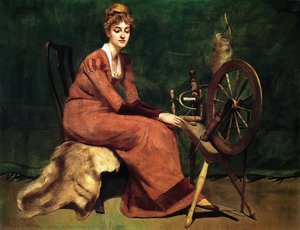
Thomas Wilmer Dewing’s “Lilac Dress” (1919) stands as a quintessential example of tonalist painting—a movement deeply rooted in English Aestheticism that championed subtle color palettes and atmospheric effects over dramatic realism. This captivating portrait captures a woman seated gracefully on a chair, gazing off-camera with an expression of quiet contemplation. The scene unfolds within a softly lit interior, dominated by a pale green wall and two unassuming chairs – one positioned centrally, the other subtly to the right—creating a harmonious backdrop that enhances the painting’s contemplative mood.- Subject Matter: Dewing's focus on aristocratic women aligns with the Aesthetic movement’s fascination for idealized femininity and psychological depth. The woman depicted embodies serenity and introspection, reflecting the prevalent Victorian ideals of feminine virtue and inner life.
- Style & Technique: Dewing meticulously employs tonalist techniques—characterized by muted hues and blended brushstrokes—to achieve a velvety surface texture and convey an emotional resonance that transcends mere visual representation. He skillfully captures light and shadow, imbuing the scene with a palpable sense of stillness and tranquility.
- Color Palette: The dominant lilac hue of the dress is juxtaposed against the muted green wall, creating a harmonious color scheme that contributes to the painting’s overall atmosphere. Dewing's masterful use of color subtly underscores the woman’s inner state—a quiet contemplation mirroring the delicate beauty of the floral motif.
- Historical Context: Created during the early 20th century, “Lilac Dress” reflects the broader cultural preoccupation with psychological realism and the exploration of feminine emotion within the framework of Aesthetic ideals. It embodies a reaction against Impressionism’s fleeting impressions of light and color, favoring instead a more contemplative approach to artistic expression.
- Symbolism: The lilac flower itself carries symbolic connotations of mourning and remembrance—a poignant reminder of Victorian sensibilities regarding death and loss—yet it is presented with grace and elegance, symbolizing beauty amidst melancholy. Dewing’s deliberate choice reinforces the painting's emotional core.
Detailed Examination: Composition & Brushwork
Dewing’s compositional choices are equally noteworthy. The woman’s gaze directs the viewer’s attention outwards, suggesting a preoccupation with thoughts and feelings beyond the immediate visual field—a hallmark of tonalist portraiture. Furthermore, Dewing's brushstrokes are remarkably delicate and blended, creating an illusion of luminous softness that envelops the figure and the surrounding space. These subtle marks contribute to the painting’s ethereal quality, mirroring the moodiness inherent in the genre.The Influence of Gustave Boulanger & Jules Lefebvre
Dewing's artistic training under Gustave Boulanger and Jules Lefebvre at the Académie Julian profoundly shaped his stylistic sensibilities. Boulanger championed a monumental style reminiscent of classical sculpture—a deliberate contrast to Impressionism’s fragmented perspectives—while Lefebvre emphasized tonal harmonies and atmospheric effects. Dewing skillfully assimilated these influences, resulting in a painting that embodies both grandeur and intimacy simultaneously.A Legacy of Quiet Elegance
“Lilac Dress” remains an enduring testament to Thomas Wilmer Dewing's artistic vision—a celebration of feminine beauty tempered by melancholy and imbued with profound psychological depth. Its subtle color palette, meticulous brushwork, and contemplative composition continue to inspire admiration and resonate with viewers seeking art that transcends mere visual spectacle. Reproductions of this masterpiece offer a captivating glimpse into the aesthetic sensibilities of the early 20th century—a period defined by its exploration of inner life and its appreciation for understated elegance.Questions & Answers
Who is the artist behind "Lilac Dress"?
"Lilac Dress" was created by Thomas Wilmer Dewing. The information on this page describes Thomas Wilmer Dewing's original work.
In what year was "Lilac Dress" by Thomas Wilmer Dewing created?
"Lilac Dress" by Thomas Wilmer Dewing was created in 1919.
How do the colors of "Lilac Dress" by Thomas Wilmer Dewing relate to its emotion?
The earthy palette of "Lilac Dress" by Thomas Wilmer Dewing goes together with its melancholic emotional tone. Color is one of the ways a work conveys feeling.
Can the image of "Lilac Dress" by Thomas Wilmer Dewing be freely reproduced?
The copyright answer for "Lilac Dress" by Thomas Wilmer Dewing: the work is in the public domain - its copyright has expired. This determines whether reproductions of the image may be freely made.
Where does "Lilac Dress" sit within Thomas Wilmer Dewing's body of work?
"Lilac Dress" belongs to Thomas Wilmer Dewing's American Tonalist Vision work, whose recorded themes include romantic aestheticism, symbolic representation, domestic tranquility, idealized femininity, quiet reflection.
What was Thomas Wilmer Dewing's age when "Lilac Dress" was created?
Thomas Wilmer Dewing was 68 years old when creating "Lilac Dress" in 1919. The age is computed from the artist's birth year, 1851.
Is "Lilac Dress" one of Thomas Wilmer Dewing's most popular works?
"Lilac Dress" is classified as recognized.
Artist Biography
**early life and training**
thomas wilmer dewing, an american painter, was born on may 4, 1851, in boston, massachusetts. his artistic journey began with a lithographic apprenticeship, which later led him to the prestigious académie julian in paris, where he studied under gustave boulanger and jules lefebvre starting from 1887.**artistic style and notable works**
dewing's artistic style is characterized by his tonalist paintings, a genre deeply rooted in english aestheticism. his preferred subjects were aristocratic women, often depicted in moody, dreamlike surroundings, playing instruments or engaging in introspective activities. * **woman in black: portrait of maria oakey dewing** (1887), a poignant oil on panel, showcases his wife, an accomplished painter with extensive formal art training. * **lady in gold** (1912), now at the brooklyn museum, exemplifies his mastery of capturing the essence of his subjects.**teaching and associations**
dewing was a founding member of the ten american painters in 1898 and taught at the art students league of new york. his association with the society of landscape painters, founded in 1899, further solidified his position within the tonalist movement.**legacy and collections**
* the freer gallery of art at the smithsonian institution has a dedicated room for dewing's works. * notable collectors include john gellatly and charles lang freer.- view thomas wilmer dewing's collection on OriginalUniqueArt
- more on thomas dewing at wikipedia
- explore the freer gallery of art at the smithsonian institution for more tonalist masterpieces.
**later life and death**
dewing's artistic output declined after 1920. he passed away in new york on november 5, 1938, leaving behind a legacy of captivating, ethereal portraits that continue to intrigue art enthusiasts. **key works and collections available for reproduction at OriginalUniqueArt:** * the white dress * woman in black: portrait of maria oakey dewing * lady in gold discover the world's most famous paintings with OriginalUniqueArt's extensive collection
Thomas Wilmer Dewing
1851 - 1938 , United States of America
Quick Facts
- Full Name: Thomas Wilmer Dewing
- Nationality: American
- Date Of Birth: 1851
- Date Of Death: 1938
- Place Of Birth: Boston, United States of America
- Notable Artworks:
- Woman in Black
- Lady in Gold
- Summer (Moonrise)
- Alma
- The Spinet
- Artistic Movement Or Style: Tonalism, Aestheticism
- Artists Who Influenced This Artist:
- Gustave Boulanger
- Jules Lefebvre
- James Whistler
- Johannes Vermeer
- Artists Or Movements Influenced By This Artist: ['The Ten American Painters']
Related Articles

American Regionalism: A Crucible of Identity – Exploring Themes of Place, Labor & Social Commentary
Explore American Regionalism's powerful depiction of the American heartland during the Great Depression. Discover Grant Wood, Thomas Hart Benton & more. Expert analysis & high-quality art reproductions at OriginalUniqueArt.

American Realism's Defining Works: 10 Masterpieces for Your Home
Explore 10 defining American Realism masterpieces – Hopper, Homer & more. Discover the stories behind these iconic paintings and bring timeless art to your home with OriginalUniqueArt's museum-quality reproductions. Explore the full collection online.

Thomas Wilmer Dewing: Atmospheric Landscapes & the American Tonalist Vision
Explore the captivating world of Thomas Wilmer Dewing, a leading figure in American Tonalism. Discover his evocative paintings, artistic influences, and legacy with OriginalUniqueArt.
Echoes of Place: Regionalism & American Identity in Interwar Art
Explore the rise of American Regionalism in interwar art! Discover Grant Wood, Thomas Hart Benton & the movement's impact on American identity. Expert analysis & historical context.

Grant Wood & American Regionalism: Identity, Myth & the Rural Landscape
Explore the world of Grant Wood & American Regionalism with OriginalUniqueArt. Discover the symbolism behind 'American Gothic', recurring themes, and the movement's lasting impact on art history. High-quality reproductions available.