Oil Edition
 Everything about Daniel LaMotte







































 For artworks or reproductions larger than 105 cm (approximately 41 inches) on any side, the frame will be shipped as a kit, disassembled. This method ensures safe delivery and prevents damage during transport.


A Presence in the Quietude
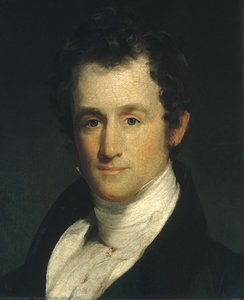
Daniel LaMotte sits in a moment of poised stillness, his gaze drifting slightly away from the viewer toward an unseen horizon. The year is 1812, and the air around him feels heavy with the dignity of his station. He is captured in a three-quarter view, his body forming a steady, pyramidal shape that anchors the entire composition. A dark jacket, textured with the weight of fine fabric, wraps around his torso, while the crisp, bright white of his shirt and cravat catches the light, drawing the eye immediately to his face. There is a quiet confidence in his expression, a sense of intelligence that lingers in the soft lines of his features. Behind him, the world recedes into a muted landscape of rolling hills and distant, hazy mountains, rendered in soft, blended strokes that suggest a vast, open space beyond the immediate room.
The Language of Light and Form
The artist employs a deliberate play of light to sculpt the man from the shadows. A focused illumination bathes LaMotte’s face and upper body, leaving the background in a gentle, atmospheric gloom. This technique creates a sense of depth, pulling the subject forward while the landscape dissolves into the distance through atmospheric perspective. The brushwork reveals a careful balance between the smooth, polished skin of the sitter and the more tactile, rougher textures of his attire. Every detail contributes to a sense of physical reality:
- The sharp, defined lines of the facial features and clothing folds.
- The contrast between the structured geometry of the vest and the organic curves of the human form.
- The subtle, warm hues of orange and pink drifting through the distant hills.
- The use of glazing to create a luminous quality in the skin and fabric.
A Study in Character
Through the medium of oil on canvas, the portrait becomes more than a mere likeness; it becomes a study of social standing and personal temperament. The structured elements of his clothing—the collar and the vest—speak to a life of order and perhaps authority. The landscape, though soft and indistinct, hints at a connection to the land, providing a sense of place to this formal encounter. The shadows are not merely absences of light but are used to build a sense of volume and presence, making the man feel as though he occupies the very space before us. The painting captures a specific intersection of person and era, preserving a moment of quiet, dignified existence from the early nineteenth century.
Questions & Answers
Is this Daniel LaMotte painted by hand or printed?
Painted by hand: a trained painter copies Daniel LaMotte in oil on linen canvas.
What size should I choose for Daniel LaMotte?
Sizes run from 35.4 x 28.3 cm ($200) to 246.0 x 196.5 cm ($1772); the table on this page lists the main steps and their prices.
How long does delivery take?
Delivery takes 4 to 5 weeks, with free worldwide express shipping; an urgent production option is offered on this page. You can return it within 100 days for a full refund, with no condition.
Where is the original Daniel LaMotte?
The original is in the collection of the Smithsonian American Art Museum, Washington, D.C..
What medium did Thomas Sully use for Daniel LaMotte?
Oil On Canvas.
More about this painting
 Preview

 Send
 Share
 Details
 Fact sheet


 Download
 Similars
 X-Ray
 Diaporama
 Q&A

 Stats