

 Preview
 Send
Send Share
Share
 Details
 Guide
Guide

 Download
 Similars
 X-Ray
X-Ray Diaporama
 Q&A
Q&A Stats
StatsOutreaching Hands


 Read More
The artwork displayed on this page is protected by copyright law, which means we cannot legally create or sell an identical reproduction. This protection is enforced under international agreements such as the Berne Convention and by national laws, including those outlined by the U.S. Copyright Law - Title 17.
This method fully complies with copyright regulations because it does not involve copying or duplicating the protected artwork. Instead, it is a creative reinterpretation - a new painting that is influenced by the original but not identical to it.
Giclée / Art Print
Museum-quality giclée or canvas print with fast production and flexible finish options. ( Buy Hand Made Painting Switch to Digital Image)




P118B $10

P118H $10

P118W $10

P438Z $10

P508JH $12

P508YH $12

P805H $10

P805Z $10

P919BZ $10

P919G $10

P919XJ $10

P959ZH $10

P968JZ $12

W106C $8

W218G $10

W218JH $8

W218Y $10

W307PJ $10

W316G $10

W316PJ $8

W316Y $10

W398PJ $8

W4111J $10

W500HY $15

W500JH $15

W692G $12

W849H $8

W940BG $15

W953PJ $8




Pick from our preset sizes that match the artwork's original proportions.

Type the width and the height you need, to fit your frame or your wall. A print can only be cut, never made bigger than the picture, so a size with a different shape loses a part of the image. We send you a digital mockup to approve before we print anything. The picture shown on this page does not show the real cut — only the mockup does.
Worldwide Delivery () in 2 weeks instead of standard 4/5 weeks. (30 October)

Free Worldwide Express Shipping

High-Quality Linen Canvas

Full Shipping Insurance

Customs Tax Refund Guarantee

True Color Matching Guarantee

100-Day Return Policy (Defects Only)

100% Money-Back Guarantee

Bulk Discount Offer
 Glass option is only available in size under 110 CM

Outreaching Hands
Giclée / Art Print
Reproduction Size
-


Total Price
$ 81
A Vision of American Resilience
In the evocative landscape of American Regionalism, few works capture the raw, pulsing energy of the human condition quite like Thomas Hart Benton’s “Outreaching Hands.” Created in 1931, a period defined by the profound economic tremors of the Great Depression, this masterpiece serves as much more than a mere visual study; it is a visceral embodiment of the American spirit. The painting presents a striking and somewhat surreal narrative where a series of hands—rendered with bold, expressive brushstrokes—extend upward toward a towering architectural edifice. This composition creates a sense of linear progression, drawing the viewer’s eye into a rhythmic dance of movement and aspiration. There is an undeniable tension in the gesture, suggesting a desperate attempt to bridge gaps, overcome obstacles, or perhaps even reach for a stability that feels momentarily out of grasp.
Benton, a titan of the Midwestern art scene, intentionally rejected the polished, avant-garde conventions flowing from Paris to anchor his creative vision in the tangible realities of the American heartland. In “Outreaching Hands,” this commitment is palpable. The subject matter, while symbolic, feels deeply rooted in the social and economic transformations of his era. As one observes the hands reaching for bread or grasping at currency, the painting becomes a poignant commentary on the collective yearning and the struggle for connection amidst widespread hardship. For the collector or designer, this piece offers a profound depth of meaning, acting as a window into a pivotal moment in history when the nation was searching for its own unique artistic and social identity.
Mastery of Form and Color
The technical brilliance of Benton’s approach lies in his ability to marry muscularity with fluidity. Utilizing oil on canvas, he employs a technique that celebrates the very process of creation. The brushstrokes are not hidden beneath a veneer of perfection; instead, they are visible and energetic, lending a sense of dynamism and authenticity to the flesh and stone alike. This layering approach allows for a rich texture that mimics the ruggedness of weathered surfaces while simultaneously capturing the warmth and vitality of human skin. His figures possess a sculpted, almost rhythmic quality that is characteristic of his unique Regionalist style, making the scene feel both grounded in reality and elevated by a dreamlike, surrealist undertone.
Color plays a transformative role in the emotional resonance of the work. The palette is dominated by earthy, grounding tones—deep browns, ochres, and sienna—which evoke the dust and soil of rural America. However, Benton masterfully punctuates these somber hues with vibrant splashes of blue and yellow. These sudden bursts of light do not merely decorate the canvas; they inject a sense of optimism and hope into an otherwise heavy atmosphere. This careful balance between the weight of the earth and the brilliance of light creates a captivating visual rhythm that can serve as a powerful focal point in any curated space, offering both a sophisticated aesthetic and a deep, contemplative emotional impact.
An Enduring Legacy for the Modern Collector
For those looking to adorn a space with art that speaks of strength, history, and human connection, “Outreaching Hands” offers unparalleled inspiration. It is a work that transcends simple decoration, inviting conversation through its complex symbolism and masterful execution. Whether placed in a contemporary gallery setting or a classic study, the painting’s ability to evoke both the struggle and the hope of the American experience remains undiminished by time.
Investing in a high-quality reproduction of this Benton masterpiece allows the enduring power of Regionalism to reside within your own environment. It provides an opportunity to possess a piece of art history that celebrates the beauty of the everyday and the indomitable will of the human spirit, making it an exquisite choice for discerning collectors and interior designers seeking to infuse their projects with soul and narrative depth.
Questions & Answers
What does "Outreaching Hands" by Thomas Hart Benton bring to an interior?
"Outreaching Hands" by Thomas Hart Benton has a calm atmosphere and is recommended for a living room. The mood is what the work brings to the space around it.
Is a download available for "Outreaching Hands"?
A download is available for "Outreaching Hands": the artwork's Download page offers a high-resolution digital image download.
How old was Thomas Hart Benton when creating "Outreaching Hands" in 1931?
Thomas Hart Benton was 42 years old when creating "Outreaching Hands" in 1931. The age is computed from the artist's birth year, 1889.
Artist Biography
A Midwestern Voice: The Life and Art of Thomas Hart Benton
Born in Neosho, Missouri, in 1889, Thomas Hart Benton emerged as a pivotal figure in American art, a painter who dedicated his life to capturing the essence of the nation’s spirit—particularly that of its heartland. His story is one of rebellion against societal expectations and a passionate embrace of distinctly American themes. Unlike many artists of his generation drawn to European modernism, Benton resolutely turned inward, seeking inspiration in the landscapes, people, and stories of the United States. This commitment placed him at the forefront of the Regionalist movement, alongside Grant Wood and John Steuart Curry, shaping a uniquely American artistic identity during a period of profound social and economic change. His father, Maecenas Benton, was a lawyer and congressman, intending for his son to follow a path in politics; however, young Thomas possessed an irrepressible creative spirit that led him away from the halls of power and toward the world of art. This divergence began with work as a cartoonist for the *Joplin American* newspaper, a formative experience that honed his observational skills and instilled a love for visual storytelling.From Paris to Regionalism: The Development of a Style
Benton’s formal artistic education took him first to the Art Institute of Chicago and then to Paris in 1909, where he studied at the Académie Julian. While exposed to European artistic traditions, he found himself increasingly disillusioned with their detachment from American life. A period of experimentation followed his return to the United States, marked by a search for a visual language that could authentically express his connection to the land and its people. This quest led him through various styles—from impressionism to synchromism—before culminating in the distinctive Regionalist aesthetic he would become known for. His figures became fluid and sculpted, imbued with a sense of dynamism and vitality. He wasn’t merely depicting scenes; he was conveying the energy and rhythm of American life. This stylistic evolution wasn't simply an artistic choice but a deliberate rejection of European dominance and an assertion of American cultural independence. He embraced naturalistic representation, focusing on everyday subjects—farmers, laborers, families—and portraying them with honesty and empathy.Murals and Masterpieces: Benton’s Artistic Achievements
Benton's artistic output was prolific and diverse, encompassing paintings, murals, prints, and illustrations. He is perhaps best known for his large-scale mural projects, which brought art directly into public spaces and made it accessible to a wider audience. The *America Today* murals, commissioned for the New School for Social Research in New York City (1930-31), stand as a monumental achievement—a sweeping panorama of American life during the Great Depression. These panels, now housed at the Metropolitan Museum of Art, depict scenes from across the country, capturing both the hardships and resilience of the American people. Beyond murals, his easel paintings like *The Sheepherder* and *Prodigal Son* demonstrate a mastery of composition, color, and narrative. He possessed an exceptional ability to imbue biblical or historical stories with contemporary relevance, grounding them in the realities of American experience. His work *City Building (Study for America Today)* exemplifies his dynamic style and raw energy. He wasn’t afraid to tackle complex social issues through his art, using it as a platform for commentary and critique.A Legacy of American Identity
Thomas Hart Benton's influence on American art is undeniable. He helped define a distinctly American artistic voice, one that celebrated the nation’s unique character and challenged prevailing European aesthetic norms. His Regionalist approach paved the way for future generations of artists to explore their own regional identities and cultural heritage. He was also a dedicated educator, teaching at institutions like the Art Students League of New York and the Kansas City Art Institute, mentoring numerous aspiring artists—including Jackson Pollock. Benton’s commitment to social realism and his willingness to engage with contemporary issues continue to resonate today. He left behind a body of work that serves as a powerful testament to the enduring spirit of America, its people, and its landscapes. His legacy extends beyond the canvas, inspiring artists to find their own voices and tell their own stories—rooted in the places they call home. He died in 1975, leaving behind a rich artistic heritage that continues to captivate and inspire audiences worldwide.
Thomas Hart Benton
1889 - 1975 , United States of America
Quick Facts
- Full Name: Thomas Hart Benton
- Nationality: American
- Date Of Birth: 1889
- Date Of Death: 1975
- Place Of Birth: Neosho, United States of America
- Notable Artworks:
- Prodigal Son I
- Flood
- City Building
- The Sheepherder
- Artistic Movement Or Style: Regionalism
Related Articles

American Regionalism: The Soul of the Heartland and the Mastery of Grant Wood
Explore the profound history of American Regionalism. Discover how Grant Wood captured the heart of the Midwest through masterpieces like American Gothic. An expert guide to the movement, its cultural impact, and the enduring beauty of American Realism.
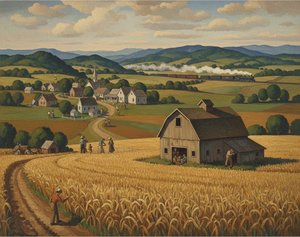
American Regionalism: Capturing the Soul of the Heartland through the Lens of Art History
Explore the profound beauty of American Regionalism. Delve into the art history of Grant Wood and John Steuart Curry, uncovering how these masters captured the soul of the American Heartland through iconic landscapes and rural identity.

Grant Wood & American Regionalism: Identity, Myth & the Rural Landscape
Explore the world of Grant Wood & American Regionalism with OriginalUniqueArt. Discover the symbolism behind 'American Gothic', recurring themes, and the movement's lasting impact on art history. High-quality reproductions available.
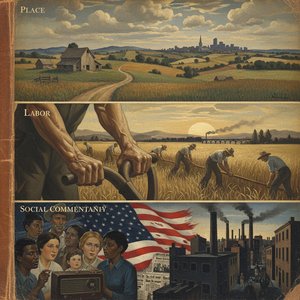
American Regionalism: A Crucible of Identity – Exploring Themes of Place, Labor & Social Commentary
Explore American Regionalism's powerful depiction of the American heartland during the Great Depression. Discover Grant Wood, Thomas Hart Benton & more. Expert analysis & high-quality art reproductions at OriginalUniqueArt.
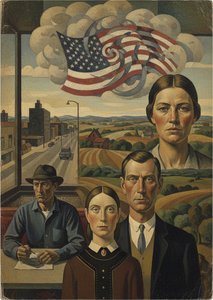
Echoes of Place: Regionalism & American Identity in Interwar Art
Explore the rise of American Regionalism in interwar art! Discover Grant Wood, Thomas Hart Benton & the movement's impact on American identity. Expert analysis & historical context.


