Hudson River School · 1826
Kaaterskill Falls (Thomas Cole, 1826)
Thomas Cole (1801–1848) made Kaaterskill Falls. It dates from 1826. It belongs to the Hudson River School movement. It is made in oil on canvas. It is kept at Wadsworth Atheneum in Hartford, United States of America. It measures 64 × 91 cm.
- 1826
- Oil On Canvas
- 64 × 91 cm
- Wadsworth Atheneum, Hartford

 Preview

 Hand Made Oil Painting
 Send
 Share
 Fact sheet


 Download
 Similars
 X-Ray
 Diaporama
 Q&A

 Stats
Kaaterskill Falls, in brief
- Title
- Kaaterskill Falls
- Artist
- Thomas Cole (1801–1848)
- Artist born in
- Bolton, United Kingdom
- Date
- 1826
- Medium
- Oil On Canvas
- Dimensions
- 64 × 91 cm
- Where to see it
- Wadsworth Atheneum, Hartford, United States of America
- Movement
- Hudson River School
- Period
- 19th Century
- Subject
- waterfall painting, american landscape, romanticism art, thomas cole artwork, hudson river scene, nature beauty
What does Kaaterskill Falls depict?
Kaaterskill Falls: A Romantic Vision of American Wilderness
Thomas Cole’s “Kaaterskill Falls,” painted in 1826, is more than just a depiction of a beautiful waterfall; it's a foundational statement of American artistic identity. Created during the height of the Hudson River School movement, this oil on canvas captures a moment of profound connection between humanity and the untamed spirit of the American landscape. Measuring 64 x 91 cm, the painting’s scale invites viewers into its serene depths, allowing for an immersive experience that speaks to the burgeoning Romantic sensibility sweeping across Europe and America alike.
- Subject Matter: The scene centers around Kaaterskill Falls in New York, a location chosen not merely for its visual appeal but for its symbolic resonance. The cascading water represents both physical force and spiritual renewal – a common theme within the Romantic movement.
- Composition: Cole masterfully employs a pyramidal composition, drawing the eye upwards towards the falls while simultaneously utilizing atmospheric perspective to create a sense of depth and vastness. The trees flanking the waterfall aren’t simply decorative elements; they frame the scene, guiding the viewer's gaze and enhancing the overall harmony.
- Technique: Cole’s brushwork is characterized by its smooth, almost luminous quality, achieved through meticulous layering of oil paint. This technique allows for a remarkable sense of light and shadow, particularly in the depiction of the water itself – shimmering with reflected brilliance.
The Romantic Spirit and Thomas Cole's Vision
Painted at the dawn of the 19th century, “Kaaterskill Falls” embodies the core tenets of American Romanticism. Unlike the classical traditions prevalent in Europe, which often prioritized historical or mythological narratives, the Hudson River School sought to capture the sublime beauty of the natural world – a concept deeply rooted in the burgeoning sense of national identity. Cole’s work reflects this shift, portraying the wilderness not as something to be conquered or exploited but as a source of spiritual inspiration and moral guidance.
Born in Bolton, England, in 1801, Cole's journey to America marked a pivotal moment in his artistic development. His early experiences with portraiture instilled a keen eye for detail and observation, which he later applied to his landscapes. However, it was his immersion in the American wilderness that truly ignited his creative spirit, leading him to develop a uniquely American style – one characterized by its reverence for nature and its profound emotional impact.
Symbolism and Historical Context
The cloudy sky above the falls isn’t merely atmospheric; it adds an element of drama and mystery, hinting at the untamed forces of nature. The small stream flowing through the landscape symbolizes the flow of time and the interconnectedness of all things. “Kaaterskill Falls” was created during a period of significant social and political change in America – a nation grappling with its identity and forging its own path. Cole’s paintings served as visual manifestos, promoting an idealized vision of American wilderness that resonated deeply with the public.
Alongside "Kaaterskill Falls," other notable works by Cole such as “An Evening in Arcadia” and “Evening in Arcadia” further solidified his position as a pioneer of American landscape painting. These paintings are available as handmade oil painting reproductions on https://OriginalUniqueArt.com.
Bringing the Masterpiece Home
A hand-painted reproduction of “Kaaterskill Falls” offers a unique opportunity to bring this iconic work of art into your home or office. Each reproduction is meticulously crafted by skilled artisans, ensuring that it captures the essence of Cole’s original vision with remarkable accuracy and detail. This artwork is perfect for collectors, interior designers, and anyone seeking to infuse their space with the timeless beauty and emotional power of the Hudson River School.
Which museum holds Kaaterskill Falls?
Wadsworth Atheneum
Hartford, United States of America
A Legacy Forged in Stone and Canvas: Exploring the Wadsworth Atheneum Nestled within the heart of Hartford, Connecticut, the Wadsworth Atheneum stands as a testament to America’s enduring passion for art – not merely a repository of masterpieces, but a living chronicle of artistic evolution. Founded in 1842 by Daniel Wadsworth, a man who envisioned an institution dedicated to elevating and inspiring through beauty, the museum's story is inextricably linked with the city itself and its commitment to cultural enrichment. Walking through its grand halls feels like traversing centuries, encountering works that resonate with profound emotional depth and intellectual force – a tangible connection to the artists and movements that shaped our world.


High-resolution images of Kaaterskill Falls

Thomas Cole, Kaaterskill Falls (1826), Wadsworth Atheneum. Public domain.
Questions on Kaaterskill Falls, answered
Where can I see the original "Kaaterskill Falls" by Thomas Cole?
The original "Kaaterskill Falls" by Thomas Cole is held at the Wadsworth Atheneum, Hartford, United States of America. A reproduction allows the work to be displayed at home.
When was "Kaaterskill Falls" made?
"Kaaterskill Falls" by Thomas Cole was created in 1826.
What is "Kaaterskill Falls" made with?
The medium of "Kaaterskill Falls" by Thomas Cole is oil on canvas. Reproductions aim to render the appearance of this technique.
How big is the original "Kaaterskill Falls"?
"Kaaterskill Falls" measures 64 x 91 cm in its original form. Original dimensions are a useful reference when choosing a reproduction size.
What subjects appear in "Kaaterskill Falls" by Thomas Cole?
"Kaaterskill Falls" by Thomas Cole depicts: waterfall painting, american landscape, romanticism art, thomas cole artwork, hudson river scene, nature beauty, mountain cascade.
Is "Kaaterskill Falls" by Thomas Cole in the public domain?
"Kaaterskill Falls" by Thomas Cole is in the public domain - its copyright has expired. This status governs how the image of the work may be reproduced.
Who created "Kaaterskill Falls"?
"Kaaterskill Falls" is attributed to Thomas Cole.
Which artistic current is "Kaaterskill Falls" by Thomas Cole part of?
"Kaaterskill Falls" is a work of Hudson River School. The movement indicates the artistic tradition the work is part of.
Which period of Thomas Cole's career does "Kaaterskill Falls" belong to?
Within Thomas Cole's career, "Kaaterskill Falls" falls in the Mature Period. The phase helps compare it with the artist's other works.
About the artist, Thomas Cole

1801–1848, United Kingdom
Thomas Cole
The Life and Art of Thomas Cole Born on February 1, 1801, in Bolton le Moors, Lancashire, England, Thomas Cole began his life far from the landscapes that would eventually define his name. His family emigrated to the United States in 1818, seeking a new beginning in a land of vast, unmapped territories. In those early years, he was a man of many trades, working as an engraver and later finding steady work as a portrait painter starting in 1822. He was largely self-taught, developing his eye through observation and the study of books rather than formal academic training.
Also by Thomas Cole
 The Oxbow
 The dream of the architect1840
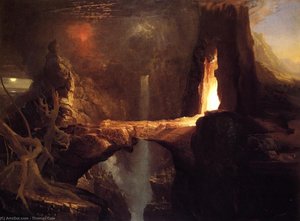 Expulsion. Moon and Firelight1828
 View of Florence from San Miniato1837

Essays around Kaaterskill Falls
 Own a Masterpiece: The Timeless Elegance of Hand-Painted Oil Reproductions of the World's Most Iconic ArtworksDiscover the profound beauty of hand-painted oil reproductions. Our master academicians recreate the world's most iconic masterpieces on 10…
 Nature's Nation: The Hudson River School and the Art of the American SublimeExplore the spiritual depth of the Hudson River School through its masters. Discover the power of the American Sublime today.
 American Romanticism: Capturing the Soul of the Wild Frontier through the Hudson River SchoolExplore the profound beauty of American Romanticism. Discover how the Hudson River School captured the wild frontier through masterful land…