Preview
 Send
Send Share
Share
 Details
 Guide
Guide

 Download
 Similars
 X-Ray
X-Ray Diaporama
 Q&A
Q&A Stats
StatsTank Battle

- 51.0 x 71.0 cm


 Read More
The artwork displayed on this page is protected by copyright law, which means we cannot legally create or sell an identical reproduction. This protection is enforced under international agreements such as the Berne Convention and by national laws, including those outlined by the U.S. Copyright Law - Title 17.
This method fully complies with copyright regulations because it does not involve copying or duplicating the protected artwork. Instead, it is a creative reinterpretation - a new painting that is influenced by the original but not identical to it.
Giclée / Art Print
Museum-quality giclée or canvas print with fast production and flexible finish options. ( Buy Hand Made Painting Switch to Digital Image)




P118B $10

P118H $10

P118W $10

P438Z $10

P508JH $12

P508YH $12

P805H $10

P805Z $10

P919BZ $10

P919G $10

P919XJ $10

P959ZH $10

P968JZ $12

W106C $8

W218G $10

W218JH $8

W218Y $10

W307PJ $10

W316G $10

W316PJ $8

W316Y $10

W398PJ $8

W4111J $10

W500HY $15

W500JH $15

W692G $12

W849H $8

W940BG $15

W953PJ $8




Pick from our preset sizes that match the artwork's original proportions.

Type the width and the height you need, to fit your frame or your wall. A print can only be cut, never made bigger than the picture, so a size with a different shape loses a part of the image. We send you a digital mockup to approve before we print anything. The picture shown on this page does not show the real cut — only the mockup does.
Worldwide Delivery () in 2 weeks instead of standard 4/5 weeks. (9 November)

Free Worldwide Express Shipping

High-Quality Linen Canvas

Full Shipping Insurance

Customs Tax Refund Guarantee

True Color Matching Guarantee

100-Day Return Policy (Defects Only)

100% Money-Back Guarantee

Bulk Discount Offer
 Glass option is only available in size under 110 CM

Tank Battle
Giclée / Art Print
Reproduction Size
-


Total Price
$ 81
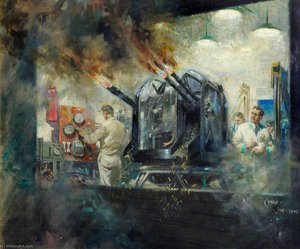
A Frozen Battlefield: Terence Tenison Cuneo’s “Tank Battle”
Terence Tenison Cuneo's "Tank Battle," painted in 1946, isn’t merely a depiction of war; it’s a visceral embodiment of its destructive power. This remarkable pen drawing, now housed within the hallowed halls of The National Archives in London, transcends the limitations of its medium to deliver an intensely emotional and profoundly unsettling experience for the viewer. Cuneo, a prolific artist known for his railway scenes and military commissions, here abandons idyllic landscapes and heroic figures to confront us with the stark reality of conflict – a landscape scarred by devastation and haunted by loss.
The artwork immediately commands attention through its dramatic composition. Diagonal lines, born from the wreckage of shattered tanks, twisted metal, and crumbling trees, slice across the canvas, creating a sense of chaotic movement and instability. The eye is relentlessly drawn from left to right, mirroring the trajectory of destruction itself. Foreground elements – mangled machinery, splintered wood, and scattered debris – are rendered with a brutal immediacy, forcing a close encounter with the tangible consequences of war. This isn’t a romanticized battle scene; it's a graveyard of metal and shattered dreams.
A Masterclass in Expressive Pen Technique
Cuneo’s choice of pen as his primary medium is crucial to the artwork’s impact. The lines are deliberately rough, energetic, and unpolished – reflecting the urgency and immediacy of the event being depicted. The artist employs a technique reminiscent of late 19th-century landscape painting, yet infuses it with a distinctly modern sensibility. Thick impasto application, particularly on the wreckage, creates a palpable sense of texture and weight, as if one could reach out and feel the cold steel and jagged edges. The use of pen allows for rapid execution, capturing the fleeting moments of destruction and conveying a sense of frantic energy.
The muted color palette – dominated by browns, greens, and grays punctuated by flashes of orange and yellow from the setting sun – further enhances the artwork’s somber mood. The sky, rendered in hazy washes, suggests both impending darkness and a lingering sense of despair. It's a landscape stripped bare, devoid of life and beauty, offering no solace or respite.
Symbolism and Historical Context
"Tank Battle" was created during the immediate aftermath of World War II, a period marked by profound loss and widespread destruction. Cuneo’s work serves as a poignant reminder of the human cost of conflict – not just in terms of casualties, but also in the irreversible damage inflicted upon the environment. The inclusion of trees amidst the wreckage is particularly significant; they represent both the resilience of nature and the devastating impact of war on the natural world.
Furthermore, Cuneo’s appointment as official artist for the Coronation of Queen Elizabeth II in 1953 highlights a fascinating duality within his career. While he was tasked with celebrating national pride and commemorating historical events, "Tank Battle" stands as a stark counterpoint – a brutally honest depiction of war's destructive legacy. The artwork’s creation during this period underscores the complex relationship between art, propaganda, and the realities of wartime.
A Legacy of Observation and Detail
Beyond its immediate impact, “Tank Battle” reveals Cuneo’s meticulous attention to detail and his ability to capture the essence of a scene. The composition is carefully balanced, with the dominant tank positioned strategically to command the viewer's attention. The scattered figures in the background – fleeing civilians or surveying the damage – add a human element to the devastation, reminding us that war affects not only machines but also the lives of ordinary people. This artwork remains a powerful testament to Cuneo’s artistic skill and his unflinching portrayal of a dark chapter in history.
Further information about Terence Tenison Cuneo and this artwork can be found on OriginalUniqueArt.com, as well as the National Archives website and Wikipedia.
Questions & Answers
Where in Terence Tenison Cuneo's career does "Tank Battle" fall, given its date?
The 1946 date places "Tank Battle" in the Mid-20th Century of Terence Tenison Cuneo's development.
What color saturation does "Tank Battle" by Terence Tenison Cuneo have?
The palette of "Tank Battle" is subtle color in saturation.
At what age did Terence Tenison Cuneo make "Tank Battle"?
When "Tank Battle" was created in 1946, Terence Tenison Cuneo - born in 1907 - was 39 years old.
Artist Biography
The Industrial Brushstroke of Terence Tenison Cuneo
To gaze upon the canvases of Terence Tenison Cuneo is to witness a vibrant confluence of human endeavor and mechanical might. He was an English painter whose artistic vision seemed inextricably linked to the pulse of progress, finding his most profound subjects in the roaring heart of the railway, the disciplined charge of military formations, and the sheer drama of industrial life. Born in London in 1907, Cuneo’s early influences were steeped in a rich artistic lineage; he was the son of Cyrus Cincinato Cuneo and Nell Marion Tenison, both artists who had studied under the esteemed Whistler in Paris. This immersion in established artistic circles provided him with a foundational understanding of technique that would prove invaluable throughout his prolific career.
A Career Forged by Conflict and Industry
Cuneo’s formal training took him through institutions such as Sutton Valence School, Chelsea Polytechnic, and the Slade School of Art. Initially, his talents were channeled into illustration for magazines and periodicals, a demanding field that honed his observational skills to an exquisite point. However, it was in oils that his true passion began to bloom. The shadow of global conflict proved to be a crucible for his artistic development. During the Second World War, while serving as a sapper in the Royal Engineers, Cuneo did not abandon his brush entirely. He contributed illustrations for the war artists' advisory committee, capturing the raw reality of tank and aircraft factories. Furthermore, he was commissioned by the Foreign Office to create anti-Nazi drawings, an act of powerful visual resistance that culminated in an exhibition at the Palaquin Fine Arts Gallery in 1942.
The Majesty of Movement: Railways and Coronation
Following the war, Cuneo found a monumental focus for his considerable skill. He was commissioned to produce a series of works dedicated to illustrating railways, bridges, and locomotives—subjects that allowed him to merge technical accuracy with breathtaking dynamism. His mastery over depicting machinery in motion became legendary. Yet, perhaps the pinnacle of his public recognition arrived when he was appointed the official artist for the coronation of Queen Elizabeth II in 1953. This monumental commission thrust his name into global prominence, cementing his reputation as a chronicler of significant national moments.
A Versatility Beyond Steam and Steel
While the steam engine and the battlefield remain hallmarks of his oeuvre, to categorize Cuneo solely by these subjects would be to overlook the breadth of his genius. His artistic reach extended across a spectrum that included grand landscapes, evocative depictions of big game in Africa, and intimate portraiture—including likenesses of H.M. The Queen herself. He also embraced regimental commissions, capturing the tension of battle scenes alongside the quiet dignity of portraits. Cuneo’s work is not merely documentation; it is an interpretation. It breathes life into rivets, smoke, and muscle, allowing the viewer to feel the grit beneath the polished brass and hear the whistle blow across the painted expanse.

Terence Tenison Cuneo
1907 - 1996
Quick Facts
- Full Name: Terence Tenison Cuneo
- Nationality: English
- Date Of Birth: 1907
- Date Of Death: 1996
- Place Of Birth: London, England
- Notable Artworks: ['Coronation of Queen Elizabeth II']
- Artistic Movement Or Style: Realism/Illustration
Related Articles

The Enduring Power of Line: Exploring Themes & Techniques in Drawing Across Art History
Explore the rich history of drawing! Discover key techniques like linear perspective & iconic artists from the Renaissance to modern times. Enhance your art appreciation with OriginalUniqueArt.
The Power of Graphite: Mastering Depth, Texture, and Detail in the Art of Pencil Drawing
Explore the profound artistry of graphite drawing. Discover professional techniques for mastering depth, texture, and detail through a lens of art history, from classical sketches to modern masterpieces. Elevate your understanding of the pencil medium with our expert guide.

Mastering the Line: A Comprehensive Expert Guide to Technical Precision and Expressive Depth in Drawing
Elevate your artistic practice with this expert guide to mastering the line. Discover advanced techniques in graphite, charcoal, and contour drawing designed for art students seeking technical precision and expressive depth in their fine art studies.
The Nuances of Graphite: Exploring Emotional Depth & Technical Mastery in Pencil Drawing
Explore the captivating world of graphite drawing! Discover its rich history, master essential techniques like chiaroscuro, and learn how artists evoke emotion through this timeless medium. Expert insights for art enthusiasts.
Frederick Bridgman: Anatomical Mastery & the Evolution of Figure Drawing Instruction
Explore the anatomical mastery of George B. Bridgman & his revolutionary figure drawing techniques. Discover how his methods transformed art instruction and continue to inspire artists today. Learn more at OriginalUniqueArt.