Preview
 Send
Send Share
Share
 Details
 Guide
Guide

 Download
 Similars
 X-Ray
X-Ray Diaporama
 Stats
StatsUrutu Snake
 Oil On Canvas
- WallArt
- Surrealism
 1928
1928- 19th Century
 60.0 x 72.0 cm
 MAM Rio
 Read More
The artwork displayed on this page is protected by copyright law, which means we cannot legally create or sell an identical reproduction. This protection is enforced under international agreements such as the Berne Convention and by national laws, including those outlined by the U.S. Copyright Law - Title 17.
As a respectful and legal alternative, we offer custom, hand-painted artworks inspired by the original. Our skilled and professional artists carefully study the original's style, mood, and artistic essence to create a new, unique piece that evokes the same feeling - while remaining an original creation in its own right.
This method fully complies with copyright regulations because it does not involve copying or duplicating the protected artwork. Instead, it is a creative reinterpretation - a new painting that is influenced by the original but not identical to it.
Hand Made Oil Reproduction
Hand-painted oil on canvas in your size and frame, made to order by our artists. ( Switch to Print Switch to Digital Image)




P118B $10

P118H $10

P118W $10

P438Z $10

P508JH $12

P508YH $12

P805H $10

P805Z $10

P919BZ $10

P919G $10

P919XJ $10

P959ZH $10

P968JZ $12

W106C $8

W218G $10

W218JH $8

W218Y $10

W307PJ $10

W316G $10

W316PJ $8

W316Y $10

W398PJ $8

W4111J $10

W500HY $15

W500JH $15

W692G $12

W849H $8

W940BG $15

W953PJ $8




Pick from our preset sizes that match the artwork's original proportions.

Type the width and the height you need, to fit your frame or your wall. This is hand-painted, so for a size with a different shape the artist can paint a bit more around the picture, or cut a bit — you choose. We send you a digital mockup to approve before the painting starts. The picture shown on this page does not show the real result — only the mockup does.
After order, OriginalUniqueArt.com team will email client for instructions and provide a mockup preview
Worldwide Delivery () in 3/4 weeks instead of standard 5 weeks. (22 October). No compromise on quality.

Free Worldwide Express Shipping

High-Quality Linen Canvas

Full Shipping Insurance

Customs Tax Refund Guarantee

True Color Matching Guarantee

100-Day Return Policy (Defects Only)

100% Money-Back Guarantee

Bulk Discount Offer
 Glass option is only available in size under 110 CM

Urutu Snake
Reproduction Medium
Reproduction Size
-


Total Price
$ 300
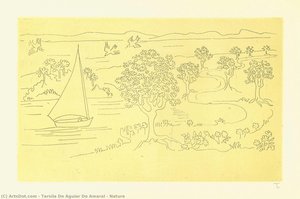
A Dream Woven in Serpent Scales: Tarsila do Amaral’s “Urutu Snake”
Tarsila do Amaral's "Urutu Snake," painted in 1928, isn’t merely a depiction of a reptile; it’s an immersion into the vibrant, surreal landscape of early Brazilian modernism. This oil on canvas, currently residing within the Museum of Modern Art in Rio de Janeiro, pulsates with a potent blend of abstract expressionism and the burgeoning dreamlike quality of Surrealism – a testament to do Amaral's embrace of European avant-garde movements while simultaneously grounding them in distinctly Brazilian imagery and symbolism. The painting immediately commands attention with its audacious scale—measuring 60 x 72 centimeters—and its bold, almost aggressively bright palette dominated by deep blues, verdant greens, and the arresting flash of a scarlet orb. It’s an artwork that refuses to be passively observed; it demands engagement, inviting viewers into a world where logic yields to intuition.
The Egg and the Serpent: Symbolism Unveiled
At the heart of “Urutu Snake” lies a colossal, textured egg – an element that immediately evokes notions of birth, potential, and nascent life. Its rough, granular surface, rendered with thick impasto strokes, suggests both fragility and immense power. Emerging from this primordial form is a sinuous serpent, its scales shimmering with subtle gradients of color, culminating in the aforementioned scarlet orb. The “Urutu” itself refers to a type of snake native to Brazil, but within do Amaral’s vision, it transcends mere identification. It embodies transformation, danger, and perhaps even the cyclical nature of existence – themes deeply rooted in Brazilian indigenous mythology. The red orb, often associated with the sun or vital energy, could represent both creation and destruction, mirroring the dualistic forces inherent in the serpent's journey.
Technique and Vision: A Fusion of European Influence
Do Amaral’s technique is a fascinating synthesis of influences. While clearly drawing inspiration from the Cubism and Surrealism prevalent in Paris at the time, she infuses her work with a uniquely Brazilian sensibility. The flattened perspective, reminiscent of early Cubist explorations, creates a sense of immediacy and intimacy, as if we are peering directly into this dreamscape. Yet, the swirling lines and organic forms—particularly those defining the serpent’s movement—suggest an embrace of Expressionism's emotional intensity. The visible brushstrokes, characteristic of oil on canvas, contribute to the painting’s tactile quality, inviting a sense of physical engagement with the artwork. The careful layering of colors and textures creates depth, despite the overall flattened composition, suggesting a deliberate attempt to capture not just a visual representation but also an atmospheric mood.
Antropofagia and Brazilian Identity
"Urutu Snake" is inextricably linked to the Antropofagia (Cannibalism) movement – a radical artistic philosophy championed by do Amaral and her contemporaries. This movement sought to dismantle European artistic conventions and forge a distinctly Brazilian identity through the incorporation of indigenous myths, folklore, and natural imagery. The painting embodies this ethos perfectly: it’s not a faithful representation of reality but rather a symbolic distillation of Brazil's soul. The vibrant colors, the serpent motif, and the overall dreamlike quality all contribute to a sense of national pride and cultural renewal—a bold declaration that Brazilian art could be both modern and uniquely its own. The painting stands as a powerful symbol of this artistic revolution, capturing the spirit of a nation rediscovering its roots.
A Timeless Masterpiece: Reproduction and Beyond
Reproductions of “Urutu Snake” offer an exceptional opportunity to bring this captivating artwork into any setting. The rich colors and dynamic composition will undoubtedly serve as a focal point, adding a touch of exoticism and intellectual depth to any room. Consider framing the reproduction in a manner that complements its vibrant palette – perhaps a dark wood frame to accentuate the intensity of the colors or a lighter tone to allow the artwork’s energy to shine through. “Urutu Snake” is more than just a painting; it's an invitation to explore the depths of Brazilian culture and the boundless possibilities of artistic expression.
Questions & Answers
How well known is "Urutu Snake" by Tarsila do Amaral?
The popularity level recorded for "Urutu Snake" by Tarsila do Amaral is recognized.
What medium is "Urutu Snake" by Tarsila do Amaral executed in?
The medium of "Urutu Snake" by Tarsila do Amaral is oil on canvas. Reproductions aim to render the appearance of this technique.
What is the dominant color of "Urutu Snake" by Tarsila do Amaral?
gray (#6c825c) is the leading color of "Urutu Snake" by Tarsila do Amaral.
Artist Biography
A Brazilian Visionary: The Life and Art of Tarsila do Amaral
Tarsila do Amaral emerged as a pivotal figure in the vibrant tapestry of early 20th-century Brazilian art, a painter who dared to distill the essence of her nation’s identity onto canvas with bold colors and an innovative spirit. Born on September 1, 1886, in Capivari, São Paulo, into a prosperous coffee-producing family, Tarsila's upbringing afforded her opportunities uncommon for women of her time. This privilege allowed her to pursue artistic training, initially under the guidance of Pedro Alexandrino Borges before embarking on a transformative journey to Paris in 1920. It was within the walls of the Académie Julian and later the Académie Moderne that she encountered the avant-garde currents reshaping the art world – Cubism, Futurism, and Expressionism – influences that would profoundly shape her artistic trajectory. The mentorship of Fernand Léger, Albert Gleizes, and André Lhote proved particularly impactful, encouraging her to synthesize European modernism with a distinctly Brazilian sensibility.Forging a National Identity Through Art
Upon returning to Brazil in the early 1920s, Tarsila became a central force in defining a uniquely Brazilian modernist tradition. She wasn’t simply importing European styles; she was actively seeking to create an art that spoke to the soul of her nation, reflecting its landscapes, people, and cultural complexities. This quest led her to collaborate with a group of like-minded artists and intellectuals – Anita Malfatti, Menotti Del Picchia, Mário de Andrade, and Oswald de Andrade – collectively known as *Grupo dos Cinco*. Together, they challenged conventional artistic norms and spearheaded a movement that sought to break free from academic constraints and embrace a new visual language. Tarsila’s contribution was particularly significant in articulating this vision through her paintings, which often depicted scenes of Brazilian life with a dreamlike quality and vibrant palette.The Power of *Abaporu* and the Antropofagia Movement
Perhaps no single work embodies Tarsila's artistic philosophy more powerfully than *Abaporu* (1928). This iconic painting, depicting a solitary figure with oversized feet seated amidst a surreal landscape, became the catalyst for one of Brazil’s most influential cultural movements: Antropofagia – or “cannibalism.” Inspired by Oswald de Andrade's manifesto of the same name, Antropofagia proposed that Brazilian artists should "devour" foreign influences and transform them into something uniquely their own. *Abaporu* visually captured this concept, representing a rejection of colonial imitation and an embrace of cultural hybridity. The painting’s imagery – the large feet rooted in the land, the enigmatic expression – resonated deeply with a nation grappling with its identity in the wake of independence. It wasn't merely a work of art; it was a declaration of artistic sovereignty. Beyond *Abaporu*, works like *A Negra* (1923) and *Morro da Favela* demonstrated her engagement with social themes, portraying marginalized communities and challenging prevailing societal norms.Legacy and Enduring Influence
Throughout her long and prolific career, Tarsila do Amaral continued to explore the complexities of Brazilian identity through a diverse body of work. Her paintings are characterized by their bold colors, simplified forms, and dreamlike atmosphere, often blending elements of realism with surrealism and abstraction. She didn’t shy away from experimentation, constantly evolving her style while remaining true to her core vision. Her influence extended beyond the realm of painting, inspiring generations of Brazilian artists and shaping the nation's cultural landscape. Today, Tarsila do Amaral’s works are held in prestigious collections worldwide, including the Museu de Valores do Banco Central do Brasil and the Museu de Arte do Rio Grande do Sul. Her art continues to captivate audiences with its vibrant energy, poetic imagery, and profound exploration of what it means to be Brazilian. She passed away on January 17, 1973, leaving behind a legacy as one of Latin America’s most important modernist artists – a visionary who dared to paint her nation's soul.
Tarsila do Amaral
1886 - 1973 , Brazil
Quick Facts
- Full Name: Tarsila do Amaral
- Nationality: Brazilian
- Date Of Birth: 1886
- Date Of Death: 1973
- Place Of Birth: Cachoeira do Sul, Brazil
- Notable Artworks:
- Abaporu
- A Negra
- Morro da favela
- Urutu Snake
- Landscape VII
- Artistic Movement Or Style: Brazilian Modernism
- Artists Who Influenced This Artist:
- Fernand Léger
- Albert Gleizes
- André Lhote
- Artists Or Movements Influenced By This Artist: ['Antropofagia movement']
Related Articles

Geometric Abstraction's 10 Defining Masterpieces | Art for Your Home - OriginalUniqueArt
Explore 10 defining masterpieces of Geometric Abstraction! Discover Kandinsky, Mondrian & Malevich’s iconic works. Find museum-quality art reproductions and curated decor ideas to elevate your home at OriginalUniqueArt.com.

Abstract Expressionism's 10 Defining Masterpieces |
Explore 10 defining Abstract Expressionism masterpieces by Pollock, Rothko & de Kooning. Discover the stories behind these iconic paintings and find museum-quality art reproductions to elevate your home decor on .
Beyond Representation: Exploring the Emotional Landscape of Abstract Expressionism
Explore the profound emotional world of Abstract Expressionism with OriginalUniqueArt. Discover key artists like Pollock & Rothko, learn about collecting, and find museum-quality reproductions to inspire your space.
Navigating Abstract Expression: A Guide to Contemporary Movements for Emotional Resonance in Art Selection
Explore the evolution of Abstract Expressionism & discover contemporary movements for emotional resonance. Expert guidance for discerning art collectors seeking lasting value. OriginalUniqueArt.

Kandinsky's Masterpieces: 25 Paintings That Define Abstract Art | OriginalUniqueArt
Journey through Wassily Kandinsky's 25 most iconic abstract paintings. Explore his revolutionary use of color, form & spiritual expressionism. Find museum-quality Kandinsky reproductions and elevate your home decor with OriginalUniqueArt.com. Discover all masterpieces on OriginalUniqueArt.com!