Oil Edition
 Everything about Model







































 For artworks or reproductions larger than 105 cm (approximately 41 inches) on any side, the frame will be shipped as a kit, disassembled. This method ensures safe delivery and prevents damage during transport.


The Form and Composition of Model
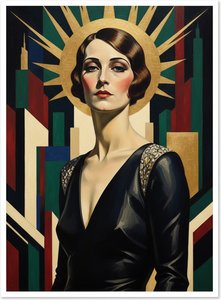
The painting presents a nude female figure positioned centrally, though her body is angled diagonally across the canvas. This orientation creates a sense of movement within the frame. A draped cloth covers the lower portion of her body, introducing a layer of white fabric that contrasts with the skin tones. The figure's anatomy is defined by sharp, clean lines and a focus on the curves of the torso and limbs. The background consists of geometric planes and muted tones, including earthy browns, beiges, and hints of green and red. Lighting is directional, casting shadows that define the volume of the body and create depth through overlapping planes rather than traditional atmospheric perspective.
Technical Execution and Style
The work is executed in a style characterized by the geometric precision of the Art Deco movement. The surface appears smooth and polished, suggesting the use of oil on canvas or panel. The artist employs a technique of precise brushwork to achieve tonal variations and a sculptural quality in the rendering of the human form. The interaction between organic shapes, such as the curves of the model, and the rigid geometric shapes of the background defines the visual structure. The following elements characterize the technical approach:
- Use of streamlined forms and polished textures.
- A palette dominated by muted, earthy tones with localized color accents.
- A flattened perspective typical of early 20th-century modernism.
- Strong, clean outlines that emphasize anatomical contours.
Historical Context and Artistic Intent
Created in 1925, this work emerged during a period of significant stylistic shifts in Paris. The piece reflects the aesthetic of the 1925 International Exhibition of Modern Decorative and Industrial Arts, a period that emphasized luxury and machine-age precision. The composition blends elements of neoclassical precision with the fragmented language of Cubism. This approach results in a depiction of the female form that is both stylized and architectural. The subject matter reflects a modern sensibility, moving away from traditional academic rendering toward a more controlled and polished representation of the human figure.
Questions & Answers
Is this Model painted by hand or printed?
Painted by hand: a trained painter copies Model in oil on linen canvas.
What size should I choose for Model?
Sizes run from 40.0 x 25.0 cm ($200) to 244.3 x 152.8 cm ($1409); the table on this page lists the main steps and their prices.
How long does delivery take?
Delivery takes 4 to 5 weeks, with free worldwide express shipping; an urgent production option is offered on this page. You can return it within 100 days for a full refund, with no condition.
What medium did Tamara de Lempicka use for Model?
Oil On Canvas.
More about this painting
 Preview

 Send
 Share
 Details
 Fact sheet


 Download
 Similars
 X-Ray
 Diaporama
 Q&A

 Stats