
 Preview
 Send
Send Share
Share
 Details
 Guide
Guide

 Download
 Similars
 X-Ray
X-Ray Diaporama
 Stats
StatsBringing in a Casualty
 Acrylic On Canvas
- WallArt
- Impressionism
 1944
1944 23.0 x 35.0 cm
 Harris Museum - Art Gallery
 Read More
The artwork displayed on this page is protected by copyright law, which means we cannot legally create or sell an identical reproduction. This protection is enforced under international agreements such as the Berne Convention and by national laws, including those outlined by the U.S. Copyright Law - Title 17.
As a respectful and legal alternative, we offer custom, hand-painted artworks inspired by the original. Our skilled and professional artists carefully study the original's style, mood, and artistic essence to create a new, unique piece that evokes the same feeling - while remaining an original creation in its own right.
This method fully complies with copyright regulations because it does not involve copying or duplicating the protected artwork. Instead, it is a creative reinterpretation - a new painting that is influenced by the original but not identical to it.
Hand Made Oil Reproduction
Hand-painted oil on canvas in your size and frame, made to order by our artists. ( Switch to Print Switch to Digital Image)




P118B $10

P118H $10

P118W $10

P438Z $10

P508JH $12

P508YH $12

P805H $10

P805Z $10

P919BZ $10

P919G $10

P919XJ $10

P959ZH $10

P968JZ $12

W106C $8

W218G $10

W218JH $8

W218Y $10

W307PJ $10

W316G $10

W316PJ $8

W316Y $10

W398PJ $8

W4111J $10

W500HY $15

W500JH $15

W692G $12

W849H $8

W940BG $15

W953PJ $8




Pick from our preset sizes that match the artwork's original proportions.

Type the width and the height you need, to fit your frame or your wall. This is hand-painted, so for a size with a different shape the artist can paint a bit more around the picture, or cut a bit — you choose. We send you a digital mockup to approve before the painting starts. The picture shown on this page does not show the real result — only the mockup does.
After order, OriginalUniqueArt.com team will email client for instructions and provide a mockup preview
Worldwide Delivery () in 3/4 weeks instead of standard 5 weeks. (22 October). No compromise on quality.

Free Worldwide Express Shipping

High-Quality Linen Canvas

Full Shipping Insurance

Customs Tax Refund Guarantee

True Color Matching Guarantee

100-Day Return Policy (Defects Only)

100% Money-Back Guarantee

Bulk Discount Offer
 Glass option is only available in size under 110 CM

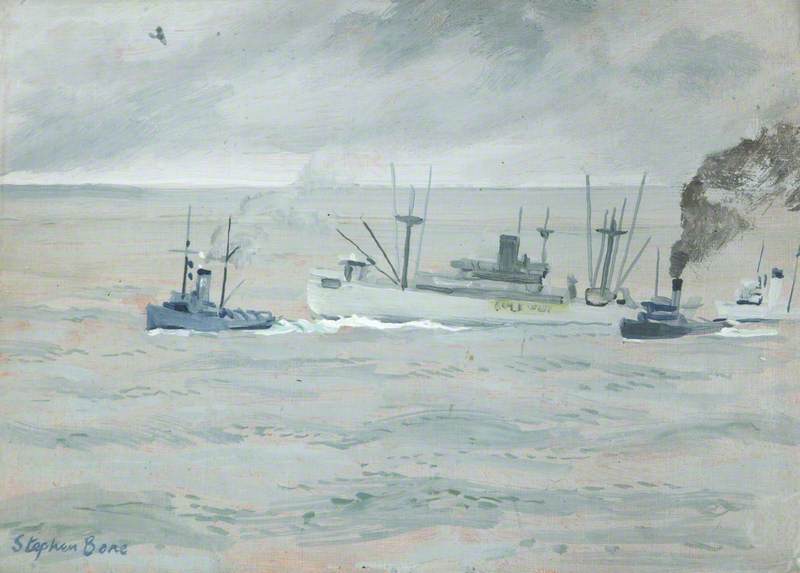
Bringing in a Casualty
Reproduction Medium
Reproduction Size
-


Total Price
$ 300
Stephen Bone’s ‘Bringing in a Casualty’: A Moment Frozen in Wartime Drama
Stephen Bone’s “Bringing in a Casualty” (1944) stands as a poignant testament to British art during World War II, capturing not just the visual spectacle of naval action but also the palpable atmosphere of anxiety and resilience. Painted with masterful watercolor technique—a medium favored by Bone for its ability to convey mood and texture—this artwork exemplifies his signature style: vibrant landscapes infused with emotional depth, particularly evident in his depictions of wartime subjects. It’s a piece that transcends mere representation, inviting viewers into a scene brimming with symbolic significance and conveying a powerful narrative about courage and perseverance amidst adversity.A Watercolor Vision of Coastal Conflict
The painting itself is dominated by a horizontal composition featuring three ships battling choppy waters under an overcast sky. Bone skillfully employs loose brushstrokes—characteristic of watercolor—to achieve an impressionistic effect, prioritizing the conveyance of atmosphere over meticulous detail. Lines ripple across the canvas, mirroring the turbulent sea surface and lending dynamism to the vessels’ movements. The muted palette—primarily blues and greys—reflects the bleakness of the weather conditions, enhancing the painting's emotional impact. Texture is achieved through layering washes and visible brushstrokes, creating a grainy appearance that adds to the realism of the seascape. Careful observation reveals subtle gradations in color and value, demonstrating Bone’s meticulous attention to capturing nuances within his subject matter.The Artist’s Legacy: Bone’s Exploration of Landscape and War
Stephen Bone (1904-1958) emerged as a prominent figure in British Neo-Romanticism—a movement that championed the expressive power of landscape painting alongside themes of heroism and national identity. Influenced by his father, Muirhead Bone—also a celebrated watercolorist—Bone honed his artistic skills at Bedales School and subsequently pursued formal training at Slade School of Fine Art before abandoning academic conventions in favor of book illustration and later, monumental mural commissions like the Piccadilly Circus underground station. His dedication to portraying Britain’s natural beauty was unwavering, documented through countless canvases painted *en plein air*, regardless of meteorological challenges—a practice that cemented his reputation as an artist committed to capturing the essence of his surroundings. Bone's involvement with the War Artists Advisory Committee during WWII marked a pivotal moment in his career, propelling him into the spotlight and affording him access to subjects of considerable importance. He undertook numerous commissions documenting naval installations and vessels engaged in combat—most notably the harrowing scenes recorded aboard submarines during the Battle of Atlantic. The painting "Bringing in a Casualty" encapsulates this period’s spirit – confronting difficult realities with artistic grace and conveying the bravery of those serving their country. It's a piece that resonates deeply with viewers, prompting contemplation on themes of duty, sacrifice, and the enduring beauty found even amidst conflict.- Artist: Stephen Bone
- Year: 1944
- Size: 23 x 35 cm
- Medium: Watercolor
- Museum: Harris Museum - Art Gallery (Preston, United Kingdom)
Explore this evocative wartime scene – realism meets impressionism, perfect for art collectors.
Questions & Answers
What does "Bringing in a Casualty" by Stephen Bone bring to an interior?
With its calm mood, "Bringing in a Casualty" is suggested for a living room.
Is "Bringing in a Casualty" held in the country of its creator?
Yes - the artwork is kept in the artist's home country. "Bringing in a Casualty" is held in United Kingdom, while Stephen Bone was born in United Kingdom.
What underlying hue runs through "Bringing in a Casualty" by Stephen Bone?
"Bringing in a Casualty" leans toward a green to violet spectrum tone.
Artist Biography
Stephen Bone: Life and Art
Early Life and Education
- Born: Chiswick, United Kingdom (1904)
- Died: 1958
- Stephen Bone was the son of renowned artist Sir Muirhead Bone and writer Gertrude Helena Dodd. This familial artistic background profoundly influenced his early development.
- He received his education at Bedales School before enrolling at the Slade School of Fine Art in 1922.
- However, he became disillusioned with the academic approach at the Slade and left in 1924 to pursue book illustration.
Early Career & Artistic Development
- Bone initially achieved success as a woodcut illustrator, creating works for his mother and other writers. He won the gold medal for wood engraving at the International Exhibition in Paris in 1925.
- In 1926, he exhibited jointly with Rodney Joseph Burn and Robin Guthrie at the Goupil Gallery, marking a significant step in his artistic recognition.
- He painted a mural for the Piccadilly Circus underground station in 1928, demonstrating his versatility and expanding artistic scope.
- Marriage to artist Mary Adshead in 1929 led to extensive travels across Britain and Europe. These journeys were crucial in developing his signature style of bright landscape painting, capturing scenes *en plein air* regardless of weather conditions.
The 1930s: Landscape Painting & Exhibitions
- During the 1930s, Bone exhibited widely at prestigious galleries including the Fine Art Society, Lefevre Gallery, and Redfern Gallery.
- In 1936, he presented a series of 41 paintings depicting British counties at the Ryman Gallery in Oxford, showcasing his dedication to capturing the essence of the British landscape.
- He also exhibited in Stockholm during 1936 and 1937, expanding his international exposure.
War Artist & WWII Contributions
- With the outbreak of World War II, Bone enlisted as an officer in the Civil Defence Camouflage Establishment.
- In 1943, he was appointed a full-time salaried artist by the War Artists' Advisory Committee, specializing in Admiralty subjects. This role had previously been held by his father, Muirhead Bone, but was taken up by Stephen following the death of their son Gavin.
- Significant WWII Works: He produced numerous paintings depicting coastal installations and naval craft, including scenes painted aboard submarines.
- Bone witnessed and documented the Normandy landings in 1944, painting scenes in Caen and Courseulles. He also recorded the assault on Walcheren Island in the Netherlands.
- He travelled to Norway in late 1944, documenting the wreck of the *Tirpitz* and recording captured naval bases, as well as mass graves of prisoners of war.
Post-War Career & Legacy
- After the war, Bone found his style somewhat out of fashion. Despite continuing to paint, he faced difficulties exhibiting his work.
- He transitioned into art criticism, writing for the *Manchester Guardian*, and contributed humorous pieces to the *Glasgow Herald*.
- Bone also worked in television and radio for the BBC and collaborated with his wife on children's books. They jointly organized a mural painting course at Dartington.
- In 1957, he was appointed Director of the Hornsey College of Art.
- Death: Stephen Bone died of cancer on September 15, 1958, at St Bartholomew's Hospital, London.
- Stephen Bone’s work provides a valuable visual record of mid-20th century Britain, encompassing both the tranquility of its landscapes and the harsh realities of wartime.

Stephen Bone
1904 - 1958 , United Kingdom
Quick Facts
- Birth Date: 1904
- Death Date: 1958
- Influenced: None, 'influenced by': 'Muirhead Bone', 'movement': ['Woodcut Illustration', 'Landscape Painting', 'War Art'], 'name': 'Stephen Bone', 'nationality': 'British', 'notable works': ['Two Aircraft Carriers', 'The Midnight Sun', 'Railway Men', 'Sunset on the Normandy Beaches',
- Birth Place: Chiswick, United Kingdom
- Date Of Birth: 1904
- Date Of Death: 1958
- Place Of Birth: Chiswick, United Kingdom
Related Articles

Ephemeral Visions: Exploring the Artistic Legacy & Nuances of Watercolor Painting
Explore the captivating world of watercolor painting! Discover its rich history, essential techniques, influential artists & collecting tips from art experts. A comprehensive guide for enthusiasts.

Ephemeral Visions: Exploring the Artistic Legacy & Contemporary Practice of Watercolor Painting
Explore the captivating world of watercolor painting! Discover its rich history, essential techniques, influential artists & collecting tips. A comprehensive guide for art enthusiasts from OriginalUniqueArt.

Ephemeral Visions: Exploring the History & Emotional Resonance of Watercolor Painting
Explore the captivating history of watercolor painting, from ancient techniques to modern masters like Kandinsky & Blake. Discover essential artists, collecting tips & the emotional power of this luminous medium. Expert insights for art enthusiasts.

Watercolor Wonders: 10 Masterpieces That Redefined Art History | OriginalUniqueArt
Journey through 10 legendary watercolor masterpieces by Sargent, Turner & Homer! Explore iconic landscapes, portraits & floral art that redefined history. Find museum-quality reproductions and curated decor ideas at OriginalUniqueArt.com.

The Enduring Appeal of Watercolor: History, Techniques & Contemporary Practice
Explore the captivating world of watercolor painting! Discover its rich history, essential techniques, influential artists, and collecting tips. A comprehensive guide for art enthusiasts.


