Preview
 Send
Send Share
Share
 Details
 Guide
Guide

 Download
 Similars
 X-Ray
X-Ray Diaporama
 Q&A
Q&A Stats
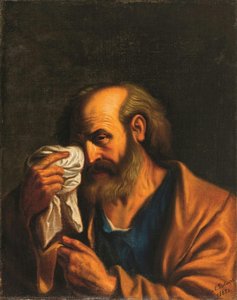
StatsSt Peter weeping

- 68.0 x 55.0 cm


 Read More
The artwork displayed on this page is protected by copyright law, which means we cannot legally create or sell an identical reproduction. This protection is enforced under international agreements such as the Berne Convention and by national laws, including those outlined by the U.S. Copyright Law - Title 17.
This method fully complies with copyright regulations because it does not involve copying or duplicating the protected artwork. Instead, it is a creative reinterpretation - a new painting that is influenced by the original but not identical to it.
Giclée / Art Print
Museum-quality giclée or canvas print with fast production and flexible finish options. ( Buy Hand Made Painting Switch to Digital Image)




































Pick from our preset sizes that match the artwork's original proportions.

Type the width and the height you need, to fit your frame or your wall. A print can only be cut, never made bigger than the picture, so a size with a different shape loses a part of the image. We send you a digital mockup to approve before we print anything. The picture shown on this page does not show the real cut — only the mockup does.
Worldwide Delivery () in 2 weeks instead of standard 4/5 weeks. (31 October)

Free Worldwide Express Shipping

High-Quality Linen Canvas

Full Shipping Insurance

Customs Tax Refund Guarantee

True Color Matching Guarantee

100-Day Return Policy (Defects Only)

100% Money-Back Guarantee

Bulk Discount Offer
 Glass option is only available in size under 110 CM

St Peter weeping
Giclée / Art Print
Reproduction Size
-


Total Price
$ 81
Questions & Answers
What orientation does "St Peter weeping" by Stanislovas Grigalauskas have?
"St Peter weeping" by Stanislovas Grigalauskas is a portrait composition. The proportions are worth checking before choosing a print size.
In what year was "St Peter weeping" by Stanislovas Grigalauskas created?
"St Peter weeping" dates from 1862. The date places the work within Stanislovas Grigalauskas's career and its era.
Where is "St Peter weeping" by Stanislovas Grigalauskas on display today?
The original "St Peter weeping" by Stanislovas Grigalauskas is held at the Lithuanian Art Fund, Vilnius, Lithuania. A reproduction allows the work to be displayed at home.
Artist Biography
A Legacy of Devotion
The life and artistry of Stanislovas Grigalauskas, also known by the name Stanislovas Daunoras, offer a window into a profound era of Lithuanian creative expression. Born in 1893 in Jieznas, Lithuania, his journey as an artist is deeply intertwined with the spiritual and cultural fabric of his homeland. While much of the specific biographical detail regarding his early years remains shrouded in the mists of history, his presence in the annals of art is marked by a commitment to themes that resonate with eternal human emotions.
His work, categorized within the Modern period, demonstrates a capacity to engage with heavy, sacred subject matter. One of his most notable contributions to the visual record is the evocative piece St Peter weeping. In this work, the artist captures the profound psychological and spiritual weight of the apostle's remorse. Through his brush, the narrative of betrayal and subsequent redemption becomes a tangible, visual experience, inviting the viewer to contemplate the complexities of faith and human frailty.
Artistic Significance and Heritage
The historical significance of Grigalauskas lies in his ability to bridge the gap between traditional religious iconography and the evolving sensibilities of the Modern era. His work is recognized within important cultural repositories, such as the Lithuanian Art Fund, ensuring that his perspective on sacred history continues to be studied and appreciated by those interested in the spiritual heritage of Lithuania.
Though the specific technical evolution of his style is a subject for deep scholarly inquiry, the enduring impact of his imagery remains clear. His ability to translate the biblical narrative into a medium that speaks to the soul allows his art to transcend its original historical context, maintaining a sense of relevance and emotional potency for contemporary audiences seeking connection with the past.

Stanislovas Grigalauskas
1893 - , Lithuania
Quick Facts
- Artistic Movement Or Style: Modern
- Full Name: Stanislovas Grigalauskas
- Nationality: Lithuanian
- Notable Artworks: ['St Peter weeping']
- Place Of Birth: Jieznas, Lithuania
- Date Of Birth: 1893