Preview
 Send
Send Share
Share
 Details
 Guide
Guide

 Download
 Similars
 X-Ray
X-Ray Diaporama
 Q&A
Q&A Stats
StatsThe Open Sea

- 122.0 x 147.0 cm


 Read More
Giclée / Art Print
Museum-quality giclée or canvas print with fast production and flexible finish options. ( Buy Hand Made Painting Switch to Digital Image)




P118B $10

P118H $10

P118W $10

P438Z $10

P508JH $12

P508YH $12

P805H $10

P805Z $10

P919BZ $10

P919G $10

P919XJ $10

P959ZH $10

P968JZ $12

W106C $8

W218G $10

W218JH $8

W218Y $10

W307PJ $10

W316G $10

W316PJ $8

W316Y $10

W398PJ $8

W4111J $10

W500HY $15

W500JH $15

W692G $12

W849H $8

W940BG $15

W953PJ $8




Pick from our preset sizes that match the artwork's original proportions.

Type the width and the height you need, to fit your frame or your wall. A print can only be cut, never made bigger than the picture, so a size with a different shape loses a part of the image. We send you a digital mockup to approve before we print anything. The picture shown on this page does not show the real cut — only the mockup does.
Worldwide Delivery () in 2 weeks instead of standard 4/5 weeks. (8 November)

Free Worldwide Express Shipping

High-Quality Linen Canvas

Full Shipping Insurance

Customs Tax Refund Guarantee

True Color Matching Guarantee

100-Day Return Policy (Defects Only)

100% Money-Back Guarantee

Bulk Discount Offer
 Glass option is only available in size under 110 CM

The Open Sea
Giclée / Art Print
Reproduction Size
-


Total Price
$ 81
A Tempestuous Vision: Soren Emil Carlsen’s “The Open Sea”
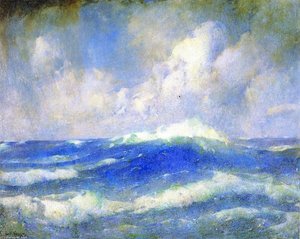
Soren Emil Carlsen's "The Open Sea," painted in 1909, isn’t merely a depiction of the ocean; it’s an immersion into its raw power and profound solitude. This monochromatic seascape, rendered in shades of gray and white, immediately commands attention with its dramatic composition – a clear division between the tumultuous sky and the vast expanse of water below. Carlsen, deeply influenced by both late 19th-century Realism and Impressionism, masterfully captures the atmospheric effects of an impending storm, evoking a sense of awe mingled with unease. The painting’s strength lies not in precise detail but in its ability to convey the *feeling* of being confronted by nature's formidable force – a sentiment powerfully resonant even today.
Crafting Atmosphere: Technique and Materials
Carlsen’s technique is characterized by a deliberate looseness, prioritizing texture and emotional impact over photographic accuracy. Visible brushstrokes dominate the canvas, creating a rough, uneven surface that mirrors the chaotic nature of the sea and sky. Thick impasto is particularly evident in areas representing crashing waves, lending them an almost sculptural quality. The absence of hard lines – instead, blurred edges and subtle gradations of gray – contribute to the painting’s atmospheric effect, drawing the viewer into a world shrouded in mist and anticipation. The choice of oil paint on canvas allowed for layering and blending, essential to achieving the depth and luminosity that define Carlsen's style. The monochromatic palette isn’t simply a stylistic choice; it amplifies the drama, stripping away distractions and focusing attention entirely on form, light, and shadow.
A Study in Light and Perspective
The lighting in “The Open Sea” is diffused and overcast, suggesting an approaching storm or a scene perpetually veiled in mist. There are no sharp shadows; instead, the artist employs subtle tonal variations to create a sense of depth and spatial recession. Atmospheric perspective – where distant objects appear lighter and less distinct – further enhances this effect, conveying the immense scale of the ocean and sky. The horizon line, slightly undulating due to the waves, adds dynamism to the composition while maintaining a sense of balance. The painting’s horizontal format reinforces this feeling of vastness, inviting the viewer to lose themselves in the endless expanse before them.
Symbolism and Emotional Resonance
Beyond its technical brilliance, “The Open Sea” carries significant symbolic weight. The turbulent ocean can be interpreted as a metaphor for the unknown, the challenges of life, or even the overwhelming forces of nature. The monochromatic palette reinforces a sense of somberness and introspection, inviting contemplation on themes of isolation, vulnerability, and perhaps even fear. Carlsen’s work taps into a primal human response to the sea – a mixture of respect, awe, and a recognition of our own insignificance in the face of such power. It's a painting that lingers in the mind long after viewing, prompting reflection on the beauty and terror inherent in the natural world.
Discovering the Artist: A Legacy of Luminism
Soren Emil Carlsen (1853-1932) was a pivotal figure in American painting, bridging the gap between European artistic traditions and the burgeoning modern art scene. Born in Copenhagen and later settling in Chicago, he developed a distinctive style characterized by tonalist landscapes and seascapes – a legacy deeply rooted in Danish Luminism, an approach emphasizing subtle gradations of light and color to evoke mood and atmosphere. His work, as evidenced by his other pieces like “Kattegat Landscape,” demonstrates a profound understanding of capturing the ephemeral qualities of light and weather. Explore more of Carlsen’s captivating oeuvre at OriginalUniqueArt to fully appreciate the breadth and depth of his artistic vision.
Questions & Answers
Is "The Open Sea" by Soren Emil Carlsen a painting, a drawing or a print?
In the catalog, "The Open Sea" by Soren Emil Carlsen is filed as wall art. The category helps find similar works.
What underlying hue runs through "The Open Sea" by Soren Emil Carlsen?
The dominant hue of "The Open Sea" by Soren Emil Carlsen is green to violet spectrum. The hue is the underlying tone of the palette.
What stage of Soren Emil Carlsen's development does "The Open Sea" represent?
Within Soren Emil Carlsen's career, "The Open Sea" falls in the Late Career. The phase helps compare it with the artist's other works.
Artist Biography
A Life Bridging Worlds: The Story of Søren Emil Carlsen
Born in Copenhagen, Denmark, on October 19, 1848 (though some records indicate 1853), Søren Emil Carlsen embarked on a journey that would see him become a pivotal figure in the evolution of American painting. His early life was steeped in artistic potential; he initially pursued architecture at the Royal Academy in Copenhagen for four years, a foundation that instilled within him a keen understanding of structure and form. However, the allure of pure artistry proved too strong to resist. He transitioned from architectural assistant to studying with Danish marine artist Lauritz Holst, absorbing techniques of depicting light and atmosphere on water – skills that would subtly influence his later landscapes. A transformative period followed in 1872 when Carlsen emigrated to the United States, settling in Chicago, a burgeoning center for artistic innovation. This move marked not just a geographical shift but a profound turning point in his artistic development. He sought further refinement of his craft with a sojourn to Paris in 1875, where he fell under the spell of Jean-Baptiste-Siméon Chardin, the celebrated French master of still life.The American Chardin: A Mastery of Stillness
Upon returning from France, Carlsen quickly established a reputation as “The American Chardin,” a testament to his remarkable ability to imbue everyday objects with dignity and poetic resonance. His early works were deeply rooted in the tonalist aesthetic, characterized by muted palettes, subtle gradations of light, and an emphasis on mood and atmosphere. He found beauty in the commonplace – copper pans gleaming softly, game birds arranged with meticulous detail, delicate flowers poised in vases. These weren’t merely depictions of objects; they were meditations on texture, form, and the fleeting nature of time. He wasn't simply painting *what* he saw, but *how* he felt when observing it. This sensitivity to light and atmosphere became a hallmark of his style, setting him apart from many of his contemporaries. However, Carlsen was not content to remain solely within the confines of still life. As his career progressed, he began to expand his artistic horizons, venturing into landscapes and marine paintings, always retaining that signature tonalist sensibility. His exploration of these genres reveals a growing interest in capturing the broader effects of light and atmosphere on the natural world, influenced by encounters with American Impressionists like John Twachtman and Julian Alden Weir.A Teacher and Innovator: Shaping the Next Generation
Carlsen’s influence extended far beyond his own canvases; he was a dedicated educator who profoundly impacted generations of artists. He began his teaching career as the first instructor of drawing and painting at the Chicago Academy of Design, laying the groundwork for countless aspiring artists. Later, he served as director of the California School of Design (now the San Francisco Art Institute) from 1887 to 1889, shaping the artistic landscape of the West Coast. He continued his commitment to teaching throughout his life, holding positions at the National Academy of Design, the Art Students League, and the Pennsylvania Academy of Fine Arts for over four decades. Among his most notable students was Guy Rose, who would go on to become a prominent figure in California Impressionism. Carlsen’s pedagogical approach emphasized observation, technique, and a deep understanding of artistic principles. He wasn't merely imparting skills; he was fostering a love of art and encouraging his students to find their own unique voices. His dedication to education earned him numerous accolades, including the Samuel T. Shaw Purchase Prize, a Gold Medal at the Louisiana Purchase Exposition, and the prestigious Medal of Honor at the Panama–Pacific International Exposition. He was also elected to membership in the National Academy of Design, solidifying his position as a leading figure in the American art world.Legacy and Enduring Appeal
Søren Emil Carlsen’s artistic legacy is one of quiet brilliance and enduring influence. He skillfully bridged the gap between Tonalism and early Impressionism, demonstrating how these seemingly disparate styles could coexist and enrich each other. His work continues to resonate with audiences today because of its timeless quality – a masterful blend of technical skill, emotional depth, and poetic sensibility. He purchased a home in Falls Village, Connecticut in 1905, finding solace and inspiration in the Berkshire Mountains, where he painted many landscapes during his summers. His sales improved significantly after joining the Macbeth Gallery, allowing him to live comfortably and continue pursuing his artistic vision. Solo exhibitions at the gallery throughout the 1910s and 1920s further cemented his reputation as a leading American artist. Carlsen continued teaching until his death on January 2, 1932, in New York City, leaving behind a rich body of work that is now represented in prominent museums across the country, including the Art Institute of Chicago, the Metropolitan Museum of Art, and the San Diego Museum of Art. His paintings are not merely historical artifacts; they are windows into a world seen through the eyes of a master – a world where beauty resides in simplicity, and light holds the power to transform the ordinary into the extraordinary.Key Characteristics of Carlsen’s Work
- Tonalism & Impressionism: A unique blend of muted tones and atmospheric effects with a touch of impressionistic vibrancy.
- Still Life Mastery: Renowned for his exquisite still lifes, often featuring copper, brass, and everyday objects imbued with poetic significance.
- Subtle Light & Atmosphere: A remarkable ability to capture the nuances of light and atmosphere, creating a sense of mood and tranquility.
- Influenced by Chardin: Deeply inspired by Jean-Baptiste-Siméon Chardin’s approach to still life painting.
- Dedication to Teaching: A committed educator who shaped the next generation of American artists.

Soren Emil Carlsen
1853 - 1932 , Denmark
Quick Facts
- Full Name: Soren Emil Carlsen
- Nationality: American/Danish
- Date Of Birth: 1853
- Date Of Death: 1932
- Place Of Birth: Copenhagen, Denmark
- Notable Artworks:
- October Summer
- The Samovar
- Still Life w/Copper
- Artistic Movement Or Style: Tonalism, Impressionism
- Artists Who Influenced This Artist:
- Jean-Baptiste Chardin
- Lauritz Holst
- Artists Or Movements Influenced By This Artist:
- Guy Rose
- American Impressionism
Related Articles
The Allure of the Horizon: A Comprehensive Exploration of Seascape Art Through History & Emotion
Explore the captivating world of seascape art! Discover its history, key artists & movements – from Dutch Masters to Impressionism. Expert insights for collectors and enthusiasts at OriginalUniqueArt.

The Soul of Impressionism: Why Oil on Canvas Captures Eternal Light and Timeless Emotion
Discover the enchanting alchemy of Impressionism. Explore how the mastery of oil on canvas, through glazing and impasto, captures eternal light and emotion. Perfect for lovers of Monet and Van Gogh seeking the profound depth of hand-painted fine art.

Oil on Canvas: A Historical & Technical Exploration of a Timeless Artistic Medium
Explore the rich history & enduring techniques of oil painting on canvas. Discover the science behind its longevity, conservation practices, and contemporary relevance. Expert insights for art enthusiasts.

The Enduring Legacy of Oil on Canvas: Technique, History & Aesthetic Impact
Explore the rich history & techniques of oil painting – from Renaissance masters to Impressionism. Discover pigments, layering methods, and why this timeless medium endures. Expert insights for artists & art enthusiasts.

Romantic Realism's Finest: 10 Masterpieces for Your Home | OriginalUniqueArt
Explore 10 defining masterpieces of Romantic Realism! Discover Courbet, Millet & Daumier's powerful paintings—capturing emotion and social realities. Find museum-quality reproductions for your home at OriginalUniqueArt.com.