Preview
 Send
Send Share
Share
 Details
 Guide
Guide

 Download
 Similars
 X-Ray
X-Ray Diaporama
 Q&A
Q&A Stats
StatsBlind Man's Buff

- 17.0 x 13.0 cm


 Read More
Giclée / Art Print
Museum-quality giclée or canvas print with fast production and flexible finish options. ( Buy Hand Made Painting Switch to Digital Image)




P118B $10

P118H $10

P118W $10

P438Z $10

P508JH $12

P508YH $12

P805H $10

P805Z $10

P919BZ $10

P919G $10

P919XJ $10

P959ZH $10

P968JZ $12

W106C $8

W218G $10

W218JH $8

W218Y $10

W307PJ $10

W316G $10

W316PJ $8

W316Y $10

W398PJ $8

W4111J $10

W500HY $15

W500JH $15

W692G $12

W849H $8

W940BG $15

W953PJ $8




Pick from our preset sizes that match the artwork's original proportions.

Type the width and the height you need, to fit your frame or your wall. A print can only be cut, never made bigger than the picture, so a size with a different shape loses a part of the image. We send you a digital mockup to approve before we print anything. The picture shown on this page does not show the real cut — only the mockup does.
Worldwide Delivery () in 2 weeks instead of standard 4/5 weeks. (6 November)

Free Worldwide Express Shipping

High-Quality Linen Canvas

Full Shipping Insurance

Customs Tax Refund Guarantee

True Color Matching Guarantee

100-Day Return Policy (Defects Only)

100% Money-Back Guarantee

Bulk Discount Offer
 Glass option is only available in size under 110 CM

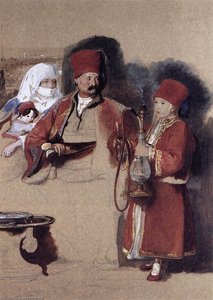
Blind Man's Buff
Giclée / Art Print
Reproduction Size
-


Total Price
$ 81
A Symphony of Spontaneity: Rediscovering Wilkie’s Blind Man's Buff
In the quiet corners of the Ashmolean Museum, tucked within a diminutive frame of only 17 x 13 cm, lies a masterpiece that breathes with the vibrant energy of a bygone era. Sir David Wilkie’s Blind Man’s Buff is far more than a mere depiction of a childhood pastime; it is a profound window into the Romantic spirit, capturing a fleeting moment of unadulterated joy. Through his masterful command of oil on panel, Wilkie invites us to step away from the rigid formalities of the Victorian age and into the warmth of a rustic farmhouse. The painting serves as a captivating snapshot of observation, where the boundaries between the viewer and the subjects blur, creating an intimate connection that feels as immediate today as it did in the early nineteenth century.
The composition is a marvel of controlled dynamism. Wilkie employs a meticulous technique characterized by subtle tonal gradations and delicate hatching to sculpt form from light. As our eyes wander across the wooden bench and the architectural bones of the room, we feel the palpable movement of the players. The children, caught in the midst of their game, possess a lifelike quality that suggests they might break into laughter at any second. This sense of motion is anchored by Wilist’s expert use of texture, where the rough grain of the wooden beams and the heavy fabric of traditional attire are rendered with such precision that one can almost sense the tactile reality of the scene. It is a technical triumph that transforms a small-scale work into an expansive emotional landscape.
The Warmth of Tradition and the Earthy Soul of Art
Beyond the immediate playfulness, the painting is steeped in a rich historical and symbolic narrative. Wilkie, often celebrated as "the people’s painter," deliberately chose a humble setting to ground his work in the reality of everyday life. The color palette is a soulful arrangement of earth tones—deep ochres, warm browns, and muted reds—which coalesce to evoke the comforting glow of a hearth. These colors do not merely decorate the scene; they provide an emotional foundation of stability and domestic contentment. Yet, Wilkie masterfully punctuates this earthy atmosphere with sudden, spirited splashes of blue and red, mirroring the unpredictable sparks of laughter found within the game itself.
For the discerning collector or interior designer, Blind Man’s Buff offers a unique opportunity to introduce a sense of narrative depth and historical elegance into a space. The painting functions as an anchor of "quiet joy," providing a focal point that is both intellectually stimulating and visually soothing. It embodies a timeless aesthetic where the rustic charm of the Victorian countryside meets the sophisticated artistry of the Romantic movement. To possess a reproduction of this work is to invite a piece of history into one's home—a piece that celebrates the beauty of the mundane and the enduring power of human connection, making it an exquisite addition to any curated collection or thoughtfully designed room.
Questions & Answers
Where can I see a preview of "Blind Man's Buff"?
To preview a reproduction of "Blind Man's Buff" by Sir David Wilkie, open the artwork's Preview page.
How big is the original "Blind Man's Buff"?
The original "Blind Man's Buff" by Sir David Wilkie measures 17 x 13 cm.
What are the format and size of "Blind Man's Buff"?
"Blind Man's Buff" by Sir David Wilkie is a portrait composition measuring 17 x 13 cm in the original.
Artist Biography
The People’s Painter: The Soul of Scottish Genre
In the grand tapestry of nineteenth-century British art, few threads shine with as much warmth and human empathy as those woven by Sir David Wilkie. Born in the humble village of Pitlessie, Fife, Wilkie emerged from a background steeped in the quiet dignity of rural Scotland. As the son of a parish minister, his path toward the canvas was not initially destined by tradition, yet his burgeoning passion for art proved an undeniable force. His early education at the Trustees’ Academy in Edinburgh, under the guidance of John Graham, provided him with a rigorous foundation, but it was his habit of haunting fairs and marketplaces that truly defined his vision. By capturing the fleeting, characteristic moments of everyday life, he developed a profound ability to transfer the spirit of a scene into his sketchbook, finding extraordinary beauty in the most ordinary subjects.
Wilkie’s artistic journey was marked by an indomitable perseverance and a unique ability to elevate the mundane to the level of high art. While many of his contemporaries sought glory in grand historical narratives or mythological allegories, Wilkie turned his gaze toward the common man. He became a master of genre painting, creating vibrant microcosms of society through works that were teeming with character and anecdotal detail. His early studies were deeply influenced by the likes of Alexander Carse and David Allan, whose focus on scenes from humble life resonated with his own sensibilities. This dedication to realism allowed him to capture the nuances of human experience—the subtle expressions of emotion, the intimate interactions between individuals, and the atmospheric details that breathed life into every canvas.
A Legacy of Light and Narrative Detail
As his reputation expanded from Scotland to the bustling art scene of London, Wilkie’s style underwent a magnificent evolution. His early work possessed a sharp, precise, and spirited touch, often characterized by subdued coloring and a silvery grey tone reminiscent of Dutch genre painters like Teniers and Ostade. However, as he matured, his brushwork grew broader and his palette more luminous, embracing a richness of tone and a powerful use of color that reflected the burgeoning Romantic movement. This transition allowed him to tackle even more monumental subjects without losing the psychological depth that was his hallmark. His appointment as Principal Painter in Ordinary to King William IV and Queen Victoria stands as a testament to this unparalleled skill, securing him prestigious commissions for royal portraits and historical scenes.
<The breadth of Wilkie’s oeuvre is truly remarkable, spanning from the intimate to the epic. His masterpiece, The Chelsea Pensioners Reading the Waterloo Dispatch, remains one of his most celebrated achievements, offering an immersive portrayal of camaraderie and shared anxiety that continues to captivate audiences at Apsley House. Beyond these narrative triumphs, he excelled in historical paintings such as Sir David Baird Discovering the Body of Sultan Tipoo Sahib, and even captured the scholarly atmosphere of intellectual pursuits in works like Washington Irving in the Archives of Seville. Whether depicting a bustling village festival or a formal royal figure, Wilkie’s work remains anchored by a distinctly Scottish sensibility and an unwavering commitment to capturing the essence of life as it is lived.

Sir David Wilkie
1785 - 1841 , Scotland
Quick Facts
- Artistic Movement Or Style: Romanticism
- Artists Who Influenced This Artist:
- Caravaggio
- Rembrandt
- Full Name: Sir David Wilkie
- Nationality: Scottish
- Notable Artworks:
- The Chelsea Pensioners Reading the Waterloo Dispatch
- The Shepherdess Returning from Watering
- A Bookcase
- Place Of Birth: Scotland
- Date Of Birth: 1785
- Date Of Death: 1841
Related Articles

David Cox the Elder: Landscape, Light & the Romantic Vision of Rural England
Explore the captivating landscapes of David Cox the Elder, a pivotal figure in British Romanticism. Discover his masterful watercolour techniques, enduring legacy & find timeless art for your home at OriginalUniqueArt.

Sir David Wilkie: Narrative Detail & the Rise of Victorian Genre Painting
Explore the life & work of Sir David Wilkie, a pivotal figure in Victorian genre painting. Discover his narrative detail, social commentary, and lasting influence on 19th-century British art. Learn more at OriginalUniqueArt.

Romantic Realism's Finest: 10 Masterpieces for Your Home | OriginalUniqueArt
Explore 10 defining masterpieces of Romantic Realism! Discover Courbet, Millet & Daumier's powerful paintings—capturing emotion and social realities. Find museum-quality reproductions for your home at OriginalUniqueArt.com.
Titan Buff Tones: 10 Masterpieces for a Warm & Sophisticated Home |
Explore 10 iconic paintings bathed in 'Titan Buff' – from Rembrandt to Rubens. Discover the stories, techniques & warm tones that define these masterpieces. Find museum-quality art reproductions for your home at .

Romantic Landscapes: 10 Masterpieces for Your Home | OriginalUniqueArt
Journey through 10 Romantic landscape masterpieces by Friedrich, Turner & Cole. Explore emotional art, sublime nature scenes & iconic 19th-century paintings. Find museum-quality reproductions for your home at OriginalUniqueArt.com – discover the full collection online!