Text size

() ·

A painting made for you, by hand

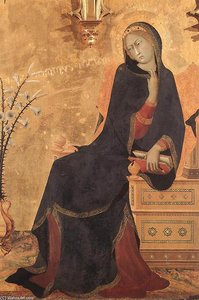
The Annunciation and Two Saints (detail)

Hand Made Oil Reproduction

Hand-painted oil on canvas in your size and frame, made to order by our artists. ( Switch to Print Switch to Digital Image)

Collectible Description

Discover Simone Martini’s ‘The Annunciation,’ a stunning 1333 tempera painting showcasing Renaissance artistry & religious devotion. Explore its detail, influence & reproductions at OriginalUniqueArt.com.

Artist Biography

Discover Simone Martini, the Sienese master of elegance and grace! His International Gothic paintings—like 'Maestà'—blend religious themes with courtly refinement & exquisite detail.

from ·

Chapter 1

How large should it be?

Slide to change the size; the picture on the left shows the frame at its real width. The proportions of the original are kept.

Standard
custom
CM
INCH

Pick from our preset sizes that match the artwork's original proportions.

width
height

Type the width and the height you need, to fit your frame or your wall. This is hand-painted, so for a size with a different shape the artist can paint a bit more around the picture, or cut a bit — you choose. We send you a digital mockup to approve before the painting starts. The picture shown on this page does not show the real result — only the mockup does.

Chapter 2

How should it arrive?

Choose the edges of the stretched canvas

Choose your frame

Corner sample of the WhiteWrap canvas edge finish, stretched on solid wood bars
White $1
Corner sample of the BlurSideWrap canvas edge finish, stretched on solid wood bars
Blurside $1
Corner sample of the ExtendedWrap canvas edge finish, stretched on solid wood bars
Extended $1
Corner sample of the P118B picture frame: moulded polystyrene, 5 cm wide and 3 cm thick
P118B $10
Corner sample of the P118H picture frame: moulded polystyrene, 5 cm wide and 3 cm thick
P118H $10
Corner sample of the P118W picture frame: moulded polystyrene, 5 cm wide and 3 cm thick
P118W $10
Corner sample of the P438Z picture frame: moulded polystyrene, 5.5 cm wide and 3.5 cm thick
P438Z $10
Corner sample of the P508JH picture frame: moulded polystyrene, 7 cm wide and 3.5 cm thick
P508JH $12
Corner sample of the P508YH picture frame: moulded polystyrene, 7 cm wide and 3.5 cm thick
P508YH $12
Corner sample of the P805H picture frame: moulded polystyrene, 5 cm wide and 3.5 cm thick
P805H $10
Corner sample of the P805Z picture frame: moulded polystyrene, 5 cm wide and 3.5 cm thick
P805Z $10
Corner sample of the P919BZ picture frame: moulded polystyrene, 7 cm wide and 3.5 cm thick
P919BZ $10
Corner sample of the P919G picture frame: moulded polystyrene, 7 cm wide and 3.5 cm thick
P919G $10
Corner sample of the P919XJ picture frame: moulded polystyrene, 7 cm wide and 3.5 cm thick
P919XJ $10
Corner sample of the P959ZH picture frame: moulded polystyrene, 5 cm wide and 3 cm thick
P959ZH $10
Corner sample of the P968JZ picture frame: moulded polystyrene, 6 cm wide and 4 cm thick
P968JZ $12
Corner sample of the W106C picture frame: solid wood, 5 cm wide and 3 cm thick
W106C $8
Corner sample of the W218G picture frame: solid wood, 5 cm wide and 3 cm thick
W218G $10
Corner sample of the W218JH picture frame: solid wood, 5 cm wide and 3 cm thick
W218JH $8
Corner sample of the W218Y picture frame: solid wood, 5 cm wide and 3 cm thick
W218Y $10
Corner sample of the W307PJ picture frame: solid wood, 6 cm wide and 3 cm thick
W307PJ $10
Corner sample of the W316G picture frame: solid wood, 6 cm wide and 3 cm thick
W316G $10
Corner sample of the W316PJ picture frame: solid wood, 6 cm wide and 3 cm thick
W316PJ $8
Corner sample of the W316Y picture frame: solid wood, 6 cm wide and 3 cm thick
W316Y $10
Corner sample of the W398PJ picture frame: solid wood, 5 cm wide and 3 cm thick
W398PJ $8
Corner sample of the W4111J picture frame: solid wood, 6.5 cm wide and 3.5 cm thick
W4111J $10
Corner sample of the W500HY picture frame: solid wood, 7 cm wide and 5 cm thick
W500HY $15
Corner sample of the W500JH picture frame: solid wood, 7 cm wide and 5 cm thick
W500JH $15
Corner sample of the W692G picture frame: solid wood, 8 cm wide and 4 cm thick
W692G $12
Corner sample of the W849H picture frame: solid wood, 5 cm wide and 3 cm thick
W849H $8
Corner sample of the W940BG picture frame: solid wood, 7.5 cm wide and 4.5 cm thick
W940BG $15
Corner sample of the W953PJ picture frame: solid wood, 6 cm wide and 3.5 cm thick
W953PJ $8
Corner sample of the H24-GOLD picture frame: carved wood with gesso, 10 cm wide and 6 cm thick
H24-GOLD $30
Corner sample of the H24-SILVER picture frame: carved wood with gesso, 10 cm wide and 6 cm thick
H24-SILVER $30
Corner sample of the H36-GOLD picture frame: carved wood with gesso, 15 cm wide and 6.5 cm thick
H36-GOLD $45
Corner sample of the H36-SILVER picture frame: carved wood with gesso, 15 cm wide and 6.5 cm thick
H36-SILVER $45
Frame preview
Framed

Moulding: . Overall size with the frame: .

Chapter 3

Who paints it, and should anything change?

Examples of what can be changed: Replace face with customer photo; Add pet (e.g., replace cat with dog); Include hidden message in background; Change background landscape or elements.
After order, OriginalUniqueArt.com team will email client for instructions and provide a mockup preview

Worldwide Delivery () in 3/4 weeks instead of standard 5 weeks. (4 November). No compromise on quality.

Chapter 4

The finishing touches

A nameplate, as in a museum?

Engraved Bronze Plaque Details

This elegant plaque features the artist's name and the title of the artwork, finely engraved for a timeless presentation.

It is made from bronze with a refined, elegant finish. The text is precisely laser-engraved for a sharp and permanent result. Measuring 9x2 cm, the plaque is compact yet easy to read. It's built to be durable and scratch-resistant, offering a professional, museum-quality look. Mounting is simple thanks to the included adhesive backing.

Transparent Acrylic Plaque Details

The plaque includes essential engraved details such as the artist's name, the title of the artwork, the date it was created, the type of media used-like oil on canvas or watercolor-a brief description of the piece, and a QR code that links to the complete artwork information.

It is crafted from clear acrylic, offering a sleek, modern appearance. The text is UV-engraved in black to ensure strong visual contrast. With a size of 10x15 cm, it ensures optimal readability. It comes equipped with two metal hooks for secure wall mounting. The plaque is designed to be weather-resistant, making it suitable for various environments, and it includes interactive features that work seamlessly with smartphone scanning.

Black Acrylic Plaque Details

This elegant plaque includes engraved information such as the artist's name, the title of the artwork, the date it was created, the type of media used (like oil on canvas or watercolor), a short description of the artwork, and a QR code for quick access to more information.

The plaque itself is made from refined black acrylic with a premium finish. The text is laser-engraved in white for high contrast and readability. Its size is 10x15 cm, designed to be easy to read. It comes with two metal hooks for professional mounting. The design is sleek and fits any interior style. It is also weather-resistant and durable, with built-in digital integration for mobile compatibility.

A protective varnish?

When do you need it?

Chapter 5

Your painting, as you ordered it

The Annunciation and Two Saints (detail)

Reproduction Medium

Reproduction Size

-

Elite Senior Artist

More detail, finesse, and extra production time

-

Reproduction Frame

-

-

For artworks or reproductions larger than 105 cm (approximately 41 inches) on any side, the frame will be shipped as a kit, disassembled. This method ensures safe delivery and prevents damage during transport.

Professional assembly required - this is not a DIY product.
The kit must be assembled and the canvas stretched by an experienced professional framer, using wood glue (not supplied), a canvas stretching plier and clamps to hold the bars square while the glue dries. Incorrect assembly or uneven canvas tension can permanently damage the artwork and is not covered by our warranty.

  • All solid wood bars are included, precisely cut to size.

  • Assembled with the screws provided, plus wood glue for the corner joints, which is not supplied and must be sourced by your framer.

  • Professional tools are required and not included: a canvas stretching plier (tensioner) and clamps to hold the bars square while the glue dries.

Important:
The corner joints require wood glue, the bars must be held with clamps until the glue is fully dry, and tightening the canvas on the assembled frame requires a canvas stretching plier. None of these are included in the kit. Please arrange an experienced professional framer before ordering this size.

Nameplate

-

-

Protective Varnish

Glossy Varnish (enhances colors, protects against light/moisture)

-

Customize My Artwork

Examples of what can be changed: Replace face with customer photo; Add pet (e.g., replace cat with dog); Include hidden message in background; Change background landscape or elements.

-

Urgent

Worldwide Delivery () in 3/4 weeks instead of standard 5 weeks. (4 November). No compromise on quality.

-

Express Shipping

Worldwide Delivery () in 5 weeks. (11 November).

Included

Total Price

$ 300

Total Price $ 300

Glass option is only available in size under 110 CM

Included with every order

  • Free Worldwide Express Shipping
  • High-Quality Linen Canvas
  • Full Shipping Insurance
  • Customs Tax Refund Guarantee
  • True Color Matching Guarantee
  • 100-Day Return Policy (Defects Only)
  • 100% Money-Back Guarantee
  • Bulk Discount Offer

A Vision of Grace: Decoding Simone Martini’s Annunciation

Simone Martini's *The Annunciation and Two Saints (detail)*, created in 1333, is more than just a religious depiction; it’s a shimmering testament to the elegance and refinement of the International Gothic style. Housed within Florence’s prestigious Galleria degli Uffizi, this tempera painting encapsulates a pivotal moment in art history, bridging the gap between Byzantine tradition and the burgeoning Renaissance.

The Scene Unveiled: Narrative & Composition

This detail focuses on the core of the Annunciation – the divine encounter between the Archangel Gabriel and the Virgin Mary. Mary is portrayed seated with a delicate grace, her hands clasped in a gesture of humble acceptance as she receives the momentous news that she will bear the Son of God. The composition isn’t merely illustrative; it's carefully constructed to draw the viewer into this sacred space. Note the subtle interplay between figures – Gabriel’s dynamic arrival contrasted with Mary’s serene composure. The inclusion of two additional saints in the background, though partially obscured in this detail, adds depth and reinforces the spiritual weight of the event. Scattered books hint at Mary's piety and learning, while a vase of lilies symbolizes her purity.

Mastering Tempera: Technique & Artistic Innovation

Martini’s mastery of tempera is breathtakingly evident. This demanding medium, requiring meticulous layering and precise brushwork, allowed him to achieve an unparalleled luminosity and detail. The vibrant colors – particularly the rich blues and radiant golds – aren't simply decorative; they contribute to the painting’s ethereal quality. Observe how Martini uses line not just to define form but also to create a sense of movement and rhythm throughout the composition. This emphasis on elegant, flowing lines is a hallmark of his style and a key characteristic of the International Gothic aesthetic.

Siena & Avignon: Historical Context & Influence

Born in Siena, Martini flourished during a period of artistic innovation and cultural exchange. He was deeply influenced by Sienese traditions but also absorbed elements from French art – particularly illuminated manuscripts – as evidenced by the decorative patterns and refined elegance of his work. Later in his career, he served at the Papal court in Avignon, bringing his distinctive style to a wider audience. His contemporary, Lippo Memmi, collaborated with him on several projects, including another version of *The Annunciation*, demonstrating the collaborative spirit within the Sienese artistic community. Artists like Ambrogio Lorenzetti and Taddeo di Bartolo continued to build upon the foundations laid by Martini, shaping the course of Italian painting.

Symbolism & Spiritual Resonance

Every element within this detail carries symbolic weight. The dove descending from heaven represents the Holy Spirit, while Gabriel’s olive branch signifies peace and divine favor. Mary's posture and expression convey both humility and acceptance. The gold leaf background isn’t merely decorative; it evokes a sense of the divine realm, creating a visual separation between the earthly and the celestial. The painting invites contemplation on themes of faith, grace, and the transformative power of divine intervention.

Emotional Impact & Enduring Legacy

*The Annunciation and Two Saints (detail)* possesses an enduring emotional resonance. It’s not a scene of dramatic action but rather one of quiet reverence and profound spiritual significance. The painting evokes a sense of peace, serenity, and awe. Martini's ability to convey such delicate emotions through his masterful technique is what makes this work so captivating even today. OriginalUniqueArt.com offers meticulously crafted reproductions, allowing you to bring the beauty and inspiration of this masterpiece into your own space.
  • Explore the full artwork and its details at OriginalUniqueArt.com.
  • Discover other works by Simone Martini and his contemporaries.
  • Learn more about the International Gothic style and its influence on art history.

Questions & Answers

Who created "The Annunciation and Two Saints (detail)" and what style is it in?

Behind "The Annunciation and Two Saints (detail)" stand Simone Martini and the International Gothic movement.

When was "The Annunciation and Two Saints (detail)" made?

"The Annunciation and Two Saints (detail)" by Simone Martini was created in 1333.

What is the recommended print size for "The Annunciation and Two Saints (detail)" by Simone Martini?

"The Annunciation and Two Saints (detail)" is recommended at a large print size. Other sizes are available with the same proportions.

More about this painting

Preview AR preview Switch to Print Switch to Digital Image Send
Details Guide Add to favorites Download Similars X-Ray Diaporama Q&A Stats

In numbers

  • 1333the year it was painted
  • 29frames to choose from
  • standard sizes, in its own proportions
  • 5weeks to paint and deliver it
Simone Martini

Simone Martini

1284 - 1344, Italy

Quick facts about Simone Martini

  • Artistic Movement Or Style: International Gothic
  • Artists Or Movements Influenced By This Artist: ['International Gothic']
  • Artists Who Influenced This Artist:
    • Duccio di Buoninsegna
    • Giotto
  • Full Name: Simone Martini
  • Notable Artworks:
    • Maestà
    • Saint Louis of Toulouse Crowning His Brother
    • Annunciation with St. Margaret and St. Ansanus
  • Place Of Birth: Siena, Italy
  • Date Of Birth: 1284
  • Date Of Death: 1344

Artist Biography

A Sienese Master of Elegance and Grace

Simone Martini, born around 1284 in the heart of Siena, Italy, stands as a pivotal figure in the transition from medieval to Renaissance art. He wasn’t merely a painter; he was an architect of elegance, a master of line and color who infused his works with a courtly refinement that distinguished him from contemporaries like Giotto. While historical accounts vary regarding his early training—some suggest apprenticeship under Duccio di Buoninsegna, the leading Sienese artist of the time, while others point to Florence and the influence of Giotto—Martini undeniably forged a unique artistic path. His brother-in-law, Lippo Memmi, was also an artist with whom he frequently collaborated, further enriching the vibrant artistic landscape of Siena. The city itself played a crucial role in shaping Martini’s aesthetic; Siena, a thriving center of commerce and culture, fostered an environment where art flourished, blending religious devotion with worldly sophistication.

The Flourishing of International Gothic

Martini's style is immediately recognizable for its departure from the more monumental forms favored in Florence. He embraced a delicate sensibility, characterized by flowing lines, soft decorative details, and an overall sense of grace. This aesthetic wasn’t born in isolation; it was profoundly influenced by external forces. The Via Francigena, a major pilgrimage route traversing Europe, brought with it artistic currents from France—particularly the refined elegance of French manuscript illumination and ivory carving. These influences are readily apparent in Martini's work, manifesting as intricate patterns, elongated figures, and a heightened attention to surface ornamentation. He didn’t simply copy these styles; he synthesized them with existing Sienese traditions, creating something entirely new. His paintings weren’t merely representations of religious scenes but rather elegant narratives imbued with emotional depth and visual poetry. The Saint Louis of Toulouse Crowning His Brother Robert of Anjou, painted in 1317 during a sojourn in Naples, exemplifies this masterful blend of narrative skill and refined composition. The work showcases Martini’s ability to depict complex scenes with clarity and grace, while simultaneously imbuing them with a sense of courtly splendor.

From Siena to Avignon: A Courtly Appointment

Martini's reputation extended beyond the borders of Italy, leading to a significant turning point in his career. In 1336, he accepted a commission from Pope Benedict XII to create frescoes for the Papal Palace in Avignon, France—a move that placed him at the heart of European power and patronage. This appointment wasn’t merely about artistic skill; it was a testament to Martini's ability to cater to the tastes of a sophisticated courtly audience. While in Avignon, he entered into a remarkable intellectual circle, befriending Francesco Petrarca—better known as Petrarch, the renowned humanist poet. The connection with Petrarch is particularly poignant, as Vasari and other sources suggest that Martini painted a portrait of Laura de Noves, Petrarch’s lifelong muse. Though the portrait itself is lost to time, its very existence speaks volumes about Martini's status as a celebrated artist capable of capturing not only physical likeness but also the essence of beauty and inspiration. The Annunciation with St. Margaret and St. Ansanus, created during his time in Florence before moving to Avignon, is a testament to this period, showcasing delicate beauty and refined aesthetic. 

Legacy and Enduring Influence

Simone Martini’s impact on the development of European art cannot be overstated. He played a crucial role in disseminating the International Gothic style—a movement characterized by its elegance, refinement, and emphasis on decorative detail—across the continent. His influence extended to generations of artists who followed, shaping the course of late medieval and early Renaissance painting. Martini’s work wasn't simply about technical skill; it was about creating a visual language that resonated with the sensibilities of his time—a language of beauty, grace, and spiritual devotion. Even today, his paintings continue to captivate viewers with their exquisite detail, harmonious compositions, and enduring sense of elegance. His frescoes in San Francesco d’Assisi demonstrate his mastery of large-scale decorative painting, while works like the Saint Catherine of Alexandria Polyptych showcase his unparalleled command of color and form. Simone Martini died in Avignon in 1344, leaving behind a legacy that continues to inspire awe and admiration centuries later—a testament to the enduring power of art to transcend time and touch the human spirit.

Quick Facts

  • location: Galleria degli Uffizi, Florence, Italy
  • medium: tempera on panel
  • title: The Annunciation and Two Saints (detail)
  • notable elements:
    • use of gold leaf
    • detailed drapery
    • vibrant colors
  • style: International Gothic

Art Quiz

There is only one correct answer for each question.

Question 1:
In what city is Simone Martini's 'The Annunciation and Two Saints' currently housed?
Question 2:
What painting technique did Simone Martini primarily employ in this work?
Question 3:
The style of 'The Annunciation and Two Saints' is most closely associated with which artistic movement?
Question 4:
What symbolic element is mentioned as being present in the painting, often representing purity?
Question 5:
According to research, who was a contemporary artist that also created a version of 'The Annunciation and Two Saints'?