Preview
 Send
Send Share
Share
 Details
 Guide
Guide

 Download
 Similars
 X-Ray
X-Ray Diaporama
 Q&A
Q&A Stats
StatsThe Beehive

- 34.0 x 49.0 cm


 Read More
Giclée / Art Print
Museum-quality giclée or canvas print with fast production and flexible finish options. ( Buy Hand Made Painting Switch to Digital Image)




P118B $10

P118H $10

P118W $10

P438Z $10

P508JH $12

P508YH $12

P805H $10

P805Z $10

P919BZ $10

P919G $10

P919XJ $10

P959ZH $10

P968JZ $12

W106C $8

W218G $10

W218JH $8

W218Y $10

W307PJ $10

W316G $10

W316PJ $8

W316Y $10

W398PJ $8

W4111J $10

W500HY $15

W500JH $15

W692G $12

W849H $8

W940BG $15

W953PJ $8




Pick from our preset sizes that match the artwork's original proportions.

Type the width and the height you need, to fit your frame or your wall. A print can only be cut, never made bigger than the picture, so a size with a different shape loses a part of the image. We send you a digital mockup to approve before we print anything. The picture shown on this page does not show the real cut — only the mockup does.
Worldwide Delivery () in 2 weeks instead of standard 4/5 weeks. (2 November)

Free Worldwide Express Shipping

High-Quality Linen Canvas

Full Shipping Insurance

Customs Tax Refund Guarantee

True Color Matching Guarantee

100-Day Return Policy (Defects Only)

100% Money-Back Guarantee

Bulk Discount Offer
 Glass option is only available in size under 110 CM

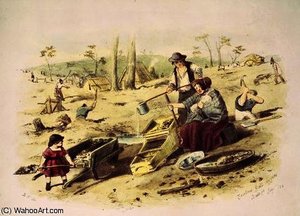
The Beehive
Giclée / Art Print
Reproduction Size
-


Total Price
$ 81
A Window into a Bygone Era
In the delicate, translucent layers of Samuel Thomas Gill’s 1849 watercolor, "The Beehive," we are invited to step through a portal into the rhythmic pulse of nineteenth-century colonial life. This exquisite illustration serves as more than just a landscape; it is a visual chronicle of a community in motion. The scene unfolds within a bustling town square, where the architecture of progress—perhaps a grand station or a highly regarded courthouse—stands as a silent witness to the daily choreography of human endeavor. Through Gill’s masterful use of watercolor washes and fine, precise linework, the viewer is transported to an age defined by the clip-clop of horse-drawn carriages and the spirited commerce of a growing settlement.
The composition captures a sense of organized vitality, where every figure and storefront contributes to a larger tapestry of social interaction. There is a profound nostalgia embedded in the way Gill renders the street life; the figures are not merely static subjects but participants in a living history. For the collector or interior designer, this piece offers more than mere decoration; it provides a narrative anchor for a room, evoking a sense of stability, heritage, and the enduring spirit of human connection.
Mastery of Light and Line
The artistry of Gill lies in his remarkable ability to balance meticulous detail with a soft, atmospheric charm. Utilizing a technique reminiscent of classical nineteenth-century illustration, he employs a slightly flattened perspective that lends the piece a charming, almost storybook quality. The geometric precision of the buildings provides a sturdy structural foundation, while the organic, fluid shapes of the figures and animals breathe life into the streets. This interplay between the rigid and the fluid creates a visual rhythm that guides the eye through the bustling square.
There is a subtle, muted texture to the pigments that suggests the gentle diffusion of light, casting a nostalgic glow over the entire scene. This soft illumination avoids harsh shadows, instead creating an even, inviting warmth that draws the viewer deep into the layers of the town square. The watercolor technique allows for a luminosity that makes the historical moment feel present and breathing, rather than distant and faded. Such delicate execution ensures that the artwork retains its emotional resonance, making it a captivating centerpiece for any curated collection.
Symbolism and Lasting Legacy
Beyond its aesthetic beauty, "The Beehive" resonates with profound symbolic depth. The title itself serves as a metaphor for the industriousness of the era—a society working in unison, much like a hive, to build a new world from the ground up. This theme of collective effort and progress is mirrored in the very composition of the piece, where the movement of people and transport symbolizes the forward momentum of colonial expansion.
For those seeking inspiration in art, Gill’s work represents the intersection of documentation and romanticism. He captures the essence of a period defined by growth and the establishment of community. Owning a high-quality reproduction of this masterpiece allows one to preserve this sense of historical continuity. Whether placed in a sophisticated study or a bright, contemporary living space, "The Beehive" serves as a poignant reminder of the beauty found in industry, order, and the shared journey of civilization.
Questions & Answers
What medium is "The Beehive" by Samuel Thomas Gill executed in?
The medium of "The Beehive" by Samuel Thomas Gill is watercolor. Reproductions aim to render the appearance of this technique.
Which palette and lead color define "The Beehive"?
"The Beehive" is defined by a neutrals palette led by putty (#ede3c3).
When was "The Beehive" created, and to which movement does it belong?
"The Beehive" by Samuel Thomas Gill is dated 1849 and belongs to 19th Century Illustration.
Artist Biography
Early Life and Artistic Foundations
Samuel Thomas Gill, a name synonymous with the visual chronicle of 19th-century Australia, was born on May 21, 1818, in the quiet coastal village of Perriton, near Minehead in Somerset, England. The son of Reverend Samuel Gill, a Baptist minister, and Winifred Oke, young Samuel’s upbringing instilled in him both a strong moral compass and an early appreciation for observation – qualities that would profoundly shape his artistic journey. His initial education at Plymouth and Dr Seabrook's academy provided a solid foundation, but it was the informal instruction in drawing from his father that first ignited his passion for art. This nascent talent led him to London, where he honed his skills as a draftsman and watercolour painter with the Hubard Profile Gallery. Here, amidst the bustling artistic scene, Gill gained valuable experience in portraiture and the delicate art of silhouette creation, mastering techniques that would later serve him well in capturing the essence of colonial life. These early years were crucial in developing his eye for detail and establishing a technical proficiency that set the stage for his future endeavors.A New World: Australia and the Goldfields
In December 1839, Gill embarked on a transformative journey, emigrating to South Australia with his family aboard the *Caroline*. This move marked not only a geographical shift but also a pivotal moment in his artistic development. Establishing a studio in Adelaide, he quickly found demand for his portrait services and topographical sketches of houses and landscapes. However, it was his participation in J.A. Horrocks’s 1846 expedition into the Flinders Ranges that truly cemented his place as an artist of exploration and documentation. The tragic death of Horrocks during this journey deeply affected Gill, yet he channeled his grief and observations into poignant diary entries and sketches – invaluable records of early colonial life and the harsh realities of venturing into the Australian interior. This experience instilled in him a profound respect for the land and its challenges, themes that would recur throughout his oeuvre. The discovery of gold in Victoria in 1852 drew Gill eastward, to the bustling diggings where he became known as “The Artist of the Goldfields.” Here, he created a prolific body of work – watercolours and lithographs depicting the vibrant, chaotic, and often brutal reality of life on the goldfields. His series *Victoria Gold Diggings and Diggers As They Are* (1853) stands as a remarkable achievement, offering a nuanced and humanizing portrayal of miners from diverse backgrounds, capturing not only their hopes for fortune but also their daily struggles and interactions.Documenting a Nation: Style and Significance
Gill’s artistic style was characterized by its directness, realism, and keen observation. He possessed an exceptional ability to capture the energy of a scene, whether it be the bustling streets of Adelaide or the frenetic activity of the goldfields. His watercolours are particularly notable for their vibrant colours and meticulous detail, while his lithographs demonstrate a mastery of line and tone. Throughout the 1860s, Gill continued to produce artwork, including *Australian Sketchbook*, which showcased his views of Melbourne and its surroundings. While some later works exhibited a coarser handling of watercolour and occasionally revisited earlier subjects, his commitment to depicting Australian life remained unwavering. He was among the first artists to portray Indigenous Australians with respect and sensitivity, offering a relatively nuanced perspective compared to prevailing societal biases. His work provides invaluable visual records of 19th-century Australia, offering insights into its social, economic, and cultural development. Gill’s ability to capture both the grandeur and the everyday realities of colonial life has secured his place as a significant artist in Australian history. He is celebrated for his vibrant watercolours and lithographs that depict Indigenous culture, goldfields scenes, and Victorian-era townscapes – images that continue to resonate with audiences today.Legacy and Enduring Impact
Samuel Thomas Gill’s life came to a poignant end on October 27, 1880, when he collapsed and died on the steps of the Bourke Street Post Office in Melbourne. Though his later years were marked by hardship and struggle, his artistic legacy endured. Initially overlooked after his death, Gill's work experienced a resurgence in appreciation during the 20th century as scholars and art enthusiasts recognized its historical importance and artistic merit. Today, he is rightfully acknowledged as a pivotal figure in Australian art history – a chronicler of a nation’s formative years. His paintings and lithographs are held in major public collections across Australia, including the Art Gallery of South Australia, the National Gallery of Victoria, and the State Library of Victoria. Gill's work continues to inform our understanding of colonial life, offering a unique window into the past and reminding us of the challenges and triumphs of those who shaped modern Australia. His dedication to capturing the essence of his adopted homeland ensures that his artistic voice will continue to resonate for generations to come, solidifying his position as “The Artist of the Goldfields” and a true pioneer of Australian art.
Samuel Thomas Gill
1818 - 1880 , United Kingdom
Quick Facts
- Full Name: Samuel Thomas Gill
- Nationality: British-Australian
- Date Of Birth: 1818
- Date Of Death: 1880
- Place Of Birth: Perriton, United Kingdom
- Notable Artworks:
- The Beehive
- Departure of Capt Sturt
- Invalid's tent
- Artistic Movement Or Style: Colonial art
Related Articles

The Enduring Appeal of Watercolor: History, Techniques & Contemporary Practice
Explore the captivating world of watercolor painting! Discover its rich history, essential techniques, influential artists, and collecting tips. A comprehensive guide for art enthusiasts.

Watercolor Wonders: 10 Masterpieces That Redefined Art History | OriginalUniqueArt
Journey through 10 legendary watercolor masterpieces by Sargent, Turner & Homer! Explore iconic landscapes, portraits & floral art that redefined history. Find museum-quality reproductions and curated decor ideas at OriginalUniqueArt.com.

Ephemeral Visions: Exploring the Artistic Legacy & Nuances of Watercolor Painting
Explore the captivating world of watercolor painting! Discover its rich history, essential techniques, influential artists & collecting tips from art experts. A comprehensive guide for enthusiasts.

Ephemeral Visions: Exploring the History & Emotional Resonance of Watercolor Painting
Explore the captivating history of watercolor painting, from ancient techniques to modern masters like Kandinsky & Blake. Discover essential artists, collecting tips & the emotional power of this luminous medium. Expert insights for art enthusiasts.

Ephemeral Visions: Exploring the Artistic Legacy & Contemporary Practice of Watercolor Painting
Explore the captivating world of watercolor painting! Discover its rich history, essential techniques, influential artists & collecting tips. A comprehensive guide for art enthusiasts from OriginalUniqueArt.