Preview
 Send
Send Share
Share
 Details
 Guide
Guide

 Download
 Similars
 X-Ray
X-Ray Diaporama
 Q&A
Q&A Stats
StatsEarly Morning

- 188.0 x 232.0 cm


 Read More
Giclée / Art Print
Museum-quality giclée or canvas print with fast production and flexible finish options. ( Buy Hand Made Painting Switch to Digital Image)




P118B $10

P118H $10

P118W $10

P438Z $10

P508JH $12

P508YH $12

P805H $10

P805Z $10

P919BZ $10

P919G $10

P919XJ $10

P959ZH $10

P968JZ $12

W106C $8

W218G $10

W218JH $8

W218Y $10

W307PJ $10

W316G $10

W316PJ $8

W316Y $10

W398PJ $8

W4111J $10

W500HY $15

W500JH $15

W692G $12

W849H $8

W940BG $15

W953PJ $8




Pick from our preset sizes that match the artwork's original proportions.

Type the width and the height you need, to fit your frame or your wall. A print can only be cut, never made bigger than the picture, so a size with a different shape loses a part of the image. We send you a digital mockup to approve before we print anything. The picture shown on this page does not show the real cut — only the mockup does.
Worldwide Delivery () in 2 weeks instead of standard 4/5 weeks. (4 November)

Free Worldwide Express Shipping

High-Quality Linen Canvas

Full Shipping Insurance

Customs Tax Refund Guarantee

True Color Matching Guarantee

100-Day Return Policy (Defects Only)

100% Money-Back Guarantee

Bulk Discount Offer
 Glass option is only available in size under 110 CM

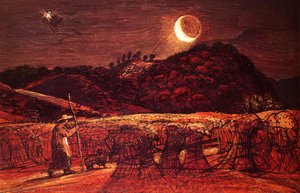
Early Morning
Giclée / Art Print
Reproduction Size
-


Total Price
$ 81
A Dawn of Serenity: Samuel Palmer’s “Early Morning”
Samuel Palmer's "Early Morning," painted in 1825, isn’t merely a depiction of a forest scene; it’s an immersion into a world steeped in Romanticism’s yearning for the sublime and the spiritual. This evocative work, now housed within the Ashmolean Museum in Oxford, captures a fleeting moment of quietude—a hushed dawn breaking over a densely wooded landscape. The painting immediately draws the viewer in with its muted palette dominated by browns, greens, and greys, punctuated by subtle washes of blue and violet that suggest the nascent light filtering through the trees. It’s a scene deliberately devoid of dramatic action or overt narrative, instead prioritizing atmosphere and mood—a hallmark of Palmer's distinctive style.
Palmer’s technique is characterized by a delicate layering of thin glazes applied to a prepared ground. He masterfully employed dry brushwork to create the texture of bark, moss, and fallen leaves, imbuing the scene with an almost tactile quality. Notice how he renders the trees—not as sharply defined forms but as hazy masses, their edges dissolving into the surrounding gloom. This blurring effect contributes significantly to the painting’s dreamlike atmosphere, suggesting a world existing just beyond our immediate perception. The placement of the two small birds, one perched on a branch and another flitting through the foliage, adds a touch of delicate life to this otherwise still scene, hinting at the renewal that dawn inevitably brings.
The Influence of Blake and the Shoreham Vision
To fully appreciate “Early Morning,” it’s crucial to understand Palmer's artistic context. He was deeply influenced by William Blake, a visionary poet and artist whose ideas about nature, spirituality, and the interconnectedness of all things resonated profoundly with Palmer. This influence is particularly evident in the Shoreham series—a group of paintings created between 1826 and 1835 depicting the landscape surrounding his secluded cottage near Sevenoaks. Palmer’s association with Blake and other artists within the “Ancients” group – a circle dedicated to exploring spiritual themes through art – fostered an environment of intense creative experimentation and a shared desire to capture the essence of nature's hidden beauty.
The Shoreham paintings, like "Early Morning," are characterized by their hazy atmosphere, symbolic imagery, and exploration of twilight realms. Palmer sought to depict not just what he saw but also what he *felt*—a sense of mystery, solitude, and connection to something larger than himself. The painting’s composition echoes the Romantic ideal of the sublime: a feeling of awe and terror inspired by the grandeur and power of nature. The use of sepia tones further enhances this effect, evoking a sense of antiquity and timelessness.
Symbolism and Emotional Resonance
Beyond its technical brilliance, “Early Morning” is rich in symbolic meaning. The forest itself represents the unconscious mind—a place of hidden depths and potential for transformation. The muted colors suggest introspection and contemplation, while the light filtering through the trees symbolizes hope and renewal. The presence of the cats, scattered throughout the scene, adds a layer of enigmatic charm. They are often interpreted as symbols of intuition and instinct – creatures attuned to the subtle rhythms of nature.
Palmer’s paintings were not intended for public display during his lifetime; he deliberately guarded them from critical scrutiny, believing that their true meaning could only be understood by those who possessed a receptive spirit. “Early Morning,” therefore, invites us to engage in a quiet dialogue with the artist—to lose ourselves in its atmosphere and contemplate its profound emotional resonance. It’s a painting that speaks not just to the eye but also to the heart, offering a glimpse into a world of beauty, mystery, and spiritual longing.
A Timeless Masterpiece for Art & Interior Design
Reproductions of Samuel Palmer's “Early Morning” offer a remarkable opportunity to bring this evocative artwork into your home or office. The delicate brushwork and atmospheric depth are beautifully captured in high-quality prints, allowing you to experience the painting’s serene beauty firsthand. Its muted color palette complements a wide range of interior design styles, from traditional to contemporary—adding a touch of understated elegance and contemplative charm. Consider framing it within a simple wooden frame to enhance its rustic appeal or pairing it with complementary artwork that evokes similar themes of nature and spirituality.
Whether you’re an art enthusiast, a collector seeking unique pieces, or simply someone who appreciates the beauty of the natural world, “Early Morning” is a timeless masterpiece—a testament to Samuel Palmer's artistic vision and his profound connection to the Romantic spirit.
Questions & Answers
Is "Early Morning" typical of what Samuel Palmer usually created?
Samuel Palmer's recurring themes include blakean mysticism, romantic vision, nature’s serenity, spiritual quest, shoreham landscapes, hidden beauty, pastoral themes, english countryside; "Early Morning" focuses on forest, cats, landscape, trees, birds, dawn, pastoral.
What color saturation does "Early Morning" by Samuel Palmer have?
The palette of "Early Morning" is muted in saturation.
How big is the original "Early Morning"?
The recorded dimensions of "Early Morning" by Samuel Palmer are 188 x 232 cm. Reproductions can be ordered in other sizes while keeping the same proportions.
Artist Biography
Early Life and the Seeds of Vision
Samuel Palmer, born in London in 1805, emerged from a world steeped in both intellectual curiosity and spiritual seeking. His father, a bookseller and Baptist minister, instilled in him a love for literature and a contemplative nature, while his early artistic inclinations manifested remarkably early – by the age of twelve, he was already diligently painting churches, demonstrating an innate talent for observation and detail. This precocious ability quickly gained recognition; at just fourteen years old, Palmer exhibited works inspired by J.M.W. Turner at the Royal Academy, signaling a promising start to his artistic journey. Though receiving limited formal training – a brief stint at Merchant Taylors' School offered little in the way of structured art education – his path was irrevocably altered by a pivotal encounter with William Blake in 1824, facilitated through the landscape painter John Linnell. This meeting proved transformative, as Blake’s visionary style and profound spiritual depth resonated deeply within Palmer, becoming a cornerstone of his artistic identity.The Shoreham Period: A Realm of Mystical Pastoral
The years spent near Shoreham, Kent (1826-1835), represent the most intensely creative and distinctive phase of Samuel Palmer’s career. He purchased a humble cottage, affectionately nicknamed “Rat Abbey,” and it was here, amidst the rolling hills and ancient woodlands, that he forged his unique artistic voice. This period wasn't merely about depicting landscapes; it was about *transforming* them into realms of mystical beauty and spiritual resonance. Palmer’s Shoreham paintings are characterized by their evocative use of sepia tones, creating a sense of timelessness and melancholy, and often bathed in the ethereal glow of moonlight. These weren’t simply representations of nature but idealized visions, imbued with personal symbolism and a deep connection to the land. He wasn't alone in this pursuit; Palmer became associated with a group of like-minded artists known as “the Ancients,” including George Richmond and Edward Calvert, all drawn to Blake’s mystical leanings and seeking to revive a spiritual dimension within their art. This collective fostered an environment of shared ideas and mutual inspiration, solidifying Palmer's commitment to visionary pastoral painting.Shifting Tides: London, Italy, and the Pursuit of Stability
In 1835, Palmer returned to London, marking a turning point in his artistic trajectory. The intensely mystical style of his Shoreham paintings began to give way to more conventional landscapes and watercolors, a shift partly dictated by financial necessity and pragmatic advice from his father-in-law, John Linnell, who urged him to cater to prevailing public tastes. While he continued to paint prolifically, Palmer increasingly relied on watercolor as a means of income, a popular medium in England at the time but one that perhaps didn’t fully satisfy his artistic ambitions. A honeymoon trip to Italy with his wife, Hannah Linnell, in 1837-1839 broadened his palette and introduced brighter colors into his work, though these sometimes resulted in hues considered overly vivid by contemporaries. To supplement his income, Palmer worked as a private drawing master, a demanding occupation that limited the time he could dedicate to his own artistic pursuits. Financial difficulties plagued him throughout this period, exacerbated by the unfortunate actions of his brother, who pawned many of his early paintings – forcing Palmer to redeem them at considerable expense.Later Years and Enduring Legacy
A move to Furze Hill House in Redhill, Surrey, in 1862 brought a degree of financial stability to Palmer’s life, allowing him to revisit the visionary style of his earlier Shoreham paintings, albeit with a more mature and refined technique. His later works include exquisite illustrations for Milton’s poems *L'Allegro* and *Il Penseroso*, demonstrating his continued mastery of line and composition, as well as a series of evocative etchings illustrating Virgil. The Lonely Tower, completed in 1879, is widely considered one of his finest later achievements, showcasing his exceptional skill in etching and capturing a mood of poignant solitude. The death of his son, Thomas More Palmer, in 1861 cast a long shadow over these final years, adding a layer of melancholy to his work. Samuel Palmer passed away in 1881, leaving behind a body of work that, while initially overlooked, has since been recognized as profoundly significant within the context of British Romanticism. He stands as a key figure in visionary art, demonstrating the lasting impact of William Blake’s artistic and philosophical ideas and helping to foster a revival of interest in spiritual themes during the 19th century. His unique ability to blend meticulous observation with imaginative vision continues to captivate audiences today, solidifying his place as an enduringly important artist.
Samuel Palmer
1805 - 1881 , United Kingdom
Quick Facts
- Full Name: Samuel Palmer
- Nationality: British
- Date Of Birth: 1805
- Date Of Death: 1881
- Place Of Birth: London, United Kingdom
- Notable Artworks:
- Cornfield by Moonlight
- Self-Portrait
- Harvesting
- The Lonely Tower
- Artistic Movement Or Style: Romanticism
- Artists Who Influenced This Artist:
- William Blake
- J.M.W. Turner
- Artists Or Movements Influenced By This Artist: ['The Ancients']
Related Articles

Romantic Landscapes: 10 Masterpieces for Your Home | OriginalUniqueArt
Journey through 10 Romantic landscape masterpieces by Friedrich, Turner & Cole. Explore emotional art, sublime nature scenes & iconic 19th-century paintings. Find museum-quality reproductions for your home at OriginalUniqueArt.com – discover the full collection online!

Nature’s Sanctuary: Curating Enchanting Forest Artworks to Transform Your Home into a Serene Woodland Retreat
Transform your home into a serene woodland retreat with enchanting forest artworks. Discover museum-quality oil reproductions and custom landscape commissions designed to bring the peaceful beauty of nature indoors.

Evocations of Place: A Historical Journey Through Landscape Art
Explore the rich history of landscape art with OriginalUniqueArt. Discover renowned artists, movements like Impressionism & Romanticism, and expert guidance for collecting timeless pieces. Find your perfect serene escape today!

Mastering the English Landscape: The Top 25 John Constable Artworks
Experience the soul of English landscapes through John Constable's top 25 works. Explore the full collection online at OriginalUniqueArt.com.
Serene Visions: Exploring Themes of Tranquility in Art History & Contemporary Practice
Explore the history of serene landscape art & discover artists who evoke tranquility. Find the perfect calming artwork for your home with expert guidance from OriginalUniqueArt.