
 Preview
 Send
Send Share
Share
 Details
 Guide
Guide

 Download
 Similars
 X-Ray
X-Ray Diaporama
 Stats
StatsWhirlirama


 Read More
The artwork displayed on this page is protected by copyright law, which means we cannot legally create or sell an identical reproduction. This protection is enforced under international agreements such as the Berne Convention and by national laws, including those outlined by the U.S. Copyright Law - Title 17.
As a respectful and legal alternative, we offer custom, hand-painted artworks inspired by the original. Our skilled and professional artists carefully study the original's style, mood, and artistic essence to create a new, unique piece that evokes the same feeling - while remaining an original creation in its own right.
This method fully complies with copyright regulations because it does not involve copying or duplicating the protected artwork. Instead, it is a creative reinterpretation - a new painting that is influenced by the original but not identical to it.
Hand Made Oil Reproduction
Hand-painted oil on canvas in your size and frame, made to order by our artists. ( Switch to Print Switch to Digital Image)




































Pick from our preset sizes that match the artwork's original proportions.

Type the width and the height you need, to fit your frame or your wall. This is hand-painted, so for a size with a different shape the artist can paint a bit more around the picture, or cut a bit — you choose. We send you a digital mockup to approve before the painting starts. The picture shown on this page does not show the real result — only the mockup does.
After order, OriginalUniqueArt.com team will email client for instructions and provide a mockup preview
Worldwide Delivery () in 3/4 weeks instead of standard 5 weeks. (26 October). No compromise on quality.

Free Worldwide Express Shipping

High-Quality Linen Canvas

Full Shipping Insurance

Customs Tax Refund Guarantee

True Color Matching Guarantee

100-Day Return Policy (Defects Only)

100% Money-Back Guarantee

Bulk Discount Offer
 Glass option is only available in size under 110 CM

Whirlirama
Reproduction Medium
Reproduction Size
-


Total Price
$ 300
A Symphony of Color and Motion
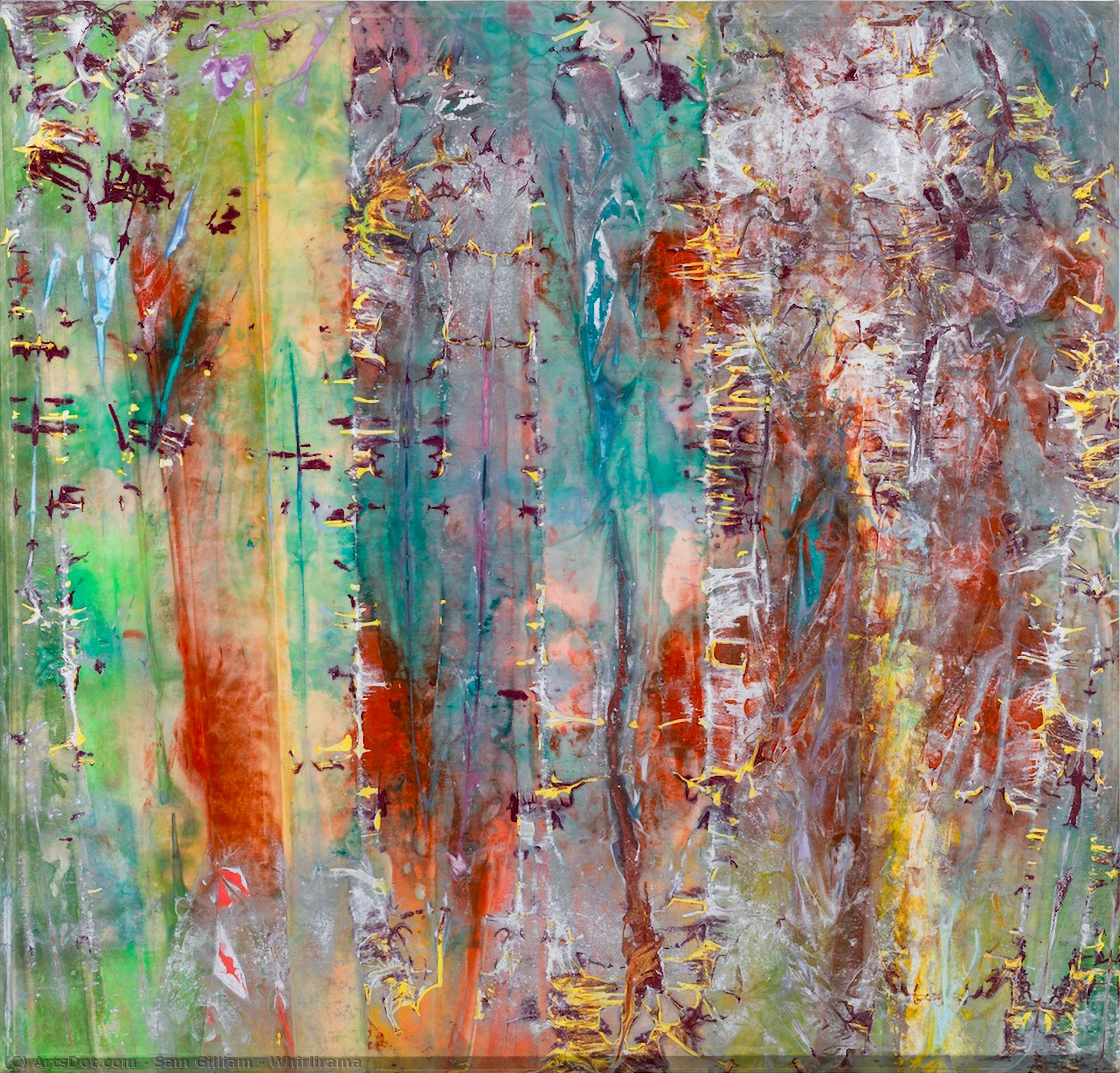
In the vibrant landscape of twentieth-century abstraction, few works capture the kinetic energy of nature as profoundly as Sam Gilliam’s Whirlirama. Created in 1970, this masterpiece serves as a breathtaking exploration of color and form, transcending the traditional boundaries of a static image to become a living, breathing entity. At first glance, the viewer is met with an explosion of chromatic brilliance; a kaleidoscope of purple, deep blue, fiery red, sun-drenched yellow, and lush green dances across the canvas. The painting depicts a tree, yet it is far from a literal representation. Instead, Gilliam utilizes an abstract language to evoke the very essence of growth, movement, and the swirling rhythms of life itself. The branches spread outward in a rhythmic, chaotic grace, suggesting a cosmic dance where every stroke of paint contributes to a larger, swirling momentum.
The technique employed in Whirlirama is a testament to Gilliam’s revolutionary approach to the medium. As a pioneer who famously redefined the physical limits of the canvas, his work here showcases an incredible mastery of texture and depth. Through the layered application of pigment, the artist creates a sense of multidimensionality; the white and orange highlights do not merely sit upon the surface but seem to emerge from within the layers, providing a luminous quality that shifts as the light hits the piece. This interplay of light and shadow, combined with the deliberate, sweeping motions of the brush, gives the work a sculptural presence. For the discerning collector or interior designer, this piece offers a profound sense of movement that can breathe life into any sophisticated space, acting as a focal point that commands attention through its sheer vitality.
Historical Resonance and Emotional Depth
To understand Whirlirama is to understand the transformative era of the late 1960s and early 1970s, a period when artists like Sam Gilliam were breaking away from the rigid constraints of Minimalism and Color Field painting. While his contemporaries often focused on flat, static planes of color, Gilliam infused his work with a sense of liberation and spontaneity. This piece stands as a bridge between the structured abstraction of the mid-century and a more expressive, gestural freedom. The historical context of his journey—from his roots in Mississippi to the influential art scenes of Washington D.C.—is etched into the very soul of this painting. There is an inherent sense of liberation in the way the colors collide and merge, mirroring the artist's own breaking of artistic barriers.
Beyond its technical brilliance, Whirlirama possesses a deep emotional resonance that speaks to the universal human experience. The swirling patterns can be interpreted as a symbol of the beautiful chaos of existence—the way life moves in cycles of growth, decay, and rebirth. There is a certain joy found in the bright, optimistic hues, yet there is also a contemplative depth found in the darker, more mysterious blues and purples. For those seeking to adorn their homes or galleries with art that inspires, this reproduction offers more than just aesthetic beauty; it provides an emotional sanctuary. It is a piece that invites the viewer to lose themselves in its complexity, finding peace within the whirlwind of color and discovering a renewed sense of wonder in the abstract beauty of the natural world.
Questions & Answers
Toward which tone does "Whirlirama" lean?
An ochre to sepia hue runs through "Whirlirama" by Sam Gilliam.
How can I get a digital file of "Whirlirama" by Sam Gilliam?
To get a digital file of "Whirlirama" by Sam Gilliam, order a high-resolution digital image download on its Digital Image page.
Is "Whirlirama" a famous Color Field artwork?
Within the Color Field movement, "Whirlirama" has an iconic popularity level.
Artist Biography
A Life Painted in Motion: The World of Sam Gilliam
Sam Gilliam, born November 30, 1933, in Tupelo, Mississippi, and passing on June 25, 2022, was more than just a painter; he was an innovator who fundamentally altered our perception of what painting could be. His journey began with humble roots – his father a railroad worker, his mother a homemaker – and a subsequent move to Louisville, Kentucky, shortly after his birth. Even as a child, the seeds of artistic expression were sown, manifesting in early cartoon drawings that hinted at the creative force within. Gilliam’s formal education at the University of Louisville, where he earned both a B.A. (1955) and an M.A. (1961) in Fine Art, provided him with a foundation, but it was his life experiences – including service in the United States Army from 1956 to 1958 – that would truly shape his artistic vision. The move to Washington D.C. in 1962, alongside his wife Dorothy Butler, proved pivotal, placing him at the heart of a burgeoning art scene and setting the stage for a career defined by groundbreaking experimentation.Breaking Boundaries: From Color Field to Sculptural Space
Gilliam’s early work aligned with the Washington Color School, a movement characterized by its exploration of color field painting – large expanses of flat, saturated hues intended to evoke emotional responses through pure chromatic experience. However, he quickly distinguished himself from his peers. While artists like Morris Louis and Kenneth Noland focused on staining canvases stretched tautly across frames, Gilliam began to question the very necessity of the stretcher itself. Around 1965, a revolutionary idea took hold: what if the canvas could be *freed*? This led to his iconic “Drape Paintings,” works that involved suspending unstretched or loosely draped fabric from ceilings and walls, allowing them to interact dynamically with their surrounding space. These weren’t merely paintings; they were sculptural interventions, shifting and changing with air currents and viewer perspective. It was a radical departure, transforming painting into an immersive, three-dimensional experience. This innovation wasn't born of abstract theory but practical observation – the simple act of laundry billowing in the breeze outside his studio sparked the initial concept. Later explorations saw him incorporating diverse materials—polypropylene, computer-generated imagery, metallic and iridescent acrylics, handmade paper, aluminum, steel, plywood, and plastic—further pushing the boundaries of artistic possibility. The 1970s brought forth the dynamic “Black Paintings,” geometric collages imbued with a jazz-inspired energy reminiscent of Miles Davis and John Coltrane, while the 1980s saw the emergence of "Quilted Paintings," echoing the African patchwork quilts of his childhood.Recognition and Legacy: A Pioneer’s Impact
Gilliam's artistic courage did not go unnoticed. In 1972, he achieved a historic milestone as the first African American artist to represent the United States at the Venice Biennale, a watershed moment that shattered barriers and paved the way for greater inclusivity in the art world. Throughout his career, accolades continued to accumulate: numerous commissions, grants, awards, exhibitions, and eight honorary doctorates from prestigious institutions including Northwestern University and the University of Louisville. A major retrospective at the Corcoran Gallery of Art in 2005 solidified his place as a leading figure in American art history. He was also honored with the Norman W. Harris Prize from the Art Institute of Chicago and received an Artist's Fellowship from the Washington Gallery of Modern Art. Gilliam’s influence extends far beyond awards and exhibitions, however. His pioneering technique of draping canvases fundamentally impacted not only the Color Field movement but also the development of installation art, challenging traditional notions of painting as a fixed, two-dimensional object.Echoes of Inspiration: Influences and Artistic Lineage
Gilliam’s artistic journey was informed by a diverse range of influences. He acknowledged early inspiration from Morris Louis and Kenneth Noland, fellow members of the Washington Color School, but his vision extended beyond their aesthetic boundaries. The emotional intensity of German Expressionists like Emil Nolde and Paul Klee resonated with him, as did the work of Nathan Oliveira from the Bay Area figurative school. Further back in art history, he found inspiration in the radical experimentation of Vladimir Tatlin, the geometric precision of Frank Stella, and the formal rigor of Hans Hofmann, Georges Braque, and Pablo Picasso. Even Paul Cézanne’s exploration of form and space left its mark on his evolving style. Yet, Gilliam wasn't simply mimicking these masters; he was synthesizing their lessons into something entirely new—a uniquely American abstract expression that embraced innovation and challenged convention.A Lasting Impression: The Significance of Sam Gilliam’s Art
Sam Gilliam’s legacy is one of fearless experimentation, unwavering artistic integrity, and a profound contribution to the evolution of abstraction. He didn't just paint; he redefined painting itself, liberating it from its traditional constraints and transforming it into a dynamic, immersive experience. As an African American artist achieving international recognition during a period of significant social change, Gilliam also broke down barriers and inspired generations of artists of color. His work continues to resonate today, reminding us that art has the power to challenge perceptions, expand possibilities, and ultimately, transform the way we see the world. He leaves behind not just a body of stunning artwork but a testament to the enduring power of artistic vision and the courage to forge one’s own path.
Sam Gilliam
1933 - 2022 , United States of America
Quick Facts
- Full Name: Sam Gilliam
- Nationality: American
- Date Of Birth: 1933
- Date Of Death: 2022
- Place Of Birth: Tupelo, United States of America
- Notable Artworks:
- Swing
- Shoot Six
- Open Cylinder
- Artistic Movement Or Style: Color Field Painting
- Artists Who Influenced This Artist:
- Morris Louis
- Kenneth Noland
- Emil Nolde
- Artists Or Movements Influenced By This Artist: ['Installation art']
Related Articles

Abstract Expressionism's 10 Defining Masterpieces |
Explore 10 defining Abstract Expressionism masterpieces by Pollock, Rothko & de Kooning. Discover the stories behind these iconic paintings and find museum-quality art reproductions to elevate your home decor on .
Beyond the Lines: Mastering the High-Impact World of Contemporary Abstraction
Master the high-impact world of contemporary abstraction. Discover how bold colors, textures, and modern movements like Abstract Expressionism can transform your space with premium, high-energy art curated for the design-conscious professional.

Geometric Abstraction's 10 Defining Masterpieces | Art for Your Home - OriginalUniqueArt
Explore 10 defining masterpieces of Geometric Abstraction! Discover Kandinsky, Mondrian & Malevich’s iconic works. Find museum-quality art reproductions and curated decor ideas to elevate your home at OriginalUniqueArt.com.

Kandinsky's Masterpieces: 25 Paintings That Define Abstract Art | OriginalUniqueArt
Journey through Wassily Kandinsky's 25 most iconic abstract paintings. Explore his revolutionary use of color, form & spiritual expressionism. Find museum-quality Kandinsky reproductions and elevate your home decor with OriginalUniqueArt.com. Discover all masterpieces on OriginalUniqueArt.com!
Beyond Sight: Exploring Tactile Dimensions and Illumination in Abstract Painting
Explore the captivating world of tactile abstraction! Discover impasto techniques, influential artists like Richter & Hoyland, and expert insights for collecting textured art. Elevate your space with museum-quality pieces.


