Preview
 Send
Send Share
Share
 Details
 Guide
Guide

 Download
 Similars
 X-Ray
X-Ray Diaporama
 Q&A
Q&A Stats
StatsThe Finding of Moses


 Read More
Giclée / Art Print
Museum-quality giclée or canvas print with fast production and flexible finish options. ( Buy Hand Made Painting Switch to Digital Image)




P118B $10

P118H $10

P118W $10

P438Z $10

P508JH $12

P508YH $12

P805H $10

P805Z $10

P919BZ $10

P919G $10

P919XJ $10

P959ZH $10

P968JZ $12

W106C $8

W218G $10

W218JH $8

W218Y $10

W307PJ $10

W316G $10

W316PJ $8

W316Y $10

W398PJ $8

W4111J $10

W500HY $15

W500JH $15

W692G $12

W849H $8

W940BG $15

W953PJ $8




Pick from our preset sizes that match the artwork's original proportions.

Type the width and the height you need, to fit your frame or your wall. A print can only be cut, never made bigger than the picture, so a size with a different shape loses a part of the image. We send you a digital mockup to approve before we print anything. The picture shown on this page does not show the real cut — only the mockup does.
Worldwide Delivery () in 2 weeks instead of standard 4/5 weeks. (4 November)

Free Worldwide Express Shipping

High-Quality Linen Canvas

Full Shipping Insurance

Customs Tax Refund Guarantee

True Color Matching Guarantee

100-Day Return Policy (Defects Only)

100% Money-Back Guarantee

Bulk Discount Offer
 Glass option is only available in size under 110 CM

The Finding of Moses
Giclée / Art Print
Reproduction Size
-


Total Price
$ 81
A Divine Encounter Amidst the Reeds
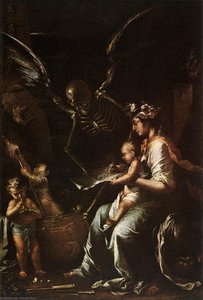
In the heart of the Baroque era, few artists captured the intersection of human emotion and divine intervention as powerfully as Salvator Rosa. His masterpiece, "The Finding of Moses," painted around 1650, serves as a breathtaking window into a pivotal biblical moment. The canvas transports the viewer to the lush, untamed banks of the Nile, where Pharaoh’s daughter discovers the infant Moses hidden within the reeds. It is not merely a depiction of a historical or religious event, but a profound study of wonder and destiny. As the eye wanders through the composition, one is immediately struck by the theatricality of the scene—a hallmark of Rosa’s unique vision that blends the rugged naturalism of his Neapolitan roots with a sweeping, dramatic grandeur.
The painting unfolds like a staged drama, utilizing a masterful chiaroscuro to guide the viewer's emotional journey. Rosa employs deep, velvety shadows that swallow the periphery, forcing our attention toward the luminous center where the princess cradles the child. The light does not merely illuminate; it sanctifies. It catches the brilliant azure of the princess’s garments—a color chosen specifically to evoke purity and divine grace—and reflects off the soft swaddling of the infant. This interplay of light and dark creates a palpable sense of tension, as if the very air is thick with the weight of the miracle unfolding before us.
Symbolism and the Baroque Spirit
Beyond its surface beauty, "The Finding of Moses" is rich with symbolic layers that would have resonated deeply with 17th-century audiences. The figures within the tableau are carefully orchestrated to represent a spectrum of human response to the divine. The princess, draped in regal yet soft tones, embodies a sense of compassionate leadership and devotion. Beside her, the kneeling figure—perhaps an attendant or a witness of lower status—provides a poignant contrast through her expression of raw, unshielded awe. Even the distant observers, partially obscured by the shadows of the foliage, serve to ground the miraculous event in a shared human reality, suggesting that even those on the fringes are touched by this celestial occurrence.
For the discerning collector or interior designer, this work offers more than just aesthetic splendor; it provides a focal point of profound narrative depth. The rugged landscape, characterized by wild trees and a turbulent, cloud-swept sky, reflects the untamed spirit of Rosa himself—an artist who famously resisted the rigid constraints of his contemporaries to pursue a more idiosyncratic, expressive style. Incorporating a high-quality reproduction of this piece into a curated space allows for the introduction of historical gravity and emotional complexity. It is an ideal selection for those seeking to evoke a sense of timelessness, drama, and spiritual contemplation within a sophisticated interior.
Questions & Answers
What was Salvator Rosa's age when "The Finding of Moses" was created?
When "The Finding of Moses" was created in 1650, Salvator Rosa - born in 1615 - was 35 years old.
Where does "The Finding of Moses" fall in Salvator Rosa's career?
"The Finding of Moses" belongs to the Mature Period of Salvator Rosa's career. This classification relates the work to the artist's development.
How strong are the colors of "The Finding of Moses"?
The color of "The Finding of Moses" is subtle color in saturation and monochromatic in intensity.
Artist Biography
**early life and training**
salvator rosa, an italian baroque painter, poet, and printmaker, was born in arenella, naples, on either june 20 or july 21, 1615. his mother, giulia greca rosa, was a member of one of the greek families of sicily. despite his father's wishes for him to become a lawyer or priest, salvator showed a preference for the arts from an early age.**artistic career**
salvator rosa's artistic career was marked by his unorthodox and extravagant style, which set him apart from his contemporaries. he was active in naples, rome, and florence, and his work was influenced by the naturalism of ribera and the classicism of poussin. however, he refused to be tied down by any particular style or movement.- pythagoras emerging from the underworld (kimbell art museum, fort worth, united states), one of his most famous works, showcases his unique blend of philosophical and artistic themes.
- his the baptism of the eunuch (chrysler museum of art, norfolk, united states) demonstrates his ability to infuse high drama into even minor bible stories.
**influences and legacy**
salvator rosa's work had a significant impact on the development of baroque art. his influence can be seen in the works of later artists, such as luca giordano, who continued to push the boundaries of artistic expression. **important links:** salvator rosa's profile on OriginalUniqueArt wikipedia: salvator rosa pythagoras emerging from the underworld on OriginalUniqueArt**conclusion**
salvator rosa's life and work continue to fascinate art lovers and historians alike. his unorthodox style and perpetual rebellion against the norms of his time have cemented his place in the annals of baroque art. as a painter, poet, and printmaker, he remains an enigmatic figure, and his work continues to inspire new generations of artists and art enthusiasts.
Salvator Rosa
1615 - 1673 , Italy
Quick Facts
- Full Name: Salvator Rosa
- Nationality: Italian
- Date Of Birth: 1615
- Date Of Death: 1673
- Place Of Birth: Arenella, Italy
- Notable Artworks:
- View of the Gulf of Salerno
- Study for 'Il Genio di Rosa
- Grotto with Cascades
- Artistic Movement Or Style: Baroque art
- Artists Who Influenced This Artist: ['José de Ribera']
- Artists Or Movements Influenced By This Artist: ['Luca Giordano']
Related Articles

Chiaroscuro & Emotion: Capturing the Dramatic Soul of Baroque Art
Explore the profound drama of Baroque art. Discover how masters used chiaroscuro and intense emotion to capture the soul of the 17th century through light, shadow, and spiritual grandeur in this expert art history guide.

The Visceral Stage: Exploring Dramatic Narratives & Emotional Intensity in Baroque Art
Explore the dramatic world of Baroque art! Discover iconic masters like Caravaggio & Rembrandt, their techniques, and the movement's lasting impact. Expert insights for collectors & enthusiasts at OriginalUniqueArt.

Giclée Prints: Archival Quality & Aesthetic Nuances for the Discerning Collector
Explore the world of giclée prints with OriginalUniqueArt. Learn about archival quality, aesthetic nuances & investment potential. Expert guidance for discerning art collectors seeking museum-quality reproductions and lasting value.

Baroque Masterpieces: 10 Paintings That Defined an Era |
Journey through the drama & grandeur of Baroque art! Explore 10 masterpieces by Caravaggio, Rembrandt, Rubens & more. Discover stunning oil paintings, rich colors & timeless stories. Find museum-quality reproductions at .

The Dramatic Flourish: Exploring the Baroque Movement's Enduring Legacy in Art History
Explore the dramatic world of Baroque art! Discover iconic artists like Caravaggio & Rubens, defining techniques, and its lasting impact on art history. Expert insights for collectors & enthusiasts at OriginalUniqueArt.