Preview
 Send
Send Share
Share
 Details
 Guide
Guide

 Download
 Similars
 X-Ray
X-Ray Diaporama
 Stats
StatsDemocrito E Protagora
 Oil On Canvas
- WallArt
- Baroque Landscape
 1664
1664- Early Modern
 128.0 x 185.0 cm
 Hermitage Museum
 Read More
Giclée / Art Print
Museum-quality giclée or canvas print with fast production and flexible finish options. ( Buy Hand Made Painting Switch to Digital Image)




P118B $10

P118H $10

P118W $10

P438Z $10

P508JH $12

P508YH $12

P805H $10

P805Z $10

P919BZ $10

P919G $10

P919XJ $10

P959ZH $10

P968JZ $12

W106C $8

W218G $10

W218JH $8

W218Y $10

W307PJ $10

W316G $10

W316PJ $8

W316Y $10

W398PJ $8

W4111J $10

W500HY $15

W500JH $15

W692G $12

W849H $8

W940BG $15

W953PJ $8




Pick from our preset sizes that match the artwork's original proportions.

Type the width and the height you need, to fit your frame or your wall. A print can only be cut, never made bigger than the picture, so a size with a different shape loses a part of the image. We send you a digital mockup to approve before we print anything. The picture shown on this page does not show the real cut — only the mockup does.
Worldwide Delivery () in 2 weeks instead of standard 4/5 weeks. (21 October)

Free Worldwide Express Shipping

High-Quality Linen Canvas

Full Shipping Insurance

Customs Tax Refund Guarantee

True Color Matching Guarantee

100-Day Return Policy (Defects Only)

100% Money-Back Guarantee

Bulk Discount Offer
 Glass option is only available in size under 110 CM

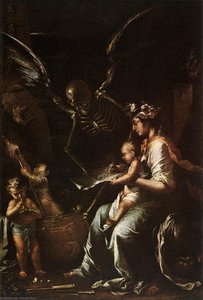
Democrito E Protagora
Giclée / Art Print
Reproduction Size
-


Total Price
$ 81
A Dialogue Among Philosophers: Salvator Rosa's Vision
To stand before Salvator Rosa’s "Democrito E Protagora" is to step directly into the vibrant, dramatic heart of the Baroque era. This painting is not merely a depiction of historical figures; it is an immersive encounter with the very essence of philosophical inquiry. The scene unfolds amidst a lush, almost theatrical grove, where ancient trees frame a profound conversation. Rosa masterfully captures a moment suspended in time—a gathering of minds grappling with the mysteries of existence. The composition draws the viewer into the intimate circle formed by the figures: two women and a man, all clad in the flowing drapery evocative of classical antiquity. One woman seems to hold an object of contemplation, while another gazes upon her, suggesting that knowledge itself is being passed down or revealed.
Baroque Drama and Naturalistic Grandeur
Rosa’s signature style imbues this work with an unparalleled sense of drama. His technique eschews mere portraiture for something far grander—a tableau vivant imbued with emotional weight. The Baroque period favored intensity, movement, and the dramatic interplay between light and shadow, and Rosa executes this with breathtaking skill. While his influence draws from the naturalism of contemporaries like Rivera, his refusal to be confined by a single style lends the piece an untamed vitality. Observe how the deep greens of the foliage contrast with the warm tones of the skin and drapery; this careful handling of color and texture gives the scene a palpable depth, making the viewer feel the cool shade beneath the canopy.
Symbolism in the Grove
The inclusion of Democritus and Protagoras—names synonymous with foundational Greek philosophy—elevates the painting beyond simple genre scene. The natural setting itself functions as a symbolic backdrop for intellectual pursuit. Nature, in this context, is not just scenery; it is the eternal stage upon which human thought plays out its dramas. The interaction between the figures suggests a dialogue concerning truth, perception, and the structure of the universe. It invites us, the modern viewer, to pause our own hurried lives and consider what fundamental questions we are currently contemplating.
Bringing Antiquity Home: Reproduction for Your Space
Owning a reproduction of "Democrito E Protagora" is an opportunity to anchor your interior space with a piece steeped in intellectual romance and artistic drama. The original, painted in 1664, carries the weight of centuries of artistic mastery. Our hand-painted reproductions aim not just for visual accuracy, but for emotional resonance. Imagine this scene—the quiet intensity of philosophical debate set against the dramatic sweep of Baroque artistry—illuminating a drawing-room or library. It serves as a magnificent focal point, whispering tales of ancient wisdom and unparalleled artistic passion to every passerby.
Questions & Answers
Where can I buy a digital image of "Democrito E Protagora" by Salvator Rosa?
"Democrito E Protagora" is available as a high-resolution digital image download, purchased directly on its Digital Image page.
What emotion does the Baroque Landscape work "Democrito E Protagora" convey?
Within the Baroque Landscape movement, "Democrito E Protagora" is recorded with a mysterious tone.
Is "Democrito E Protagora" by Salvator Rosa a portrait, landscape or square composition?
"Democrito E Protagora" by Salvator Rosa is a portrait composition. The proportions are worth checking before choosing a print size.
Artist Biography
**early life and training**
salvator rosa, an italian baroque painter, poet, and printmaker, was born in arenella, naples, on either june 20 or july 21, 1615. his mother, giulia greca rosa, was a member of one of the greek families of sicily. despite his father's wishes for him to become a lawyer or priest, salvator showed a preference for the arts from an early age.**artistic career**
salvator rosa's artistic career was marked by his unorthodox and extravagant style, which set him apart from his contemporaries. he was active in naples, rome, and florence, and his work was influenced by the naturalism of ribera and the classicism of poussin. however, he refused to be tied down by any particular style or movement.- pythagoras emerging from the underworld (kimbell art museum, fort worth, united states), one of his most famous works, showcases his unique blend of philosophical and artistic themes.
- his the baptism of the eunuch (chrysler museum of art, norfolk, united states) demonstrates his ability to infuse high drama into even minor bible stories.
**influences and legacy**
salvator rosa's work had a significant impact on the development of baroque art. his influence can be seen in the works of later artists, such as luca giordano, who continued to push the boundaries of artistic expression. **important links:** salvator rosa's profile on OriginalUniqueArt wikipedia: salvator rosa pythagoras emerging from the underworld on OriginalUniqueArt**conclusion**
salvator rosa's life and work continue to fascinate art lovers and historians alike. his unorthodox style and perpetual rebellion against the norms of his time have cemented his place in the annals of baroque art. as a painter, poet, and printmaker, he remains an enigmatic figure, and his work continues to inspire new generations of artists and art enthusiasts.
Salvator Rosa
1615 - 1673 , Italy
Quick Facts
- Full Name: Salvator Rosa
- Nationality: Italian
- Date Of Birth: 1615
- Date Of Death: 1673
- Place Of Birth: Arenella, Italy
- Notable Artworks:
- View of the Gulf of Salerno
- Study for 'Il Genio di Rosa
- Grotto with Cascades
- Artistic Movement Or Style: Baroque art
- Artists Who Influenced This Artist: ['José de Ribera']
- Artists Or Movements Influenced By This Artist: ['Luca Giordano']
Related Articles

Baroque Masterpieces: 10 Paintings That Defined an Era |
Journey through the drama & grandeur of Baroque art! Explore 10 masterpieces by Caravaggio, Rembrandt, Rubens & more. Discover stunning oil paintings, rich colors & timeless stories. Find museum-quality reproductions at .

Salvator Rosa: A Baroque Rebel's Vision of Landscape, Allegory & the Human Condition
Explore the captivating world of Salvator Rosa, a rebellious Baroque master. Discover his dramatic landscapes, allegorical paintings & lasting influence on Romanticism. Hand-painted reproductions available at OriginalUniqueArt.

The Dramatic Flourish: Exploring the Baroque Movement's Enduring Legacy in Art History
Explore the dramatic world of Baroque art! Discover iconic artists like Caravaggio & Rubens, defining techniques, and its lasting impact on art history. Expert insights for collectors & enthusiasts at OriginalUniqueArt.

Baroque Drama: Bringing Opulence & Emotion into Contemporary Interiors
Explore the opulent world of Baroque interior design! Discover key elements, modern applications & how to bring dramatic elegance into your home with OriginalUniqueArt.com's authentic reproductions.

Baroque Classicism: The Grandeur of Order and Drama in 17th-Century Art History
Explore the profound elegance of Baroque Classicism. Discover how 17th-century masters synthesized dramatic emotion with classical order through the lens of the Counter-Reformation and the works of legends like Carlo Maratta and Andrea Sacchi.