

 Send
Send Share
Share
 Details
 Guide
Guide

 Download
 Similars
 Diaporama
 Q&A
Q&A Stats
StatsWatts Towers


 Read More
The artwork displayed on this page is protected by copyright law, which means we cannot legally create or sell an identical reproduction. This protection is enforced under international agreements such as the Berne Convention and by national laws, including those outlined by the U.S. Copyright Law - Title 17.
This method fully complies with copyright regulations because it does not involve copying or duplicating the protected artwork. Instead, it is a creative reinterpretation - a new painting that is influenced by the original but not identical to it.
Giclée / Art Print
Museum-quality giclée or canvas print with fast production and flexible finish options. ( Buy Hand Made Painting Switch to Digital Image)




































Pick from our preset sizes that match the artwork's original proportions.

Type the width and the height you need, to fit your frame or your wall. A print can only be cut, never made bigger than the picture, so a size with a different shape loses a part of the image. We send you a digital mockup to approve before we print anything. The picture shown on this page does not show the real cut — only the mockup does.
Worldwide Delivery () in 2 weeks instead of standard 4/5 weeks. (29 October)

Free Worldwide Express Shipping

High-Quality Linen Canvas

Full Shipping Insurance

Customs Tax Refund Guarantee

True Color Matching Guarantee

100-Day Return Policy (Defects Only)

100% Money-Back Guarantee

Bulk Discount Offer
 Glass option is only available in size under 110 CM

Watts Towers
Giclée / Art Print
Reproduction Size
-


Total Price
$ 81
A Monument of Devotion: The Soul of the Watts Towers
Standing as a breathtaking testament to human perseverance and singular vision, the Watts Towers—originally known as Nuestro Pueblo—represent one of the most profound examples of outsider art ever conceived. Created by the Italian immigrant Sabato Rodia over a staggering thirty-three-year period, this sprawling assemblage is not merely a collection of structures, but a living, breathing mosaic of memory and labor. To gaze upon these towers is to witness a surreal landscape where the boundaries between architecture and sculpture dissolve into a complex, layered dance of texture and form. The composition presents an overwhelming density of detail, where thousands of small, spherical objects and fragments of glass catch the light, creating a sense of rhythmic chaos that is simultaneously mesmerizing and deeply ordered.
The technique employed by Rodia is a masterclass in the art of assemblage. Utilizing a rugged armature of steel rebar and wire mesh, he meticulously layered found objects to create a skin of immense complexity. The visual language of the towers is defined by a striking contrast between smooth white ceramic spheres and the jagged, translucent beauty of blue glass fragments. This interplay of materials creates a tactile experience that shifts with the sun; as natural light moves across the structures, shadows dance within the crevices, emphasizing the three-dimensional depth of the mosaic. For the discerning collector or interior designer, this work offers an unparalleled study in organic geometry and the transformative power of repurposed materials.
Symbolism and the Beauty of the Fragmented
Beyond its physical grandeur, the Watts Towers carry a profound symbolic weight that resonates with anyone moved by the concept of art brut. The structure can be interpreted as a metaphor for growth and fragmentation—a beautiful arrangement born from the accumulation of disparate, broken pieces. There is a hauntingly beautiful surrealism in how Rodia transformed industrial detritus into something celestial and monumental. Each tile, bottle, and shard serves as a building block in a larger narrative of cultural identity and personal legacy. The towers do not depict a recognizable scene or figure, yet they communicate an intense emotional frequency, evoking feelings of wonder, resilience, and the eternal human desire to leave a permanent mark upon the world.
For those seeking to bring a sense of historical depth and avant-garde spirit into a curated space, a high-quality reproduction of this masterpiece serves as a powerful focal point. The intricate textures and the interplay of light and shadow captured in these works provide an incredible layer of visual interest, making them ideal for sophisticated interiors that celebrate texture, history, and the sublime. To own a piece inspired by Rodia’s vision is to possess a fragment of Los Angeles's artistic soul—a reminder that from the most humble materials, one can construct a monument of incomparable beauty.
Questions & Answers
Is "Watts Towers" by Sabato Rodia among the sought-after Surrealism artworks?
Within the Surrealism movement, "Watts Towers" has an iconic popularity level.
Is a download available for "Watts Towers"?
"Watts Towers" by Sabato Rodia can be downloaded from the artwork's Download page, as a high-resolution digital image download.
Which museum holds the original "Watts Towers"?
The original "Watts Towers" by Sabato Rodia is held at the Public Art in Public Places, California, United States of America. A reproduction allows the work to be displayed at home.
Artist Biography
early life and career
sabato rodia, also known as simon rodia, was an italian immigrant who lived in the united states. born in serino, italy in 1879, he spent most of his adult life in los angeles, where he built the watts towers, a collection of 17 interconnected sculptural towers, architectural structures, and individual sculptural features and mosaics.the watts towers: a masterpiece of outsider art
the watts towers are an example of outsider art (or art brut) and italian-american naïve art. designed and built solely by rodia over a period of 33 years, from 1921 to 1954, the tallest tower stands at 99.5 feet (30.3 m). the site is now part of the simon rodia state historic park, a los angeles historic-cultural monument and one of nine folk art sites listed in the national register of historic places in los angeles.design and construction
rodia's armatures are constructed from steel rebar, wrapped with wire mesh, and decorated with found objects, including bottles, ceramic tiles, seashells, figurines, mirrors, and other items. the main supports are embedded with pieces of porcelain, tile, and glass. [https://OriginalUniqueArt.com/@@/d4csx7-sabato-rodia-watts-towers](painting by 'sabato rodia' | sabato rodia:watts towers (public art in public places (california, united states),sculpture,))legacy and preservation
the watts towers were designated a national historic landmark and a california historical landmark in 1990. [https://en.wikipedia.org/wiki/watts_towers](wikipedia: watts towers) provides more information on the site's history and preservation efforts.- key facts:
- born in serino, italy in 1879
- spent most of his adult life in los angeles
- built the watts towers over a period of 33 years (1921-1954)
- designated a national historic landmark and california historical landmark in 1990
- related artists:
- [https://OriginalUniqueArt.com/@/carlo-jeannerat](artist: carlo jeannerat)
- [https://OriginalUniqueArt.com/@/michelangelo-buonarroti](artist: michelangelo buonarroti)
- related paintings:
- [https://OriginalUniqueArt.com/@@/d4csx7-sabato-rodia-watts-towers](painting by 'sabato rodia' | sabato rodia:watts towers)
- [https://OriginalUniqueArt.com/@@/9gg6g7-michelangelo-buonarroti-the-conversion-of-saul-(detail-)](painting by 'michelangelo buonarroti' | michelangelo buonarroti:the conversion of saul (detail - ))

Sabato Rodia
1879 - 1965 , Italy
Quick Facts
- Full Name: Paul Klee
- Nationality: Swiss-German
- Date Of Birth: 1879
- Date Of Death: 1965
- Place Of Birth: Serino, Italy
- Notable Artworks:
- Angelus Novus
- Senecio
- Twittering Machine
- Artistic Movement Or Style: Expressionism, Surrealism
- Artists Who Influenced This Artist:
- Leonardo da Vinci
- Wassily Kandinsky
- Artists Or Movements Influenced By This Artist:
- Bauhaus
- Surrealism
Related Articles

The Enduring Form: Exploring Themes & Techniques in Sculpture Across Historical Periods
Explore the rich history of sculpture from ancient masterpieces to contemporary innovations. Discover key techniques, influential artists & investment potential for discerning art collectors.

Bronze Sculptures That Defined Art History | OriginalUniqueArt
Journey through art history with our Top 10 bronze sculptures! Explore masterpieces by Rodin, Michelangelo & more. Discover stories behind iconic statues and find museum-quality reproductions for your home decor at OriginalUniqueArt.com.
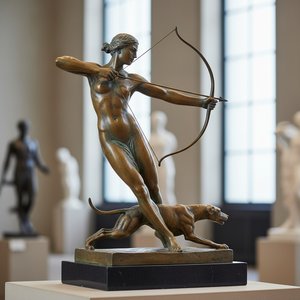
Paul Manship: Reassessing the Master of American Art Deco Sculpture
Explore the captivating world of Paul Manship, a leading figure in American Art Deco sculpture. Discover his iconic works like Prometheus, influence on modernism, and investment potential. Expert insights for collectors.

The Enduring Form: Sculpture Across History, Technique & Emotional Resonance
Explore the rich history of sculpture with OriginalUniqueArt. Discover key techniques, influential artists & investment potential for discerning collectors. Expert insights into valuing and collecting timeless masterpieces.

Bronze Age to Modern Masters: 10 Sculptures That Redefined Art | OriginalUniqueArt
Journey through art history with 10 legendary bronze sculptures – from Michelangelo's David to Rodin’s Thinker. Explore the stories, techniques & timeless beauty of these masterpieces. Find museum-quality reproductions & elevate your home decor on OriginalUniqueArt.com.


