Preview
 Send
Send Share
Share
 Details
 Guide
Guide

 Download
 Similars
 X-Ray
X-Ray Diaporama
 Stats
Statsharem guard

 Read More
Hand Made Oil Reproduction
Hand-painted oil on canvas in your size and frame, made to order by our artists. ( Switch to Print Switch to Digital Image)




































Pick from our preset sizes that match the artwork's original proportions.

Type the width and the height you need, to fit your frame or your wall. This is hand-painted, so for a size with a different shape the artist can paint a bit more around the picture, or cut a bit — you choose. We send you a digital mockup to approve before the painting starts. The picture shown on this page does not show the real result — only the mockup does.
After order, OriginalUniqueArt.com team will email client for instructions and provide a mockup preview
Worldwide Delivery () in 3/4 weeks instead of standard 5 weeks. (22 October). No compromise on quality.

Free Worldwide Express Shipping

High-Quality Linen Canvas

Full Shipping Insurance

Customs Tax Refund Guarantee

True Color Matching Guarantee

100-Day Return Policy (Defects Only)

100% Money-Back Guarantee

Bulk Discount Offer
 Glass option is only available in size under 110 CM

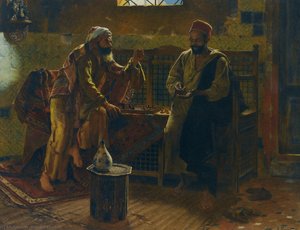
harem guard
Reproduction Medium
Reproduction Size
-


Total Price
$ 300
Artist Biography
The Visionary of the Orient: The Life and Art of Rudolf Ernst
Born in the heart of Vienna in 1854, Rudolf Ernst emerged as a luminous figure in the late nineteenth-century European art scene, weaving a bridge between the structured traditions of the West and the vibrant, sun-drenched atmospheres of the East. His journey began within the prestigious halls of the Akademie der Bildenden Künste Wien, where he studied under masters such as Anton Hansekampf and Wilhelm Leibl. While his early training was rooted in the rigorous academic standards of Vienna, Ernst possessed an intellectual curiosity that could not be contained by classical boundaries. Though he initially pursued a path in law, the siren call of the canvas proved irresistible, leading him to abandon legal studies for a life dedicated to the pursuit of light, texture, and color.
The true metamorphosis of his style occurred when Ernst relocated to Paris in 1880. This move placed him at the epicenter of a global artistic revolution, where he breathed the same air as Impressionist pioneers like Camille Pissarro and even encountered the burgeoning genius of Henri Matisse. It was in this vibrant Parisian milieu that Ernst began to synthesize his academic precision with a new, more expressive approach to brushwork. He moved away from mere representation toward an evocative Orientalism—a style that sought not just to document foreign lands, but to transport the viewer into their very soul through meticulous detail and atmospheric depth.
A Master of Detail and Cultural Reverence
What distinguishes Ernst from many of his contemporaries in the Orientalist movement was his profound respect for the subjects he depicted. While others often leaned into exoticized stereotypes or mere fantasy, Ernst’s work—particularly his depictions of Morocco and Constantinople—displayed an almost ethnographic devotion to local customs, architecture, and daily life. His canvases serve as windows into a world of opulent textures, from the intricate patterns of faience tiles to the heavy silks of palace interiors. In masterpieces such as "Outside the Selim Taibe, Constantinople," he captures the bustling energy of Istanbul’s commerce and architecture with an astonishing clarity that feels both timeless and immediate.
His ability to balance grand architectural vistas with intimate human moments is perhaps his greatest technical achievement. Whether portraying the rhythmic movement of "Traveling Musicians Playing for the Sultan" or the brooding, mysterious atmosphere of a "Harem Guard," Ernst utilized a rich palette and complex layering to create depth. His work often features:
- Intricate Textures: A masterful rendering of stone, metal, and woven fabrics that invites tactile engagement.
- Luminous Light: The use of light to define the heat of North Africa or the soft shadows of a Mediterranean afternoon.
- Cultural Authenticity: An emphasis on the dignity of his subjects, capturing musicians, guards, and merchants with profound humanity.
Legacy and Historical Significance
The historical significance of Rudolf Ernst lies in his ability to have captured a vanishing era of global history through a lens of high artistry. As the nineteenth century gave way to the twentieth, his paintings remained enduring testaments to the grandeur of the Ottoman Empire and the North African landscapes during the reign of Sultan Moulay Hassan I. He did not merely paint scenes; he constructed immersive environments that allowed European audiences to experience the majesty of the Orient with a sense of wonder and respect.
Today, Ernst’s legacy continues to resonate within the halls of art history and private collections alike. His work remains a cornerstone of Orientalist studies, celebrated for its technical brilliance and its role in shaping the Western perception of Eastern beauty. Through his eyes, we continue to witness the vibrant colors of the marketplace, the quiet dignity of tradition, and the eternal dance of light across the ancient streets of the East.

Rudolph Ernst
1854 - 1932 , Austria
Quick Facts
- Full Name: Rudolf Ernst
- Nationality: Austrian-French
- Date Of Birth: 1854
- Date Of Death: 1932
- Place Of Birth: Vienna, Austria
- Notable Artworks:
- Outside the Selim Taibe, Constantinople
- Traveling Musicians Playing for the Sultan
- The Musician
- Artistic Movement Or Style: Orientalist Painting
Related Articles

Capturing the Exotic: A Journey Through the Allure and Artistry of Orientalism
Explore the captivating world of Orientalism art. Discover the history, masters like Gérôme, and the cultural allure of 19th-century academic painting through our expert-led journey into the exotic and beautiful.

The Alluring Gaze: Orientalism in 19th-Century Art – Representation, Reception & Construction of the 'Orient'
Explore the complex history of Orientalism in 19th-century art. Discover how Western artists depicted the 'Orient,' its cultural impact, and Edward Said's critical analysis. A deep dive for art lovers & historians.
Max Ernst's Masterpieces: 25 Surreal Visions for Art Lovers & Home Decor
Journey into the surreal world of Max Ernst! Explore 25 iconic paintings, from Dada to abstract expressionism. Discover the stories behind his masterpieces & find museum-quality art reproductions for your home decor at OriginalUniqueArt.com.

The Allure of the Exotic: Orientalism in 19th-Century Art
Explore the captivating world of 19th-century Orientalist art! Discover iconic painters like Gérôme & Benjamin-Constant, key themes, and collecting insights. Expert analysis at OriginalUniqueArt.

Orientalism: Exploring the Exotic Allure and Cultural Narratives of 19th-Century Masterpieces
Delve into the captivating world of 19th-century Orientalism. Explore the historical context, academic techniques, and exotic allure of masterworks through an expert art-history lens. Discover how these iconic paintings continue to inspire collectors and historians today.