
The Historical Context: Europe's Fascination with the 'Orient'
For centuries, the lands beyond the Mediterranean – encompassing present-day Turkey, Greece, the Middle East, and North Africa – held a potent allure for the Western imagination. This fascination wasn’t born of pure curiosity; it was interwoven with trade routes, military ambitions, and a burgeoning sense of European identity defined, in part, by its perceived difference from ‘the Other.’ Figures appearing in dress evocative of these regions graced Renaissance and Baroque works, hinting at an exoticism that predated the 19th century. However, it was Napoleon’s Egyptian campaign of 1798 that truly ignited a sustained period of intense engagement with the East. The subsequent publication of the *Description de l’Égypte*, a monumental twenty-four-volume illustrated survey, provided Western artists and scholars with unprecedented access to visual and textual information about this previously remote world. This wasn't simply documentation; it was the beginning of a process of interpretation – and often misinterpretation – that would shape artistic representations for decades to come.
Defining Orientalism: Beyond Snake Charmers and Veiled Women
The term “Orientalism,” as articulated by Edward Said in his seminal 1978 work, transcends the mere depiction of Eastern subjects. It’s a complex system of representation built upon power dynamics, where the ‘Orient’ is constructed not as an objective reality but as a Western fantasy – a mirror reflecting European anxieties and desires. The very word “Orient” reveals its inherent bias; it's a geographically vague designation defined *by* Europe, rather than originating from within the regions themselves. This construction wasn’t simply about aesthetics; it was deeply political. It served to justify colonial expansion by portraying Eastern societies as backward, irrational, and in need of Western guidance. The images we often associate with Orientalism – snake charmers, carpet vendors, veiled women – are not neutral observations but rather carefully curated stereotypes designed to reinforce this narrative of dominance. Said highlights how the Orient was deemed incapable of self-representation, forever filtered through a Western lens.
Artistic Representations: Key Themes and Notable Works
In art history, literature, and cultural studies, Orientalism is the imitation or depiction of aspects of the Eastern world (or "Orient") by writers, designers, and artists from the Western world. Orientalist painting, particularly of the Middle East...
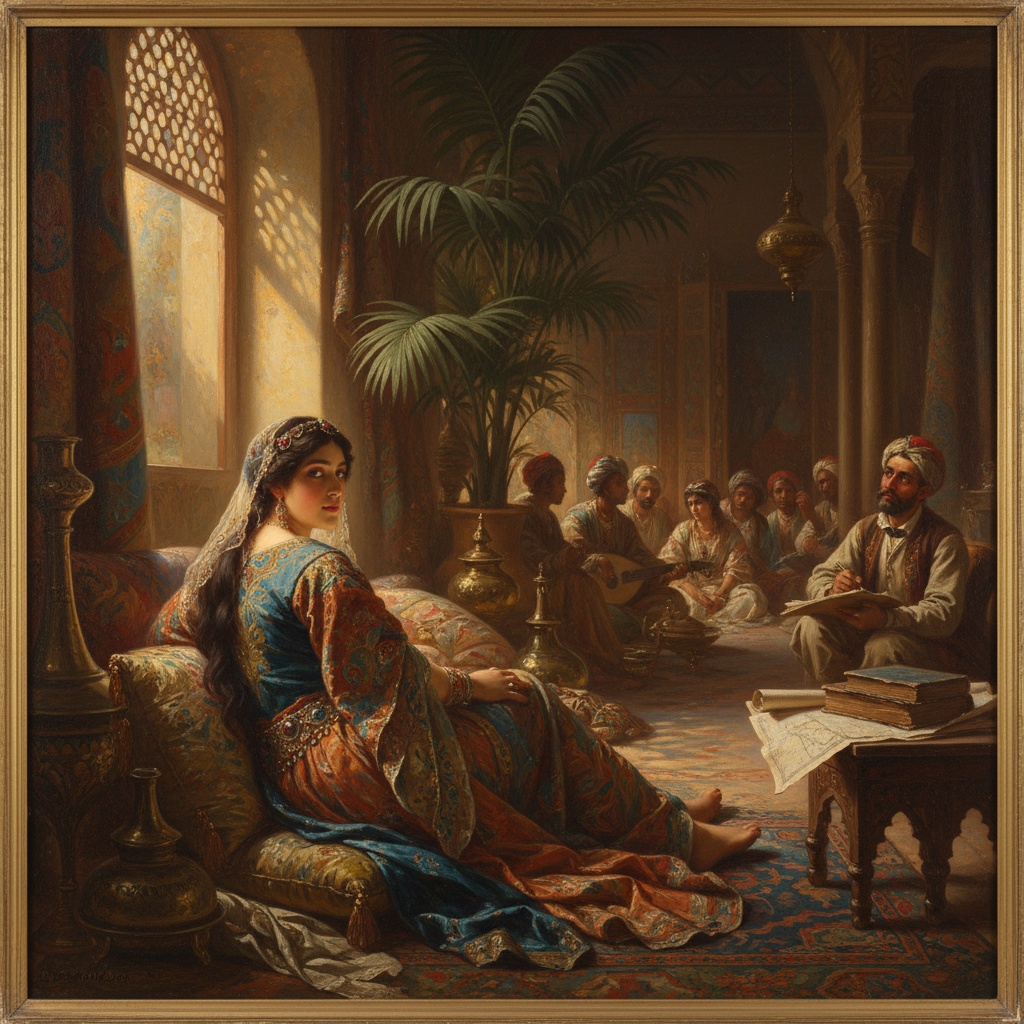
The 19th century witnessed an explosion of Orientalist painting, particularly within the academic tradition. Artists like Antoine Jean Gros, though never having visited the Near East, employed dramatic compositions – such as *Napoleon in the Plague House at Jaffa* – to subtly legitimize French imperial ambitions. The scene, while ostensibly depicting a moment of compassion, simultaneously reinforces notions of Eastern barbarism and the civilizing influence of Napoleon’s rule. Eugène Delacroix, captivated by Romantic themes of passion and violence, further explored these motifs in works like *Massacre at Chios* and *Death of Sardanapalus*, imbuing his scenes with a heightened emotional intensity. However, it was Jean-Léon Gérôme who became perhaps the most prolific and popular Orientalist painter. His meticulous depictions – often imagined reconstructions based on travel literature – presented a highly detailed, yet ultimately fabricated, vision of Eastern life. The allure of the harem proved particularly potent, offering artists a socially acceptable means of depicting nudity and eroticism within an ‘exotic’ context. These paintings weren't simply about visual pleasure; they were imbued with complex power dynamics and anxieties surrounding Western masculinity and sexuality.
Romanticism’s Influence & The Construction of the ‘Other’
Romanticism (also known as the Romantic movement or Romantic era) was an artistic and intellectual movement that originated in Europe towards the end of the 18th century. The purpose of the movement was to advocate for the importance of subjectivity...
The rise of Romanticism profoundly shaped Orientalist art. Rejecting Enlightenment rationality, Romantics prioritized emotion, intuition, and a fascination with the sublime – qualities they often projected onto the ‘Orient.’ This led to depictions of dramatic landscapes, exotic customs, and passionate encounters. However, this romanticized vision frequently obscured the realities of Eastern life. The 'Other' was constructed as simultaneously alluring and dangerous, sensual yet submissive, ancient yet stagnant. Artists like Théodore Chassériau, while demonstrating a sensitivity to color and composition, still perpetuated stereotypes in his depictions of Moroccan scenes. This construction wasn’t accidental; it served to reinforce Western perceptions of Eastern inferiority and justify colonial intervention. The emphasis on military brutality – evident in paintings depicting conflicts in Greece, Algeria, and Crimea – further underscored this narrative of dominance and control. The Romantic fascination with the exotic often masked a deeper desire for conquest and exploitation.
Reception and Critique: Edward Said and Postcolonial Perspectives
Postcolonialism is the academic study of the cultural, political and economic consequences of colonialism and imperialism, focusing on the impact of human control and exploitation of colonized people and their lands. The field started to emerge in th...
For much of the 20th century, Orientalist art was celebrated as a testament to Western artistic skill and cultural curiosity. However, Edward Said’s *Orientalism* fundamentally challenged this perspective. He argued that these paintings weren't simply representations of reality but rather products of a specific ideological framework designed to legitimize colonial power. Said demonstrated how the ‘Orient’ was essentialized – reduced to a set of static characteristics – and used to justify Western domination. His work sparked a wave of postcolonial scholarship, prompting art historians to re-examine the underlying power dynamics at play in these images. Linda Nochlin's essay “The Imaginary Orient” further emphasized the importance of questioning the artist’s perspective and the socio-political context of their work. Contemporary scholars have also highlighted the agency of Eastern artists who challenged Western representations and offered alternative perspectives.
The Legacy of Orientalism in Contemporary Art and Culture
While overtly Orientalist painting fell out of favor after the decline of colonialism, its legacy continues to resonate in contemporary art and culture. The stereotypes perpetuated by 19th-century artists – depictions of veiled women, menacing Arabs, exotic landscapes – continue to circulate in popular media and political discourse. Artists today often engage with these tropes critically, deconstructing Orientalist imagery and challenging Western perceptions. The work of artists like Shirin Neshat, for example, offers a powerful counter-narrative to the stereotypical representations of Iranian women. Understanding the history of Orientalism is crucial not only for art historians but also for anyone seeking to critically engage with issues of representation, power, and cultural identity. At OriginalUniqueArt.com, we offer a wide selection of 19th-century paintings, including works from the Orientalist movement, allowing you to explore these complex themes firsthand. We encourage viewers to approach these artworks not as neutral observations but as products of a specific historical and political context – inviting critical reflection on the enduring legacy of the alluring gaze. Explore our collection today and discover the stories behind these captivating images.



