Preview
 Send
Send Share
Share
 Details
 Guide
Guide

 Download
 Similars
 X-Ray
X-Ray Diaporama
 Q&A
Q&A Stats
StatsCopper Coin


 Read More
The artwork displayed on this page is protected by copyright law, which means we cannot legally create or sell an identical reproduction. This protection is enforced under international agreements such as the Berne Convention and by national laws, including those outlined by the U.S. Copyright Law - Title 17.
This method fully complies with copyright regulations because it does not involve copying or duplicating the protected artwork. Instead, it is a creative reinterpretation - a new painting that is influenced by the original but not identical to it.
Giclée / Art Print
Museum-quality giclée or canvas print with fast production and flexible finish options. ( Buy Hand Made Painting Switch to Digital Image)




P118B $10

P118H $10

P118W $10

P438Z $10

P508JH $12

P508YH $12

P805H $10

P805Z $10

P919BZ $10

P919G $10

P919XJ $10

P959ZH $10

P968JZ $12

W106C $8

W218G $10

W218JH $8

W218Y $10

W307PJ $10

W316G $10

W316PJ $8

W316Y $10

W398PJ $8

W4111J $10

W500HY $15

W500JH $15

W692G $12

W849H $8

W940BG $15

W953PJ $8




Pick from our preset sizes that match the artwork's original proportions.

Type the width and the height you need, to fit your frame or your wall. A print can only be cut, never made bigger than the picture, so a size with a different shape loses a part of the image. We send you a digital mockup to approve before we print anything. The picture shown on this page does not show the real cut — only the mockup does.
Worldwide Delivery () in 2 weeks instead of standard 4/5 weeks. (30 October)

Free Worldwide Express Shipping

High-Quality Linen Canvas

Full Shipping Insurance

Customs Tax Refund Guarantee

True Color Matching Guarantee

100-Day Return Policy (Defects Only)

100% Money-Back Guarantee

Bulk Discount Offer
 Glass option is only available in size under 110 CM

Copper Coin
Giclée / Art Print
Reproduction Size
-


Total Price
$ 81
A Singular Pursuit of Infinity: Examining Roman Opałka’s “Copper Coin”
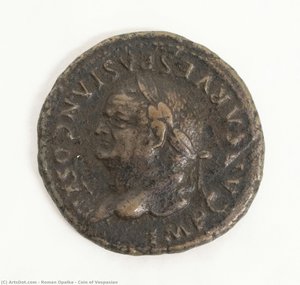
Roman Opałka's "Copper Coin," a deceptively simple photograph capturing an antique copper coin, transcends its materiality to embody a profound philosophical meditation on time and repetition. Created in 2011, shortly before his passing, this artwork represents the culmination of Opałka’s lifelong preoccupation with quantifying existence—a concept brilliantly distilled into visual form. The stark white background serves not merely as a canvas but as an active participant in the piece's narrative, isolating the coin and amplifying its textural qualities, inviting viewers to contemplate the relentless march forward while simultaneously acknowledging the immutable nature of history itself.Composition and Technique: Precision Meets Conceptual Depth
The photograph’s composition is meticulously balanced—the coin positioned centrally against a neutral backdrop—emphasizing its geometric purity. This deliberate restraint underscores Opałka's commitment to conceptual art, prioritizing idea over elaborate visual embellishment. The camera lens captures the coin with remarkable clarity, utilizing diffused lighting that minimizes glare and maximizes detail, revealing subtle variations in tone indicative of oxidation and age – marks of time etched onto the metal surface. This technique speaks to Opałka’s fascination with decay and transformation as processes fundamental to understanding life's continuum.Historical Resonance: Echoes of Roman Antiquity
The coin itself is a relic from antiquity, likely originating in Rome, hinting at connections to imperial power and cultural heritage. The inscription encircling the edge adds another layer of significance, prompting reflection on written language’s role in preserving memory and conveying narratives across generations. Opałka's selection of this object wasn’t arbitrary; it functioned as a tangible symbol of permanence amidst constant change—a visual anchor grounding the artwork’s abstract exploration of infinity.Symbolism: The Infinite Within the Finite
“Copper Coin” operates on multiple symbolic levels. The coin represents not just monetary value but also the cyclical nature of time, mirroring Opałka's own artistic practice – a continuous series of numbered paintings and sculptures designed to explore the concept of unending progression. Its weathered surface symbolizes resilience and endurance, suggesting that even objects subjected to degradation retain an inherent dignity and hold onto fragments of their past. The photograph’s minimalist aesthetic reinforces this message, stripping away extraneous distractions to focus solely on the core idea: the pursuit of infinite understanding through finite observation.Emotional Impact: Contemplation and Acceptance
Ultimately, “Copper Coin” invites viewers into a moment of quiet contemplation—a recognition that despite our efforts to control time and shape experience, we are inevitably swept along by its unstoppable flow. Opałka’s artwork encourages acceptance of this reality, prompting us to appreciate the beauty inherent in both beginnings and endings, and recognizing that even seemingly insignificant objects can hold profound emotional resonance when viewed through the lens of philosophical inquiry. It's a testament to Opałka’s ability to transform an everyday item into a vehicle for exploring universal themes—a captivating reminder that art can illuminate the deepest questions about human existence.Questions & Answers
What orientation does "Copper Coin" by Roman Opałka have?
"Copper Coin" by Roman Opałka has a square format. The format describes the proportions of the composition.
What kind of piece is "Copper Coin"?
"Copper Coin" by Roman Opałka is classified as wall art. The category describes the kind of artwork the original is.
Which room is "Copper Coin" by Roman Opałka recommended for, given its colors?
With its neutrals palette, "Copper Coin" by Roman Opałka is recommended for a living room. The colors are part of the reason for this suggestion.
Artist Biography
A Life Dedicated to Counting: The Singular Vision of Roman Opałka
Roman Opałka, born in 1931 in Abbeville-Saint-Lucien, France, to Polish parents, embarked on an artistic journey that defied conventional categorization. His life, marked by displacement and a profound engagement with philosophical inquiry, ultimately led him to create one of the most conceptually rigorous and emotionally resonant bodies of work in contemporary art. The family’s return to Poland in 1946 following World War II deeply impacted Opałka, shaping his early experiences and fueling a lifelong exploration of identity, memory, and the relentless passage of time. He initially trained in lithography at a graphics school in Łódź before continuing his artistic education at the School of Art and Design there, laying the groundwork for an approach that would transcend traditional mediums and embrace conceptual frameworks.The Genesis of Infinity: OPALKA 1965/1 – ∞
Opałka’s career wasn't a linear progression through styles but rather a constant questioning of artistic boundaries, culminating in the monumental project that would define his legacy: OPALKA 1965/1 – ∞. Beginning on September 1st, 1965, he committed himself to painting canvases sequentially numbered from one onwards. Each canvas bore the next integer in the series, rendered in black against a stark white background. This wasn’t merely an exercise in enumeration; it was a profound meditation on time, mortality, and the human condition. As the numbers grew larger, they began to spill over the edges of the canvases, visually representing the inexorable march forward and the artist's own aging process. The scale of this undertaking is almost incomprehensible – 233 “Details” were completed during his lifetime, encompassing over five million numbers. He meticulously documented each stage, recording himself vocalizing the numbers in Polish before painting them, creating a multi-layered artwork that encompassed visual, auditory, and performative elements. The gradual lightening of the background, beginning in 1972 with the addition of one percent white to each successive canvas, further emphasized the passage of time and the approaching “horizon” of white on white – a symbolic vanishing point representing infinity.Influences and Artistic Development
While Opałka’s work is often associated with minimalism due to its apparent simplicity, it's an oversimplification that belies the depth of his conceptual concerns. He was profoundly influenced by Marcel Duchamp, particularly Duchamp’s rejection of traditional artistic conventions and embrace of intellectual playfulness. The spirit of Dada and Surrealism also resonated within his early explorations. However, Opałka wasn’t simply mimicking existing movements; he was forging a unique path that drew upon diverse sources. His earlier works reveal a fascination with texture and abstraction, demonstrating a willingness to experiment with various materials and techniques before settling on the rigorous structure of the numbering series. He explored monochrome compositions – his “Chronomes” – and abstract drawings, constantly searching for a visual language capable of expressing his evolving philosophical ideas. These early experiments were crucial stepping stones toward the conceptual clarity and sustained commitment that characterized OPALKA 1965/1 – ∞.Legacy and Historical Significance
Roman Opałka’s death in 2011 marked the end of an extraordinary artistic life, but his work continues to resonate with audiences today. His relentless dedication to a single, seemingly simple concept challenged conventional notions of artistic creation and offered a powerful meditation on mortality, infinity, and the human condition. His influence can be seen in the works of numerous artists who explore themes of repetition, sequence, and process-based art. Opałka’s project transcends the boundaries of painting; it is a philosophical statement, a performance piece, and a testament to the power of sustained artistic vision. His work remains relevant in contemporary discussions about time, identity, and the search for meaning in an increasingly complex world. Exhibitions of his work have been held in prestigious institutions worldwide, including the Indianapolis Museum of Art, the Philadelphia Museum of Art, and the Museum Pomorskie in Poland, solidifying his place as a significant figure in 20th and 21st-century art history. Opałka’s legacy is not merely one of artistic innovation but also of unwavering commitment to an idea – a testament to the enduring power of conceptual art.
Roman Opałka
1931 - 2011 , France
Quick Facts
- Full Name: Roman Opałka
- Nationality: Polish-French
- Date Of Birth: 1931
- Date Of Death: 2011
- Place Of Birth: Abbeville, France
- Notable Artworks:
- OPALKA 1965/1 - ∞
- table top
- Relief of a Falling Warrior
- Ornament with Wolf
- Artistic Movement Or Style: Conceptual Art
- Artists Who Influenced This Artist: ['Marcel Duchamp']
- Artists Or Movements Influenced By This Artist:
- Minimalism
- Process-based art
Related Articles

Beyond the Lens: Photography's Enduring Influence on Modern & Contemporary Art
Explore photography's pivotal role in shaping modern & contemporary art. Discover key movements, influential artists like Stieglitz, and expert collecting advice from OriginalUniqueArt.

Pictorialism: A Search for Artistic Photography's Soul – Aesthetics, Techniques & Legacy
Explore the captivating world of Pictorialism – a pivotal movement that transformed photography into fine art. Discover key artists like Stieglitz & Käsebier, techniques, and collecting tips from experts.

The Lens of Truth: A Comprehensive History and Legacy of Documentary Photography
Explore the profound history of documentary photography. From early daguerreotypes to social reform movements, discover how the lens captures truth, preserves vanishing cultures, and shapes our global visual narrative through an expert art-historical lens.

Monochrome Visions: Exploring the Aesthetic & Historical Significance of Black & White Photography
Explore the rich history & artistic power of black and white photography. From early techniques to iconic masters like Ansel Adams, discover why monochrome continues to captivate art lovers today. Expert insights for collectors.

Witnessing History Through Lens & Light: Documentary Photography's Enduring Legacy
Explore the powerful history of documentary photography – from its origins to contemporary masters like Gordon Parks & W. Eugene Smith. Discover how this art form shapes our understanding of society and witness pivotal moments in time.