Text size

() ·

A painting made for you, by hand

Dame en Deuil

Hand Made Oil Reproduction

Hand-painted oil on canvas in your size and frame, made to order by our artists. ( Switch to Print Switch to Digital Image)

Collectible Description

Discover 'Dame en Deuil' by Romaine Brooks (1910). A haunting grey-toned portrait embodying Symbolist aesthetics & androgyny. Explore this evocative oil painting’s texture & mood.

Artist Biography

Romaine Brooks (1874-1970): American Symbolist painter renowned for evocative portraits in grey tones, exploring androgyny & bohemian life in Paris & Capri. A defiant artist.

from ·

Chapter 1

How large should it be?

Slide to change the size; the picture on the left shows the frame at its real width. The proportions of the original are kept.

Standard
custom
CM
INCH

Pick from our preset sizes that match the artwork's original proportions.

width
height

Type the width and the height you need, to fit your frame or your wall. This is hand-painted, so for a size with a different shape the artist can paint a bit more around the picture, or cut a bit — you choose. We send you a digital mockup to approve before the painting starts. The picture shown on this page does not show the real result — only the mockup does.

Chapter 2

How should it arrive?

Choose the edges of the stretched canvas

Choose your frame

Corner sample of the WhiteWrap canvas edge finish, stretched on solid wood bars
White $1
Corner sample of the BlurSideWrap canvas edge finish, stretched on solid wood bars
Blurside $1
Corner sample of the ExtendedWrap canvas edge finish, stretched on solid wood bars
Extended $1
Corner sample of the P118B picture frame: moulded polystyrene, 5 cm wide and 3 cm thick
P118B $10
Corner sample of the P118H picture frame: moulded polystyrene, 5 cm wide and 3 cm thick
P118H $10
Corner sample of the P118W picture frame: moulded polystyrene, 5 cm wide and 3 cm thick
P118W $10
Corner sample of the P438Z picture frame: moulded polystyrene, 5.5 cm wide and 3.5 cm thick
P438Z $10
Corner sample of the P508JH picture frame: moulded polystyrene, 7 cm wide and 3.5 cm thick
P508JH $12
Corner sample of the P508YH picture frame: moulded polystyrene, 7 cm wide and 3.5 cm thick
P508YH $12
Corner sample of the P805H picture frame: moulded polystyrene, 5 cm wide and 3.5 cm thick
P805H $10
Corner sample of the P805Z picture frame: moulded polystyrene, 5 cm wide and 3.5 cm thick
P805Z $10
Corner sample of the P919BZ picture frame: moulded polystyrene, 7 cm wide and 3.5 cm thick
P919BZ $10
Corner sample of the P919G picture frame: moulded polystyrene, 7 cm wide and 3.5 cm thick
P919G $10
Corner sample of the P919XJ picture frame: moulded polystyrene, 7 cm wide and 3.5 cm thick
P919XJ $10
Corner sample of the P959ZH picture frame: moulded polystyrene, 5 cm wide and 3 cm thick
P959ZH $10
Corner sample of the P968JZ picture frame: moulded polystyrene, 6 cm wide and 4 cm thick
P968JZ $12
Corner sample of the W106C picture frame: solid wood, 5 cm wide and 3 cm thick
W106C $8
Corner sample of the W218G picture frame: solid wood, 5 cm wide and 3 cm thick
W218G $10
Corner sample of the W218JH picture frame: solid wood, 5 cm wide and 3 cm thick
W218JH $8
Corner sample of the W218Y picture frame: solid wood, 5 cm wide and 3 cm thick
W218Y $10
Corner sample of the W307PJ picture frame: solid wood, 6 cm wide and 3 cm thick
W307PJ $10
Corner sample of the W316G picture frame: solid wood, 6 cm wide and 3 cm thick
W316G $10
Corner sample of the W316PJ picture frame: solid wood, 6 cm wide and 3 cm thick
W316PJ $8
Corner sample of the W316Y picture frame: solid wood, 6 cm wide and 3 cm thick
W316Y $10
Corner sample of the W398PJ picture frame: solid wood, 5 cm wide and 3 cm thick
W398PJ $8
Corner sample of the W4111J picture frame: solid wood, 6.5 cm wide and 3.5 cm thick
W4111J $10
Corner sample of the W500HY picture frame: solid wood, 7 cm wide and 5 cm thick
W500HY $15
Corner sample of the W500JH picture frame: solid wood, 7 cm wide and 5 cm thick
W500JH $15
Corner sample of the W692G picture frame: solid wood, 8 cm wide and 4 cm thick
W692G $12
Corner sample of the W849H picture frame: solid wood, 5 cm wide and 3 cm thick
W849H $8
Corner sample of the W940BG picture frame: solid wood, 7.5 cm wide and 4.5 cm thick
W940BG $15
Corner sample of the W953PJ picture frame: solid wood, 6 cm wide and 3.5 cm thick
W953PJ $8
Corner sample of the H24-GOLD picture frame: carved wood with gesso, 10 cm wide and 6 cm thick
H24-GOLD $30
Corner sample of the H24-SILVER picture frame: carved wood with gesso, 10 cm wide and 6 cm thick
H24-SILVER $30
Corner sample of the H36-GOLD picture frame: carved wood with gesso, 15 cm wide and 6.5 cm thick
H36-GOLD $45
Corner sample of the H36-SILVER picture frame: carved wood with gesso, 15 cm wide and 6.5 cm thick
H36-SILVER $45
Frame preview
Framed

Moulding: . Overall size with the frame: .

Chapter 3

Who paints it, and should anything change?

Examples of what can be changed: Replace face with customer photo; Add pet (e.g., replace cat with dog); Include hidden message in background; Change background landscape or elements.
After order, OriginalUniqueArt.com team will email client for instructions and provide a mockup preview

Worldwide Delivery () in 3/4 weeks instead of standard 5 weeks. (1 November). No compromise on quality.

Chapter 4

The finishing touches

A nameplate, as in a museum?

Engraved Bronze Plaque Details

This elegant plaque features the artist's name and the title of the artwork, finely engraved for a timeless presentation.

It is made from bronze with a refined, elegant finish. The text is precisely laser-engraved for a sharp and permanent result. Measuring 9x2 cm, the plaque is compact yet easy to read. It's built to be durable and scratch-resistant, offering a professional, museum-quality look. Mounting is simple thanks to the included adhesive backing.

Transparent Acrylic Plaque Details

The plaque includes essential engraved details such as the artist's name, the title of the artwork, the date it was created, the type of media used-like oil on canvas or watercolor-a brief description of the piece, and a QR code that links to the complete artwork information.

It is crafted from clear acrylic, offering a sleek, modern appearance. The text is UV-engraved in black to ensure strong visual contrast. With a size of 10x15 cm, it ensures optimal readability. It comes equipped with two metal hooks for secure wall mounting. The plaque is designed to be weather-resistant, making it suitable for various environments, and it includes interactive features that work seamlessly with smartphone scanning.

Black Acrylic Plaque Details

This elegant plaque includes engraved information such as the artist's name, the title of the artwork, the date it was created, the type of media used (like oil on canvas or watercolor), a short description of the artwork, and a QR code for quick access to more information.

The plaque itself is made from refined black acrylic with a premium finish. The text is laser-engraved in white for high contrast and readability. Its size is 10x15 cm, designed to be easy to read. It comes with two metal hooks for professional mounting. The design is sleek and fits any interior style. It is also weather-resistant and durable, with built-in digital integration for mobile compatibility.

A protective varnish?

When do you need it?

Chapter 5

Your painting, as you ordered it

Dame en Deuil

Reproduction Medium

Reproduction Size

-

Elite Senior Artist

More detail, finesse, and extra production time

-

Reproduction Frame

-

-

For artworks or reproductions larger than 105 cm (approximately 41 inches) on any side, the frame will be shipped as a kit, disassembled. This method ensures safe delivery and prevents damage during transport.

Professional assembly required - this is not a DIY product.
The kit must be assembled and the canvas stretched by an experienced professional framer, using wood glue (not supplied), a canvas stretching plier and clamps to hold the bars square while the glue dries. Incorrect assembly or uneven canvas tension can permanently damage the artwork and is not covered by our warranty.

  • All solid wood bars are included, precisely cut to size.

  • Assembled with the screws provided, plus wood glue for the corner joints, which is not supplied and must be sourced by your framer.

  • Professional tools are required and not included: a canvas stretching plier (tensioner) and clamps to hold the bars square while the glue dries.

Important:
The corner joints require wood glue, the bars must be held with clamps until the glue is fully dry, and tightening the canvas on the assembled frame requires a canvas stretching plier. None of these are included in the kit. Please arrange an experienced professional framer before ordering this size.

Nameplate

-

-

Protective Varnish

Glossy Varnish (enhances colors, protects against light/moisture)

-

Customize My Artwork

Examples of what can be changed: Replace face with customer photo; Add pet (e.g., replace cat with dog); Include hidden message in background; Change background landscape or elements.

-

Urgent

Worldwide Delivery () in 3/4 weeks instead of standard 5 weeks. (1 November). No compromise on quality.

-

Express Shipping

Worldwide Delivery () in 5 weeks. (8 November).

Included

Total Price

$ 300

Total Price $ 300

Glass option is only available in size under 110 CM

Included with every order

  • Free Worldwide Express Shipping
  • High-Quality Linen Canvas
  • Full Shipping Insurance
  • Customs Tax Refund Guarantee
  • True Color Matching Guarantee
  • 100-Day Return Policy (Defects Only)
  • 100% Money-Back Guarantee
  • Bulk Discount Offer

A Portrait of Quietude: Dame en Deuil by Romaine Brooks

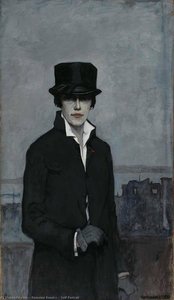
Romaine Brooks’ “Dame en Deuil” (Lady in Mourning) is more than just a portrait; it's a carefully constructed meditation on grief, introspection, and the subtle power of female presence. Painted in 1910, this work immediately draws the viewer into a world of muted tones and restrained emotion, hallmarks of Brooks’ distinctive style that would later garner her critical acclaim. The painting depicts a woman in profile, rendered with an almost unsettling directness – her gaze fixed on some unseen point beyond the canvas, inviting us to share in her silent sorrow.

Dame en Deuil by Romaine Brooks

Impressionistic Echoes and Post-Impressionist Depth

Brooks’ technique skillfully blends elements of both Impressionism and Post-Impressionism. Like the Impressionists, she prioritizes capturing fleeting moments of light and atmosphere, evident in the loose brushstrokes that define the folds of her dark garment and the subtle gradations of color within the pale background. However, unlike the purely optical focus of the Impressionists, Brooks imbues her work with a deeper emotional resonance – a characteristic often associated with Post-Impressionism. The thick impasto application of paint, particularly around the fabric’s texture, adds a tactile quality and emphasizes the subject's physicality, preventing the image from becoming merely a detached observation.

Symbolic Weight and Personal Narrative

The painting’s somber palette – dominated by browns, grays, and patches of green and beige – immediately establishes a mood of melancholy. The woman’s dark clothing, likely mourning attire, reinforces this sense of loss and introspection. The pale background, sparsely rendered, could be interpreted as representing vulnerability or the absence of comfort. Brooks herself was known for her intensely personal subject matter, often exploring themes of female identity and isolation. Her biography reveals a life marked by hardship and emotional turbulence, experiences that undoubtedly informed her artistic vision – a vision characterized by a profound understanding of human suffering and resilience.

A Study in Form and Light

The composition is remarkably simple yet powerfully effective. The vertical orientation emphasizes the subject’s height and presence, while the directional lighting—coming from above and slightly to the side—creates dramatic shadows that sculpt her face and clothing. Brooks' mastery of light and shadow isn't merely about realism; it’s a deliberate tool for conveying emotion and creating depth within the relatively small canvas. The visible brushstrokes, rather than detracting from the image, contribute to its immediacy and sense of movement, suggesting a spontaneous act of creation. “Dame en Deuil” remains a poignant testament to Brooks' ability to transform personal experience into a universally resonant work of art.

Questions & Answers

What are the dimensions of the original "Dame en Deuil" by Romaine Brooks?

The recorded dimensions of "Dame en Deuil" by Romaine Brooks are 92 x 61 cm. Reproductions can be ordered in other sizes while keeping the same proportions.

What space matches the colors of "Dame en Deuil" by Romaine Brooks?

With its earthy palette, "Dame en Deuil" by Romaine Brooks is recommended for a living room. The colors are part of the reason for this suggestion.

Which artist and which style stand behind "Dame en Deuil"?

"Dame en Deuil" was created by Romaine Brooks in the Symbolism style. Artist and movement identify the work's tradition.

More about this painting

Preview AR preview Switch to Print Switch to Digital Image Send
Details Guide Add to favorites Download Similars X-Ray Diaporama Q&A Stats

In numbers

  • 1910the year it was painted
  • 29frames to choose from
  • standard sizes, in its own proportions
  • 5weeks to paint and deliver it

About the original

Dimensions
92.0 x 61.0 cm
Romaine Brooks

Romaine Brooks

1874 - 1970, Italy

Quick facts about Romaine Brooks

  • Artistic Movement Or Style: Symbolism
  • Artists Who Influenced This Artist:
    • Charles Conder
    • Walter Sickert
  • Date Of Birth: 1874
  • Date Of Death: 1970
  • Full Name: Romaine Brooks
  • Nationality: American
  • Notable Artworks:
    • Jeune Fille Anglaise...
    • Azalées Blanches
    • Self-Portraits
  • Place Of Birth: Rome, Italy

Artist Biography

A Life Forged in Shadow and Grey

Romaine Brooks, born Beatrice Romaine Goddard in Rome in 1874, was an artist whose life echoed the muted palette she so masterfully employed on canvas. Her story is not one of conventional artistic blossoming, but rather a testament to resilience, defiance, and the forging of a unique aesthetic vision from the crucible of personal hardship. From a fractured childhood marked by parental neglect and emotional turmoil, Brooks emerged as a painter who dared to look beyond societal expectations, capturing the complexities of human experience with an unflinching gaze. The early years were far from idyllic; her father’s abandonment and her mother's instability cast a long shadow, punctuated by a particularly traumatic period spent in a New York City tenement at age seven when her mother disappeared, leaving payments unpaid. This instilled within her a fierce independence and a profound understanding of vulnerability—qualities that would permeate both her life and her art. Though financially supported by her maternal grandfather, Isaac S. Waterman Jr., the emotional landscape of her upbringing remained barren, fostering a spirit of self-reliance and a rejection of conventional norms.

Parisian Bohemia and the Cultivation of Style

In 1893, at nineteen, Brooks decisively turned her back on familial chaos and embarked for Paris, initially pursuing vocal training before discovering her true calling in painting. She studied art in Rome, notably becoming the sole female student in her life class—a testament to her determination in a deeply patriarchal environment. It was during this period that she first encountered the pervasive harassment faced by women artists, further solidifying her independent spirit and fueling her resolve to carve out her own path. Paris became her sanctuary, a haven where she immersed herself in the vibrant artistic circles of Montparnasse and Capri. Rejecting the burgeoning avant-garde movements like Cubism and Fauvism, Brooks instead sought inspiration from artists such as Charles Conder and Walter Sickert, developing a distinctive style characterized by its restrained palette of greys, ochres, and subtle reds. This wasn’t merely an aesthetic choice; it was a deliberate attempt to create a mood of introspection and melancholy, reflecting the emotional complexities she had experienced firsthand. Her subjects were drawn from the bohemian milieu she inhabited—artists, writers, intellectuals, and individuals who existed on the fringes of society—often possessing an ambiguous or androgynous quality that challenged conventional notions of identity.

The Language of Grey: Portraits of a Lost Generation

Brooks’s signature style is immediately recognizable for its atmospheric use of grey tones. This wasn't a limitation, but rather a deliberate artistic statement—a means of stripping away superficiality and revealing the inner lives of her subjects. Her portraits are not celebrations of wealth or status; they are psychological studies, capturing moments of vulnerability, defiance, and quiet desperation. Jeune Fille Anglaise Yeux et Rubans Verts (1910), with its captivating depiction of youthful beauty rendered in muted tones, exemplifies her ability to evoke emotion through subtle nuances of color and composition. Azalées Blanches (White Azaleas) (1914), a nude reclining figure, drew comparisons to Goya and Manet but distinguished itself with its distinctly female perspective on the traditionally male gaze. Perhaps most revealing are her self-portraits, created throughout her career, which offer glimpses into a complex personality marked by both confidence and vulnerability. In these works, she confronts the viewer directly, challenging them to see beyond the surface and acknowledge the complexities within. She wasn’t simply painting faces; she was capturing souls—often those haunted by secrets or burdened by societal constraints.

Defiance, Recognition, and a Lasting Legacy

Brooks' personal life was as unconventional as her art. Her brief marriage in 1903 to John Ellingham Brooks, an unsuccessful pianist, ended quickly amidst conflict and separation. She then embarked on a decades-long relationship with Natalie Clifford Barney, the American writer and salonnière, finding both intellectual companionship and romantic fulfillment. Throughout her life, she traveled extensively, eventually settling in Florence during World War II. She documented her tumultuous experiences in her memoir, No Pleasant Memories, offering a raw and unflinching account of her struggles. Despite achieving some recognition during her lifetime, Brooks’s work was largely overlooked for several decades after her death in 1970. However, in the late 20th century, with the rise of feminist art history, her contribution to the artistic landscape began to be re-evaluated. She is now celebrated as a pioneer—an artist who defied convention, challenged societal norms, and explored themes of gender, sexuality, and identity at a time when such topics were rarely addressed openly in art. Her paintings stand as powerful testaments to the resilience of the human spirit and the enduring power of artistic expression.

Major Works

  • Jeune Fille Anglaise Yeux et Rubans Verts (1910)
  • Azalées Blanches (White Azaleas) (1914)
  • Self-Portrait (various iterations throughout her career)
  • La Veste en Soie Verte
  • La Jaquette Rouge
  • The Charwoman

Quick Facts

  • Dimensions: 92 x 61 cm
  • Subject or theme: Portrait of a Woman
  • Title: Dame en Deuil
  • Year: 1910
  • Movement: Modern Art
  • Artist: Romaine Brooks